


September, 2025
10 mins read
Resilience Must be Treated as a Strategic Capability
 27 Sep 2025
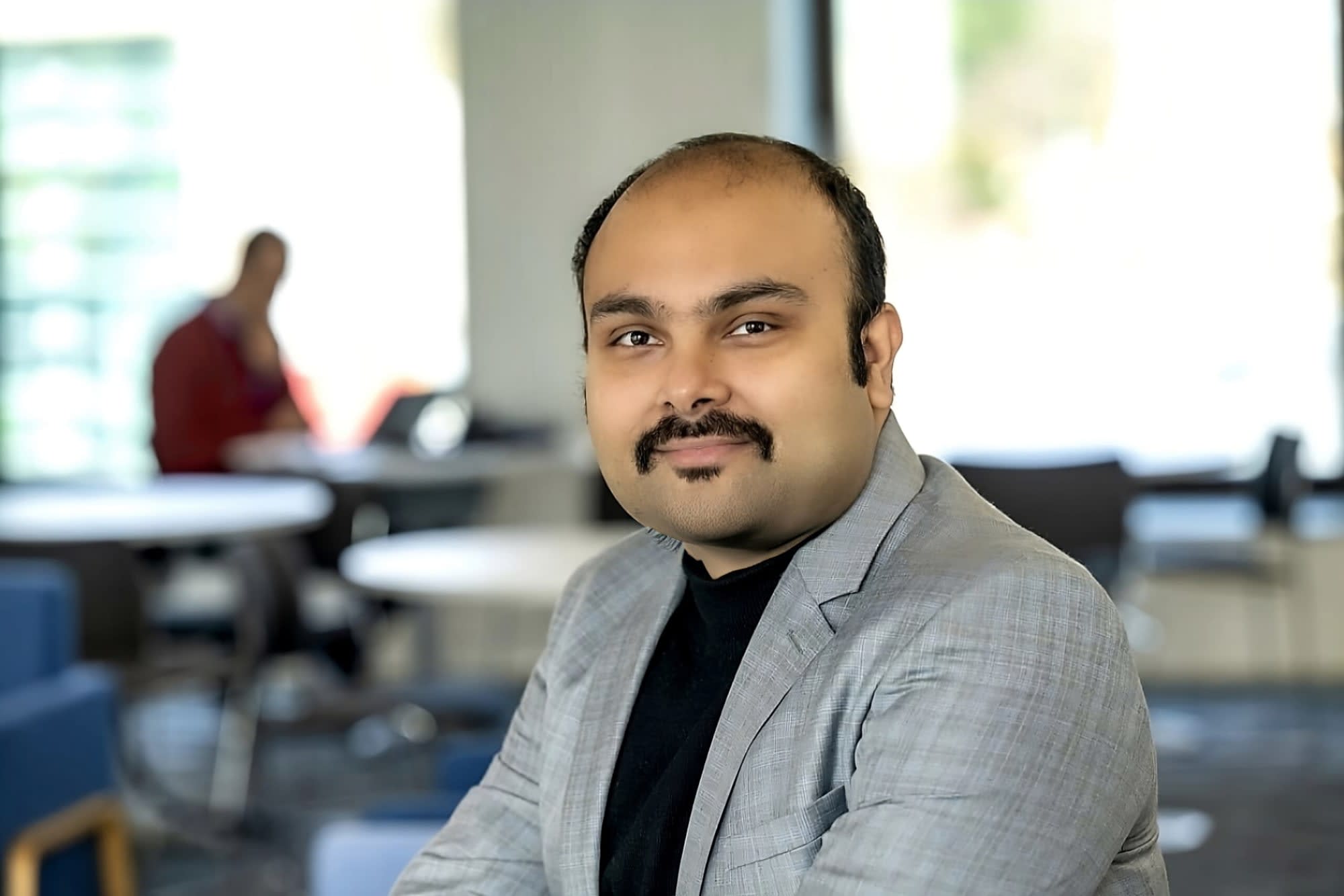
In a wide-ranging conversation with Anushka Aggarwal, Dr Soumyatanu Mukherjee, Associate Professor of Economics and Decision Sciences at XLRI Delhi, discusses how economics today must move beyond efficiency to embrace resilience, equity and sustainability. Drawing on his research into AI adoption, informal economies and supply-chain risks, he argues for a balance between technological ambition and social responsibility, while highlighting the need to prepare future leaders as reflective and ethical decision-makers.
From Kolkata to Nottingham, and then across IIT, IIM, and now XLRI, your journey spans diverse academic and institutional environments. How has this trajectory shaped your perspective on economics and its role in addressing global challenges?
The journey across different contexts has really shaped the way I think about economics. For me, it isn’t just an abstract theory, it’s something living, constantly shaped by institutions, culture, and history. Growing up and studying in Kolkata, I was exposed to the realities of grassroots development. Then, in Nottingham, I experienced the rigor and breadth of global research standards.
Later, when I started teaching at IIT Kharagpur and IIM Kozhikode, I developed a much deeper appreciation for academia, not only as a space for research, but as a place where teaching and interdisciplinary thinking are just as important.
And now at XLRI, I’ve found an environment that allows me to really connect economic theory with the practical needs of industry and society. That’s been very meaningful for me. All these experiences together have convinced me that economics can’t just be about efficiency. It needs to go further, to embrace resilience, equity, and sustainability as essential priorities in today’s interconnected world.
Your recent work on AI-driven production investments highlights the tension between technological advancement and socio-economic concerns. In your view, how should policymakers and businesses strike a balance between efficiency gains and broader developmental priorities, particularly in emerging economies like India.
I usually describe this challenge as a kind of “dual optimization.” On one side, we absolutely need to capture the efficiency gains that AI can bring. But on the other side, we have to make sure we’re building in safeguards for inclusivity and fairness. For a country like India, ignoring productivity-enhancing technologies isn’t really an option, they’re too critical. At the same time, adopting them without care could easily lead to job losses, inequality, or regional imbalances.
That’s why policymakers have such an important role. Things like active labour market intervention, upskilling programs, and even fiscal incentives for responsible adoption can make a huge difference. For businesses, the mindset shift is equally important. AI shouldn’t be seen just as a tool to cut costs, it should be treated as a platform for creating sustainable value, one that strengthens the broader developmental goals of society.
Research on supply-chain resilience often highlights trade-offs between efficiency and risk preparedness. In an era marked by pandemic shocks and geopolitical tensions, which factors, diversification, digital transparency, or policy alignment, play the most decisive role in determining whether global supply chains adapt or collapse?
While diversification and policy alignment are crucial, digital transparency has proven to be the decisive factor in enabling supply chains to withstand shocks. Diversification spreads exposure and policy alignment provides stability, but without visibility into vulnerabilities, both remain incomplete solutions. The pandemic starkly revealed how opaque supply chains amplify disruptions, whereas transparent, digitally enabled networks allowed firms to trace and address bottlenecks in real time. True resilience requires an integrated approach: diversified supplier networks, enhanced by transparent digital systems, and reinforced by coordinated trade and industrial policies. In my opinion it is this alignment that prevents breakdowns and sustains adaptation.
Economists often talk about “rational actors.” In your experience, what’s the most irrational thing you’ve seen in global markets that actually worked out successfully?
One of the most fascinating, and a bit counterintuitive, things I’ve seen in global markets is the way informal financial ecosystems continue to survive and even thrive alongside formal institutions. From the outside, they might look irrational, but in practice they’re often highly adaptive.
Take informal credit networks or non-bank lending to larger firms. These systems run on trust, flexible terms, and social enforcement rather than strict contracts. Yet, they don’t undermine the formal financial system, in many cases, they actually support it by filling gaps where banks are constrained by collateral rules or heavy processes.
Another striking example is India’s huge informal economy. Roughly 90 to 92 percent of workers are informally employed, even within officially regulated industries. Despite the lack of significant formal job creation, these informal sectors absorb labor and provide livelihoods, helping to prevent a sharp rise in urban poverty. I have explored the underlying reasons behind these phenomena in my research, which examined how informal institutions, labor markets, and migration dynamics create adaptive equilibria that sustain economic activity in unexpected ways (Mukherjee, 2016; Mukherjee, 2017; Mukherjee & Banerjee, 2021).
I like to think of this as functional irrationality. Practices that seem fragile or inefficient from a textbook perspective often work well because they’re rooted in trust, local institutions, and community networks. The fact that informal and formal systems can coexist and complement each other actually creates a resilience that standard models usually miss.
Classroom discussions can often spark unexpected insights. Has a student question or perspective ever changed the way you think about your own research?
Yes, classroom discussions often provide fresh lenses through which I view my own research. I teach Managerial and Micro Economics at XLRI, where students are encouraged to challenge the assumptions behind standard models. In one session on production and cost optimization, a student asked: “Professor, firms usually minimize costs or maximize profits in the models we study, but can resilience itself be treated as an objective, much like efficiency?”
That question stayed with me. It pushed me to think about resilience not merely as a constraint or a side condition but as something that could be built into the firm’s optimization problem itself. This perspective has since influenced the way I frame research on supply chains, risk, and decision-making under uncertainty.
Moments like these remind me that teaching is not a one-way transmission of knowledge. In subjects like Microeconomics, where abstract concepts are often reduced to neat equations, student questions highlight the need to connect models to the messy realities of business practice. These interactions keep my research grounded, while also making the classroom a living laboratory for new ideas.
As a Fellow of the Higher Education Academy and a teacher across multiple institutions, what practices do you believe are most effective in preparing students, not just as competent managers, but as ethical leaders capable of navigating systemic uncertainty?
Across my teaching career, whether it was econometrics for finance students at Southampton Business School or microeconomics and global business at Roehampton University, I’ve found that the best way to prepare students as future leaders is to combine analytical rigor with ethical reflection.
At Southampton, for instance, I trained students to apply econometric tools to financial data. A recurring moment came when they faced issues like omitted variable bias or endogeneity. For me, those weren’t just technical challenges, they were opportunities to highlight how poor modelling choices can ripple out into financial markets and policy. I wanted them to see econometrics not as a mechanical exercise, but as something that carries ethical responsibility, since models often guide real-world decisions with serious consequences.
At Roehampton, teaching microeconomics sparked some powerful debates on fairness and efficiency. I remember one discussion on price discrimination, where students asked whether maximizing profits through differential pricing could ever be justified if it harmed vulnerable groups. That kind of question reinforced the need to embed ethical reasoning into what might otherwise feel like abstract theory.
Here at XLRI, I teach Microeconomics and Managerial Economics, and I try to bring that same spirit into the classroom. I use a lot of games and simulations, for example, an Oligopoly Game where students compete on prices and quantities, to help them see how profit-maximization works in practice. But then I like to shake things up. I’ll throw in shocks like regulatory changes or labour disputes so they can experience firsthand how fragile pure profit-seeking strategies can be.
I also use behavioural experiments to highlight how real decision-making often deviates from the rational actor model. It gets students thinking about what that means for managers who have to make decisions in complex, unpredictable environments.
Ultimately, I want students to leave the classroom knowing that leadership in uncertain environments isn’t just about technical proficiency or chasing short-term efficiency. It’s about ethical judgment, empathy, and the ability to balance competing objectives. In other words, it’s about preparing them not just as managers, but as reflective leaders.
Your research spans decision-making under uncertainty, supply-chain resilience, and the socio-economic impact of AI adoption. In that light, how do you see platforms like Xplore contributing to the development of future business leaders, those who can move beyond technical efficiency and short-term gains to engage with broader questions of resilience, equity, and long-term institutional value?
My research has shown me again and again that decision-making under uncertainty forces leaders to think beyond short-term efficiency gains. For example, in my work on Industry 4.0 investments under supply chain risks, I found that risk-averse firms can’t just see digital adoption as a simple efficiency tool. Their choices are shaped by trade-offs, between building capabilities and achieving competencies, both of which are influenced by systemic and operational risks (Padhi, Mukherjee, & Cheng, 2024). In other words, resilience isn’t an accidental by-product. It’s a conscious choice, shaped by how managers approach uncertainty.
In a related study on AI-driven production investments, I examined how socio-economic risks such as job displacement, regulatory shocks, and volatility in workforce preparedness affect optimal investment. The findings indicate that while AI promises productivity gains, firms must weigh these benefits against the volatility it introduces to productivity and employment structures (Mukherjee, Nawazish, Padhi, & Jayaram, 2024). This reinforces the need for leaders to engage not only with efficiency metrics but also with broader societal impacts of technology.
I have also explored portfolio decision-making in supply chains facing catastrophic disruptions, where firms must split orders between primary and backup suppliers under uncertainty. The research highlighted how risk preferences and behavioural factors influence sourcing strategies, and how resilience can be strategically embedded into procurement decisions (Padhi & Mukherjee, 2022). Here too, the lesson is that firms thrive when they treat resilience as a strategic capability, not a defensive cost.
Finally, in my work on sustainable sourcing under uncertain demand, I explored how governments and firms can design tax and rebate structures to nudge risk-averse suppliers toward sustainable products. The takeaway was that sustainability requires the right incentives, with policy and business working hand in hand to align economic value with social good. (Mukherjee, Padhi, & Jayaram, 2023)
That’s why I think platforms like Xplore have huge potential. They can be much more than just a space for sharing success stories. They can act as a bridge between research and practice, where future leaders really grapple with tough questions: How do you balance resilience with efficiency? How do you combine technological ambition with social responsibility? How do you pursue profitability while still ensuring sustainability? If Xplore can foster that kind of engagement, it will help shape leaders who are not only sharp decision-makers, but also thoughtful stewards of resilience, equity, and long-term value.