


April, 2025
12 mins read
Customer Centricity is a Lifeline for India’s Future
 27 Apr 2025
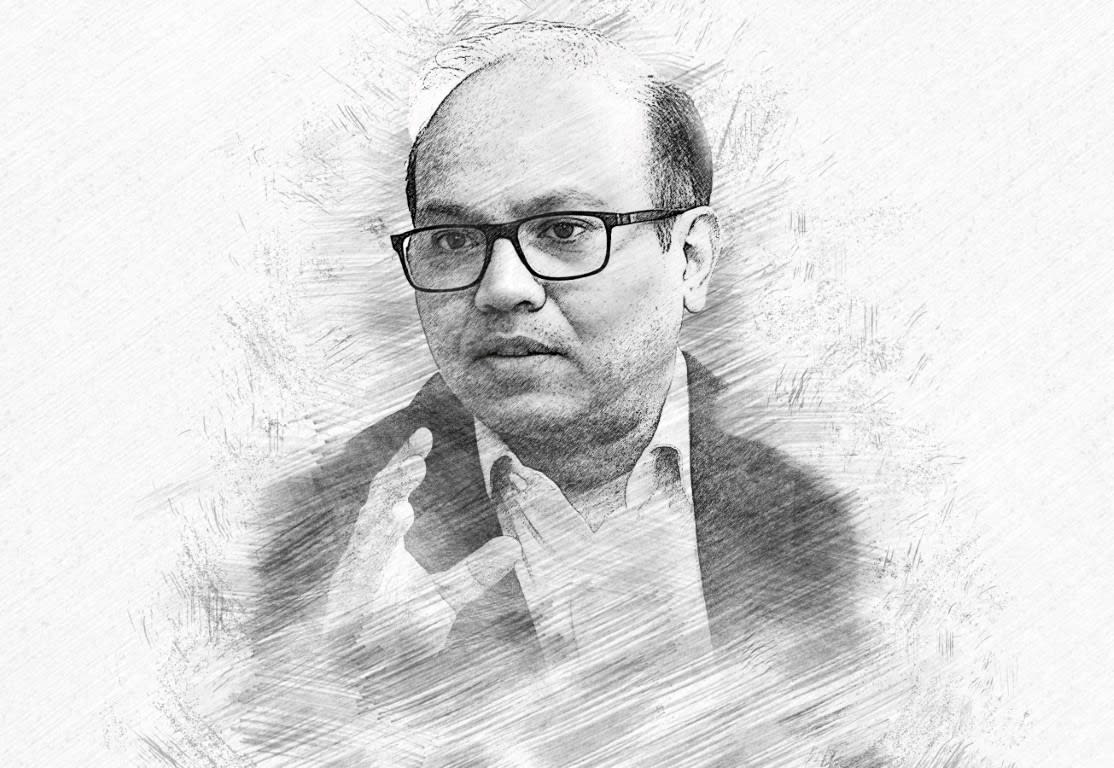
With a career spanning startups, global consulting, and tech-driven transformation, Kingshuk Ray, Partner at IBM Consulting, brings a unique perspective to India’s digital evolution. In this discussion with Talha Anjum Jamil, Ray explains why customer-centric innovation must go beyond convenience to drive real inclusion, and how AI, blockchain, and IoT are reshaping financial services and supply chains. His reflections remind us that true entrepreneurship demands purpose, resilience, and the courage to ‘hug the cactus and still smile’.
With your experience in financial services, how do you define digital transformation — and why is it a critical strategy for banks aiming to stay competitive?
Let me break that down, especially in the Indian context, as the evolution of digital transformation can be quite geography- specific. In India, digital transformation is vital because it significantly reduces the cost of distribution across sectors — especially financial services. It also helps bridge cultural and linguistic divides, making financial services more accessible to people in remote and underserved areas, not just those in urban centres.
Now, at a broader level, digital transformation is essentially about upgrading an organisation’s central nervous system — its decision-making and communication processes. Every organisation revolves around people, processes, and products, and these interact constantly with external players — suppliers, buyers, facilitators. When you digitise the way information flows within and outside the organisation, it speeds up decision-making and unlocks entirely new ways of doing business. It reshapes the organisation’s identity, its operating model, and the value it delivers.
Typically, the first step is digitising existing processes. From there, organisations become more efficient and agile, opening the door to new opportunities and technologies — AI, blockchain, IoT, and others — that can further enhance performance and scale.
You mentioned AI and blockchain among other technologies. How can financial institutions not only use them to innovate, but also create new business models? Any examples you can share?
Let’s start with AI. At its core, AI lowers the cost of intelligence. Instead of relying on expensive specialists, you can deploy AI to do the same job faster and more cost-effectively. That’s the game-changer.
Blockchain, on the other hand, acts as a trust ledger. It allows multiple parties to trust a transaction that can’t be altered unilaterally — essentially locking it in. This removes the need for bilateral contracts and enables multilateral interactions across ecosystems. It’s not limited to financial services — it links banking with e-commerce, shipping, land records, and more.
Take cross-border trade, for example. Today, it depends on multiple intermediaries and can take days to settle. But with blockchain, central banks can use digital currencies to settle transactions in seconds. This frees up capital that would otherwise be stuck waiting for approvals or signatures, creating massive efficiencies.
Together, AI and blockchain unlock tremendous potential. Other technologies — 5G, IoT —expand sensing and data collection capabilities. For instance, if a bank is issuing a trade finance loan involving overseas shipments, IoT can verify whether goods are loaded onto a ship. Blockchain then secures that information, making it immutable. These technologies amplify each other, creating a multiplier effect for innovation.
I come from a category management and sourcing background, and I’ve been exploring how blockchain can enhance supply chains. For instance, companies like Walmart and Target have started using blockchain to track materials from manufacturers to warehouses. Earlier, the process was manual — someone would update the system based on phone calls or emails. Now, items are scanned at each step, and updates are automatically recorded, streamlining the entire operation. It’s transformed how they manage their bulk supply chains.
Absolutely — and it’s not just streamlined, it’s also tamper-proof. That’s where the real power lies.
Since you mentioned sensors, it’s worth highlighting that IoT is evolving rapidly. We’re now working on sensors as small as a grain of rice, potentially costing even less than a rupee — probably 40 paisa or so. These can generate a non-tamperable digital signature linked to the commodity they’re attached to.
When combined with blockchain, this creates reliable, secure, and immutable data trails. That data can then be analysed and integrated into financial systems — unlocking enormous value and efficiency. It’s a game-changer for supply chains, particularly in sectors dealing with large volumes and multiple stakeholders.
Customer experience is a huge focus in banking, especially with rapid technological advancements. How do you see customer centricity evolving as technology continues to disrupt the industry?
That’s a great question. To answer it meaningfully, we need to look at the Indian context —because India is far more complex than many other markets.
A significant portion of our population is still emerging from poverty and striving to become part of India’s growth story. We have a moral responsibility to include them in this progress. And in that context, customer centricity takes on a very different meaning.
It’s relatively easy to be customer-centric when you’re dealing with digitally mature users — people who are educated, understand instructions, and know what they want. For them, it’s about speed, convenience, and relevance — streamlining the experience so you only show them what they need, when they need it.
But for those who are just crossing the digital divide, customer centricity is far more critical. If we overwhelm them with a screen full of instructions or complex options, we risk losing them entirely. And when that happens, they may retreat to traditional systems — moneylenders, local doctors, or community intermediaries — people they can talk to and understand.
That’s why I believe customer centricity is not just a feature, it’s a lifeline for India’s future.
Let me give you a real example. While consulting in the financial services space, we looked at something as basic as passwords. For many of us, creating a password is second nature. But imagine a woman working in the fields with limited formal education — this becomes a hurdle. She might ask someone for help and become vulnerable to fraud.
So we asked: how does the human mind naturally remember things? We experimented with visual passwords. For instance, instead of typing characters, the user selects images — say, a house. Then, she chooses one from a set of options within that theme. We found that people remember pictures far more easily than numbers or patterns.
This approach proved to be remarkably effective. It’s just one example of how thinking deeply about the customer segment can lead to better service design.
Customer centricity, in this context, means rethinking every touchpoint to ensure inclusion, simplicity, and trust. And we still have a long way to go — but every step counts.
You mentioned India’s diversity and how people have very different needs. Given your role in a global company working with teams across regions, what challenges do you face when collaboration is key? And how do you navigate cultural differences to ensure team cohesion and the right outcomes?
To be honest, my approach here is quite personal. It’s not something I picked up from management textbooks, but from lived experience.
What I’ve seen work consistently well are two things. First, we don’t operate using organisational hierarchy. The moment you bring hierarchy into the room, you’re essentially saying, “My opinion matters more than yours” — and that’s a dangerous mindset. So we leave hierarchy at the door.
Instead, we spend time agreeing on a shared purpose and a shared goal. Once everyone has debated, contributed, and aligned on that, we treat each person as an equal, regardless of title or seniority.
Second, we let the person who best understands the problem — or brings the most innovative thinking — take the lead, regardless of their role or experience level. Everyone else then rallies behind them to support the outcome. It becomes a truly collaborative effort.
So, in short: no hierarchy, shared goals, and letting talent — not titles — take the lead. And that model tends to work well even across cultures and geographies, because it’s based on human values, not cultural constructs.
Switching gears a bit — when you founded a startup that developed a unique technology to make Indian food portable, how did your consulting background help shape that journey and support what you wanted to achieve?
I’d just like to add a small nuance to that question. I’ve actually done three startups in my life.
The first one was straight out of college. I was working on a challenge project for one of the world’s leading banks. What I did ended up saving them a significant amount of money almost instantly. That success led a few of us — friends from college — to think bigger. We wondered if it could be converted into a product. Even though we didn’t have much experience, we went ahead and built it. That solution eventually evolved into a major financial product. Today, it’s one of the leading ones globally.
My second stint was in setting up a consulting firm focused on risk management, financial services, and mergers and acquisitions. We consulted across the world and grew the firm to over $25 million.
Then, of course, I’ve been in consulting in different capacities — but consulting itself, in my view, isn’t defined by being in a consulting firm. It’s about solving problems, regardless of the domain. That mindset is what drove my third entrepreneurial effort.
That third startup was originally aimed at developing a financial services platform — specifically structured credit layered over payments. But Indian regulatory constraints at the time made it hard to pursue. Meanwhile, the food-tech idea happened quite by chance.
While travelling, I met a chef who mentioned that India has no global food brand like McDonald’s or Subway. We got talking and realised that one reason is our food’s high moisture content. Indian food is designed for hot climates — we don’t just drink water, we eat it. That’s why our dishes are often quite wet, and as a result, hard to carry or eat on the go.
So we asked: how do we make Indian food portable without compromising on taste? That was the science problem I took on. We came up with a way for the food to retain its natural moisture while staying structurally intact — so you could hold it in your hand and eat it without a mess.
I solved that scientific piece. The chef, who was far more experienced in food production, took over from there and scaled the enterprise. I handed the IP to him because my core interests are elsewhere — my passion lies more in problem-solving across finance and tech, not food.
So yes, whether you’re in a formal consulting role or not, if you’re wired to solve problems, you’ll keep finding avenues to apply that skill — even if sometimes it means consulting yourself.
You mentioned your financial services startup. What motivated you to take that entrepreneurial leap, and while you noted that regulations were a challenge, what were some of the major hurdles you faced during that journey?
The reason I started that venture was largely driven by the direction India seemed to be heading in. Without naming specific entities, there was clear intent from the RBI and policymakers to open up the credit ecosystem and strengthen the country’s digital infrastructure. And we’ve seen that happen — India today has one of the best digital payment systems and public digital goods infrastructures globally.
What really motivated me was the possibility of extending credit access to India’s hinterlands — places where formal banking and credit facilities are hard to come by. I felt that if individuals were willing to take informed risks, credit needn’t come only from institutions. People could invest in others’ futures and potentially earn returns, creating a new kind of ecosystem for financial inclusion.
That larger purpose — the opportunity to drive social good through innovation — is what led me to take the plunge. But over time, it became clear that regulations in India were not going to open up the space in the way I had hoped. It remains a tightly regulated area, and that ultimately limited what we could achieve.
What advice would you give aspiring entrepreneurs, especially those trying to bring innovation into more traditional sectors?
First off, don’t become an entrepreneur just because it sounds cool. Entrepreneurship is a lonely journey. It comes with both joy and pain — but the pain will arrive in much larger doses, especially in the early stages. The joy, if it comes, comes much later.
If you’re genuinely passionate about building something and believe there’s a larger purpose behind it, then go for it. But think from first principles. Don’t just add marginal, incremental value — it won’t be enough to sustain you. Price is not a competitive advantage — someone else will always do it cheaper. Instead, focus on solving a real problem in a meaningful way.
And most importantly, be prepared to have the mental resilience to, as I like to say, hug the cactus and still smile. If you can do that, the journey — despite its hardships — can be deeply rewarding.