


December, 2025
18 mins read
Information Is Abundant; Wisdom Is Not
 30 Dec 2025
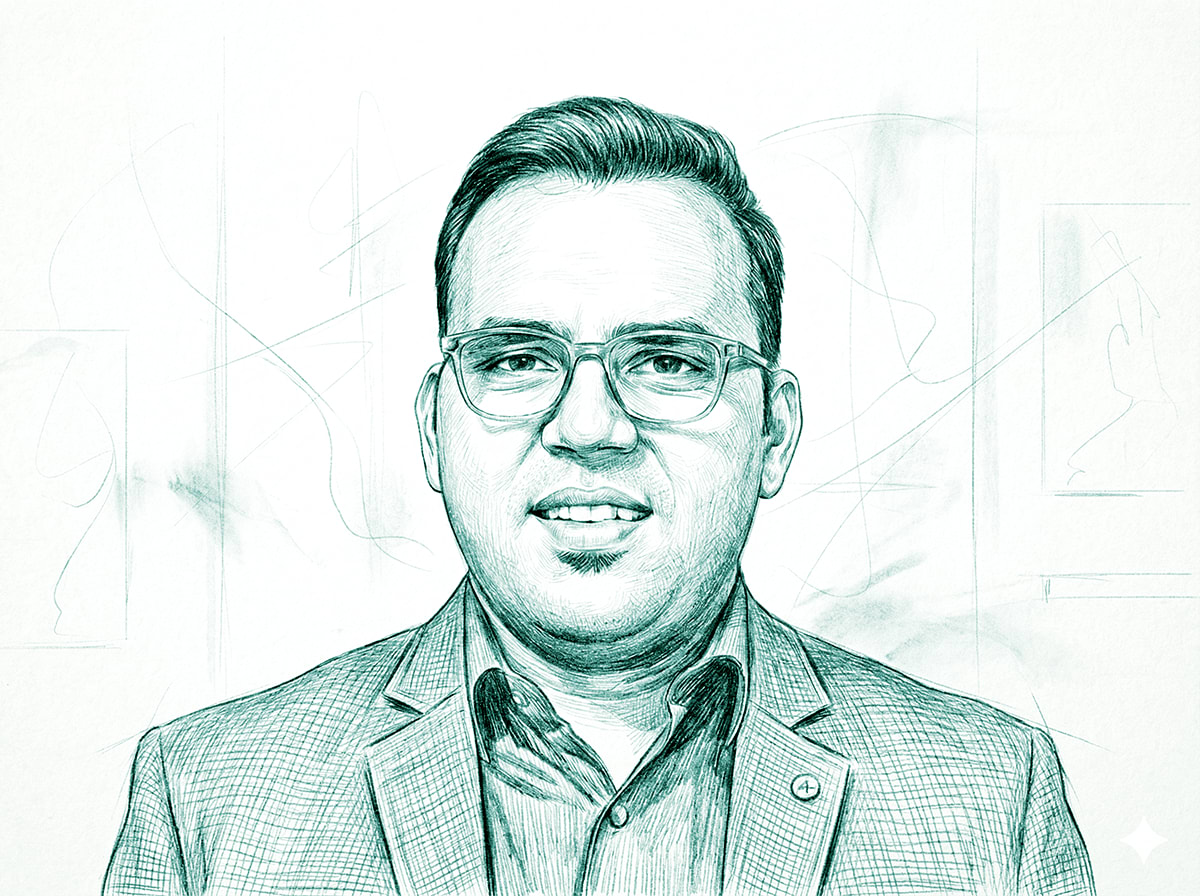
In the ever-evolving world of business, where technology reshapes industries and global shifts redefine leadership, conversations with educators who witness this transformation firsthand become invaluable. Professor Rahul Kumar Shukla, Fulbright Fellow, researcher and faculty member at XLRI, is one such voice. With over a decade of experience at XLRI and deep expertise in communication, culture and leadership, he brings a rare blend of academic insight and lived experience. In this candid conversation with Ananya Joshi and Juhi Agarwal, he discusses the future of management, the values that define XLRI, the importance of empathy, and the subtle skills that transform information into wisdom and students into responsible leaders.
Management studies have undergone significant evolution over the years, and the pace of change is only accelerating. From
your vantage point as a faculty member at XLRI, how do you see management education transforming, and what qualities
should students develop to stay future-ready?
Management education has undoubtedly evolved, but its core philosophy has remained steady. At its heart, management is still
about optimising operations, improving employee effectiveness, enhancing productivity and building stronger organisations.
Those fundamentals are perennial. Foundational aspects of management will always remain timeless. The behavioural aspects
of organisational leadership, including interpersonal skills, team spirit and empathy, will never lose relevance.
What has changed, and will continue to change, is the role of technology. With the rapid rise of AI, the way we approach
managerial processes has undergone significant changes over the past decade. Technology now intervenes directly in how
decisions are made, how teams collaborate and how organisations function.
Another major shift is the entry of Generation Z into the workforce. They are incredibly comfortable with technology; having
grown up with it, they expect workplaces to be equally agile and up to date. Organisations that are quick to adopt technology
and new-age corporate trends find it easier to attract and harness the potential of this generation. Because Gen Z is tech-savvy,
they naturally add new dimensions to organisational capabilities.
While generational differences do create friction at times, managers today are consciously investing effort in finding ways
to bring different generations together, encourage collaboration and build inclusive workplaces where each cohort’s strengths
can shine. That, I believe, is the future of management education: a blend of technological fluency and human-centric
leadership. At the end of the day, teams drive organisations, not individuals. No amount of automation can replace the need
for strong human connection and collaboration.
Should we study management as an art, science, or as both?
Management is inherently a blend of both science and art. It is a science because managers rely on established methods,
mental models and frameworks. These frameworks may not magically give you the “perfect” solution, but they help you think
systematically. They make your decisions replicable and explainable, which is crucial for building and improving processes
over time.
At the same time, management is also very much an art. In organisations, you work with people, not machines. No
framework can fully capture the complexity and unpredictability of human behaviour. You may have a model in mind, but you
must continually adapt it to the specific situation, culture and team in front of you. Creativity captures the context.
Let me put it this way: B-schools teach you what the ideal is. Theories present what should happen. But when you step into
the corporate world, you are confronted with the real, and the real often looks quite different. Many students wonder why they
are taught ideal theories when reality deviates from them. The answer is simple: to adapt theories intelligently, you must first
understand them well. If you do not know the ideal, you cannot meaningfully create or justify deviations. The ideal gives you the
foundation; the real requires your creativity. The science lies in learning the frameworks; the art lies in interpreting, modifying and
applying them judiciously based on context.
So yes, management is a beautiful combination of art and science. And those who learn to balance the two not only survive
but excel as leaders.
With so much information available today, what should managers, both as learners and future leaders, truly focus on?
We live in an era of information revolution. Search engines have given us access to unimaginable volumes of data. The
challenge now is not finding information, it is making sense of it. How does one filter out the noise? That is where critical thinking
becomes the most essential managerial skill.
Today’s managers must learn to question assumptions, evaluate the credibility of information and distinguish what is relevant
from what is merely available. Critical thinking enables you to interpret situations accurately, construct sound arguments,
challenge flawed premises and make decisions that are both logical and contextually sensitive.
But critical thinking does not develop in isolation. It requires:
A habit of questioning rather than accepting things at face value.
An ability to look beneath the surface.
Strong fundamentals, because you can filter information only when your conceptual base is solid.
Information is abundant; wisdom is not. Managers who can filter, interpret and apply information thoughtfully through critical
and integrative thinking will be the ones who succeed in the future.
Many students today prepare extensively for B-school or placement interviews and for presentations, yet common feedback is
that their delivery isn’t impactful or that they miss key elements. What subtle aspects do people commonly overlook in interviews
and public presentations?
That’s a very relevant question because students often underestimate the subtleties behind good interviews and compelling
presentations.
A. In Personal Interviews
Most candidates tend to answer based on what they want to showcase rather than what the interviewer is actually asking. There’s a
common misconception that you must “drive the interviewer into your comfort zone.” That rarely works. Interviewers, whether in B-
school admissions or corporate panels, ask questions with an evident intent. Your task is to align your answer with that intent, rather
than dragging the conversation into unrelated territory. If you wander off-topic, interviewers may not interrupt you, but they will
evaluate you negatively; it signals a red-herring approach.
A few fundamentals matter enormously:
Answer what is asked, not what you know. Think from the interviewer’s perspective. Why are they asking this? What do they
want to understand?
If you don’t know something, say so gracefully. You may add, “I don’t know the exact answer, but I can attempt it if you’d like.”
Interviewers appreciate honesty and effort, not overconfidence.
Be thoroughly clear about your own work experience. Students often exaggerate unknowingly, claiming tasks done by
teammates as their own. Interviewers instantly know what responsibilities are realistic for a given role. Be very honest
about what you have done, what you haven’t, and what you learned.
Tailor your academic preparation to the role. Don’t revise everything. Understand what the specific summer internship or final
placement role demands and connect your coursework to that. Relevance matters more than quantity.
Show interpretive and reflective ability. Good interviewees don’t just answer; they interpret the question, anticipate follow-up
questions, and demonstrate self-awareness, critical thinking, problem-solving ability and stakeholder sensitivity.
B. In Presentations
Presentation skills depend heavily on context. A boardroom presentation differs significantly from a classroom one. But some
principles remain universal.
Logic first, slides next. Be very clear about the reasoning behind every point. Senior managers may raise objections that seem to
come out of nowhere. The key is to handle objections with grace and politeness, not defensiveness.
Politeness is a leadership skill. Whether you are addressing seniors, colleagues or juniors, politeness demonstrates emotional
intelligence. Even if you know more, deliver it with respect. Sometimes juniors ask naïve questions that spark interesting ideas;
don’t shut them down.
Be mindful of your audience. Always keep your listeners in mind: their background, expectations and concerns. Your tone, pace and
examples should be tailored to the audience.
Non-verbal communication matters more than people think. Your posture, eye contact, gestures and presence communicate
as much as your words. Add elements of interaction and a bit of light humour. People disengage quickly if the delivery feels
monotonous.
As a communications professor, what is your perspective on students from Tier-2 or Tier-3 cities who may have strong managerial
potential but feel insecure because they are not as proficient in English? What advice would you give them to succeed?
First, let me say this very clearly: once you have made it to a top B-school like XLRI, there is absolutely no doubt about your
competence. Whether you come from a Tier-1, Tier-2 or Tier-3 city, your admission itself proves that.
The only difference is exposure. Students from Tier-1 cities often grow up with more opportunities to interact with diverse
people, participate in public events, or simply be around environments that encourage speaking up. This exposure naturally
builds confidence. Students from smaller towns may not have had that advantage, so they often experience what we call an
“amygdala hijack”, a sudden rush of fear when asked to speak publicly. But this has nothing to do with capability. It is only about
familiarity.
My advice to such students is simple: actively seek opportunities to speak even when it feels uncomfortable. In fact,
especially when it feels uncomfortable. If I were from a Tier-3 city and attended a significant event like the recent “JRD Tata
Oration on Business Ethics”, I would have prepared one question in advance and made it a point to go to the mic. Speaking in
front of 400–500 people just once can give you a level of confidence no classroom session can provide. The more familiar you
become with speaking in public, the less fear you feel. With comfort, confidence follows automatically.
As for English, it is no longer the barrier it once was. Social media and digital content have given everyone access to
language resources. Most students today, regardless of their hometown, already have a functional command of English. What
they need is practice, not perfection.
So my suggestion is: push yourself into situations that scare you a little. Surprise yourself. Speak up even when you feel
underprepared. Every time you do that, the fear reduces. And once the fear goes, your talent and capability shine through as
they always should.
You’ve been part of XLRI’s journey for nearly a decade now. What is your favourite aspect of XLRI? What makes it truly special
in your eyes?
Having taught at several institutions as an adjunct professor at various IIMs, what sets XLRI apart is its culture. There is
something profoundly unique here, something we affectionately refer to as the “XL Family.”
At XLRI, the bond between students and faculty is unusually strong. It’s not just academic; it feels personal, warm and rooted
in mutual respect. One of my fondest memories is from Diwali 2019. I still remember my house was overflowing with students.
Nearly 180 of them walked in! There was barely space to sit, but the energy was incredible. They hadn’t come for sweets; they
had come simply to wish me and share the moment. I was performing my puja when a group of students stepped in and said,
“Sir, we’ll take care of the puja. You please go and meet the kids.” That level of affection, comfort and togetherness is something
you rarely find in academic institutions.
This openness extends beyond festivals. Students frequently walk into my home, sometimes late at night. One of my
students would drop by and say to my wife, “Ma’am, can I have some Maggi?” And my wife would happily make it for him at
midnight. Many graduate students still visit me regularly, and our home has always been open to them.
In many other B-schools, there is a clear boundary between faculty and students. Professors maintain a certain distance. But
at XLRI, those walls simply don’t exist. Here, we talk, we share, we celebrate and we build bonds that last far beyond the
campus.
For me, as someone who loves engaging with students, this culture is the most cherished part of XLRI. It is what makes this
place feel like home, not just a workplace. And as long as I am here, this is what will keep me loving XLRI with all my heart.
The effect managers create in the world is often very subtle. So, as students, what kind of impact can we aspire to beyond
career success?
Upon examining our values, it is clear that XLRI has consistently stood for fairness and integrity. And at the core of our
philosophy lies the Jesuit principle of “for the greater good.” I’m sure that when you joined XLRI, you, too, were sent to the rural
immersion programme called UNURUM. Why do we do that — something you won’t find in most B-schools?
The objective behind sending you to environments that may feel uncomfortable, different and difficult to adapt to —
especially for students from Tier-1 cities or privileged backgrounds — is to help you see a very different side of life. When you
live with families who may not even have toilets in their homes, you realise that life is not defined by urban experiences
alone. Living in such a space, even if only briefly, creates a profound shift in perspective. It reminds students that these
communities, too, need compassionate and capable managers.
Due to this kind of formative exposure, when our students become managers or head organisations, the principle of working
for the greater good continues to guide them. So, when you ask what impact managers can create beyond their careers, our
value-based training, along with fairness, integrity and service, shapes them into responsible leaders.
XLRI has been a pioneer in introducing courses on ethics and sustainability long before they became fashionable in
management education. The intention has always been clear: we don’t just want corporate experts; we want leaders who make
a positive impact on the world around them. If you look at our alumni, you will see this value system reflected in them. Many
individuals make meaningful contributions to their nation, the global community or the environment. Responsible leaders
inevitably create positive change in society.
So when you ask what impact managers can aspire to beyond career success, my answer is this: aspire to be responsible leaders
who uphold fairness, integrity, empathy and a commitment to the greater good.
From your experience, what are the core competencies top B-schools look for today? What should aspiring students consciously
develop both before joining and during their time at a B-school like XLRI?
The expectations of B-schools today are very aligned with what the industry demands. One of the most essential competencies
students must develop, ideally even before entering a business school, is critical and analytical thinking. The New Education Policy
emphasises it, and rightly so.
You may carry strong academic knowledge, but if you don’t know how to apply that knowledge in real situations, you will
struggle as a manager. Application is what differentiates effective leaders from those who merely understand concepts.
Along with critical thinking, another key competency is stakeholder sensitivity. As future managers and leaders, you will work
with people from diverse backgrounds and cultures. Here empathy becomes essential. You don’t work with robots; you work with
human beings. If you lack empathy, you cannot lead effectively.
B-schools intentionally bring together students from varied regions, professions and experiences so that you learn to:
understand people who think differently,
become comfortable across cultures, and
develop the emotional intelligence to feel at home in any environment.
This adaptability is a leadership skill in its own right. These skills enable you to work effectively with others, influence
constructively and drive outcomes without being overly authoritative.
So, whether you are preparing to join a business school or are already enrolled, continue to strengthen your critical thinking, empathy,
cultural intelligence, collaboration and persuasive skills. These are the competencies that truly shape successful managers.
If you had to share one mantra you personally live by, what would it be?
For me, the mantra has always been simple: consistency is the key. Consistency doesn’t mean doing the same amount of work
every day. It means doing something every day. If I want to build my knowledge, it doesn’t require finishing a chapter daily. Even
on a busy day, I make sure I read at least one page. One page may seem small, but it keeps the momentum alive; little drops of
water make the mighty ocean.
The same applies to health. Maybe I cannot go to the gym or run on certain days, but I will at least step out and take a walk.
When you show up consistently, even in small ways, your brain understands that this goal matters. It will start guiding you in that
direction automatically.
Whether you are a student or a working professional, embracing the principle of consistency makes it very difficult for anyone to
outshine you. Small steps taken every day eventually lead to extraordinary outcomes.
How have the professors or mentors in your own life influenced your approach to teaching and interacting with students
and examinees?
I genuinely love this question. My professors have shaped my entire life. I was very close to them. When you are young, you
have many distractions around you, but fortunately, I was surrounded by professors. So whenever I drifted, they kept an eye on
me.
The first professor who influenced me deeply was Professor BN Singh. He was the one who encouraged me to apply to
foreign universities. Once, he was travelling to Canada, and I asked him, “How do you get to go to Canada every year? You are
so lucky.” He replied, “No, I am not lucky, I am smart. I know how to write applications. If you develop that skill, you can go
abroad too.” He told me this in 2007, and in 2008, I received the opportunity to study in the US as a Fulbright Scholar. His belief
in me had a profound impact on my personality.
Then there was Professor Teresa Picker. She influenced my teaching style enormously. She loved engaging her classes
through anecdotes, and I think I’ve adopted that approach quite a lot in my own teaching.
Another important mentor was Professor Thomas Adams, who made it a point to interact personally with every student. That
personal touch shaped the way I engage with my own students today.
Later, at IIM Ahmedabad, I was deeply influenced by Professor Vijay Sherry Chand. He was a perfectionist, never satisfied
with anything. Even when you gave your best, he would still find errors. Not because he wanted to criticise, but because he had
an extraordinary eye for detail. That meticulousness rubbed off on me. Today, whether I am reading or evaluating something, I can
easily spot anomalies. This eye for detail comes from him.
Some professors had a profound influence on me during my time at the University of Pennsylvania. Professor Vijaya
Gambhir, who has since passed away, and Professor Sudhenu Gambhir, who is still in Philadelphia. Professor Sudhenu, though
not my direct professor, played a significant role in helping me understand how the US education system works. He would take
me to his lectures, to seminars and even to other universities. He knew I was living alone in the city, so he developed a bond
with me and exposed me to academic spaces I would never have experienced otherwise.
Indeed, these five or six professors have had a profound influence on me. I have absorbed their teachings and made their
lessons my own. But among all the lessons I’ve received, I always remember something Professor Sherry Chand told me at
IIMA: “Rahul, you must learn from others, definitely. But in the process of learning, never lose your own style or uniqueness.”
That stayed with me.
While I have learned from many mentors, I still have my own approach to teaching and interacting with students. There are a
few principles I follow:
I don’t want to be harsh with students, because my professors were never harsh with me.
I don’t bully or judge students.
My professor once told me, “What is the point of judging? As professors, our job isn’t to categorise students. Even if
someone displays deviant behaviour, our responsibility is to correct it, not label the person. If we label, we have failed as
teachers.” I carry that philosophy with me. I avoid judging students. My role is to guide, not condemn. So yes, my professors’
values continue to guide the way I teach, think and interact.