


September, 2025
10 mins read
Never Worry About Being Employed, Worry About Being Employable
 27 Sep 2025
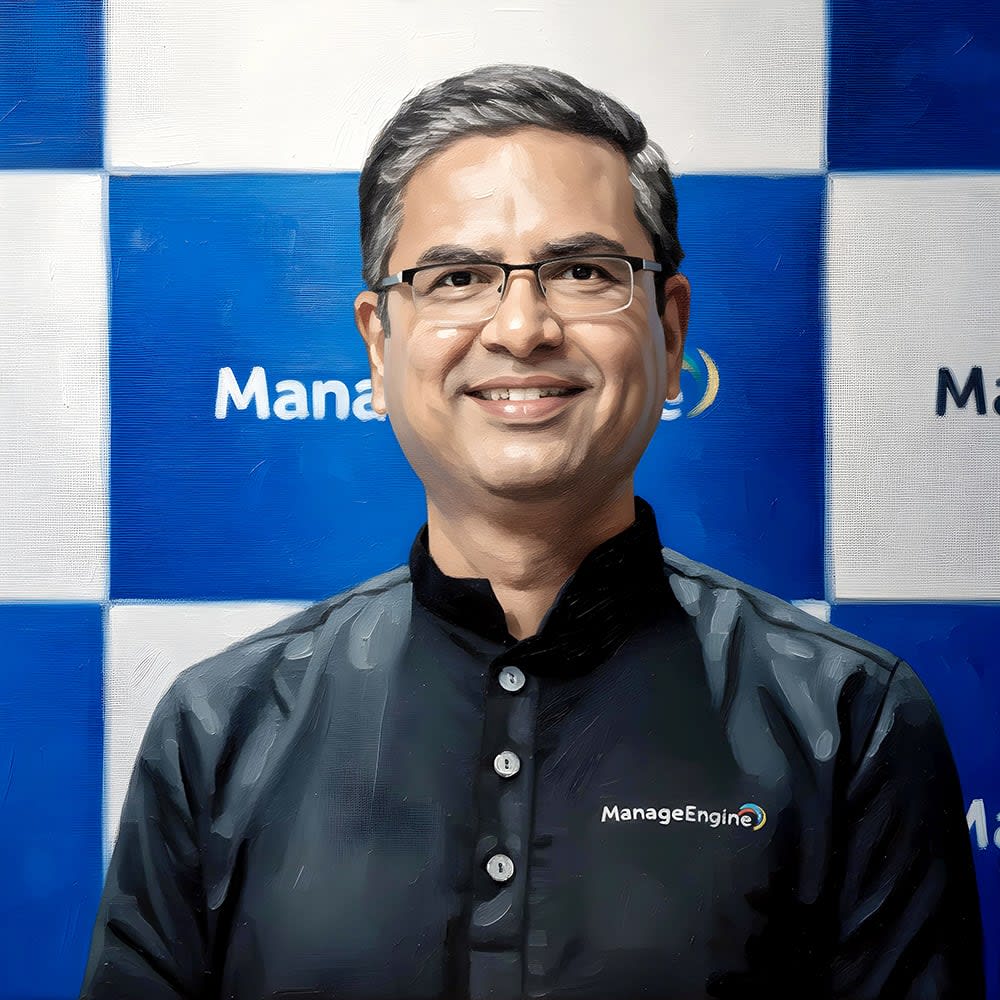
Rajesh Ganeshan, CEO of ManageEngine, believes careers are built on constantreinvention — or as he puts it, “never worry about being employed, worry about being employable.” Over 25 years at Zoho Corporation’s IT management arm, he has shifted roles, embraced discomfort, and chosen long-term integrity over short-term wins. Speaking with Yuktaa Tiwari, he reflects on the lessons of failure, why AI’s future lies in building massive infrastructure, and how relevance, not titles, will define tomorrow’s leaders.
I was going through your profile, and I have to say, your journey is genuinely inspiring. In a world where people switch jobs every two or three years, you’ve stayed with Zoho and ManageEngine for 25 years. That’s rare. What has kept you so deeply anchored through all the changes and phases?
I can’t take credit alone — many of my colleagues have also been with the company this long, so I’ll answer on their behalf too.
First, we had outstanding mentors. When I joined, I was raw and clueless, with just a lot of energy and willingness to learn. Mentors like my current boss, Sesh Kumar, and our CEO, Sridhar Vembu, broke things down, gave us purpose, and guided us. That was invaluable in those early years.
Second, I could see from the start that what we were doing was very different. This was around 1997–98. Imagine: a product company in India, just ten of us working out of a small house. Friends from college would tease me — “What are you even doing there?” I sometimes wondered myself. But when I compared notes with them, I realised I was working on something far more interesting, useful, and purpose-driven. In hindsight, I’m glad I made that choice.
Third, people usually leave companies because of conflicts or boredom. I was fortunate on both counts. We had good managers, and I never got stuck doing the same thing. I started as a programmer, then moved into documentation when customers said our manuals weren’t good enough. Writing gave me clarity and later helped me become a better product manager. I also spent time in customer support before moving into new roles. In many ways, I reinvented myself within the company instead of hopping between firms.
That’s been the pattern ever since. Even now, as CEO, I don’t know what the next reinvention might be, but I’m sure there will be one. That possibility keeps things exciting.
I agree. It comes down to whether a company gives you space to grow and evolve.
Exactly. You put it better. I’ve always seen growth and learning at Zoho and ManageEngine. I’ve deliberately taken on roles that made me uncomfortable. For instance, marketing is not my strongest area, which is why I work closely with that team. Unlike sales, support or development — where results are very clear — marketing is broad and experimental. You think a campaign will work and it fails; you do something half-heartedly and it takes off. That unpredictability challenges me, and I enjoy it.
For me, ManageEngine has always been a playground — a place to learn, to fight, to fail and to grow. That’s why the journey has been so rewarding.
Earlier you spoke about purpose but you also mentioned failures. Were there any detours or “aha” moments that changed the way you lead?
Many. You can’t escape them. For every product I’ve released, an equal number have been shut down. Only a few succeed by any metric — but that’s all it takes. We don’t have a crystal ball to know which ones will work. It’s a cliché, but true: failure teaches you more than success.
What I bring to the table is a sense of history. In every other capability my colleagues are just as good, but I remember what worked, what didn’t, and why. That context helps me bring balance to decisions and execution, and I see that as my key contribution.
Switching gears a bit — you started out as an engineer, and once an engineer, always an engineer. I began as a programmer too, and this industry is incredibly dynamic. What’s cutting edge today can be outdated tomorrow. How does ManageEngine keep pace?
That’s the existential question for anyone in tech. Whether as an individual, a team or a business, the only way forward is to keep adapting.
Definitely.
You simply have to stay plugged in. It’s the same answer I gave earlier about reinvention — keep putting yourself in situations where you’re uncomfortable and learning.
So, if you ask whether I prefer engineering or marketing, I’ll immediately say engineering. Marketing is harder for me, but that doesn’t mean I can ignore it. You still have to learn it. When new technologies emerge, there are no shortcuts — you have to put in the hard yards.
I often think of Rafael Nadal. No matter how many matches he wins, he takes practice more seriously than the games themselves. Whether it’s a Grand Slam final or a first round, he still hits a thousand forehands and a thousand backhands every day. It’s repetitive and boring, but those countless strokes prepare you for the one crucial point.
There’s no secret. Do the hard yards and hope for the best.
Staying relevant clearly comes from constant innovation. ManageEngine serves both large enterprises and mid-sized firms. How do you balance building for complex needs while keeping products intuitive — especially across different countries with their own rules and regulations?
It’s a classic dilemma. On one side it’s an engineering challenge: can you give a complex product to a low-maturity customer, or an out-of-the-box product to a high-maturity one? On the other side it’s a marketing and positioning challenge. How do you present the product — is it for big enterprises or everyone? Then there’s sales: do you sell remotely, through partners, or directly? How do you price it? Answering all of this is essentially my job.
We start by breaking the problem into parts.
Engineering: Launch an out-of-the-box product, then gradually make it configurable and extensible so larger customers can tune it to their needs. The same core product can be offered in different “avatars”, much like car companies use the same engine across different models.
Marketing: Create distinct customer personas and speak to each in their own language. The website, messaging and positioning must clearly separate those audiences.
Sales and support: Run parallel approaches. One team focuses on low-complexity customers, while another handles high-maturity clients who expect NDAs and detailed compliance discussions.
This dual approach lets us serve mature markets that demand sophisticated features while also expanding in developing regions. It’s hard work, but that’s exactly what makes the job worthwhile.
We’re often told that long-term wins matter most, but short-term gains can be tempting. Can you share a decision where you chose long-term product integrity over a quick market win?
It’s all about mindset and awareness. Take fitness as an analogy. You can chase shortcuts — surgery, crash diets — or you can truly understand your body and do the slow, steady work. Both options exist, but values determine the choice.
At ManageEngine, when we face tough calls, our bias is always towards the long term. We ask: Is this a short-term gain or a lasting one? Experience has shown that the long game pays off, even if it’s harder.
I empathise with those starting out who need quick results, but part of leadership is offering reassurance that the patient route is worth it. Sometimes you have to take the short-term hit — and be ready to absorb the blow — because it sets you up for lasting success.
No technology discussion is complete without mentioning AI. The big question everyone asks — often nervously — is whether AI will replace our jobs. What’s your take?
The good — or bad — news is that it’s already happening. The question isn’t if AI will replace some jobs; it’s how we respond. One way is to be pessimistic and assume humans will become irrelevant. I don’t see it that way.
I often refer to an interview with Jensen Huang of Nvidia. He pointed out that every major technological wave needs massive infrastructure before it can truly serve society. In the 1920s and 30s, for example, building cars wasn’t enough — countries that prospered were those that built highways. The same happened with the cloud and software-as-a-service: global infrastructure had to be created first.
AI is no different. People imagine AI replacing teachers, doctors or lawyers overnight, but that won’t happen by magic. Before AI can reach that scale, we need vast infrastructure to make it safe, reliable and always on. Building that will be a multi-trillion-dollar opportunity — and AI itself can’t do it.
So yes, many existing jobs will change or disappear, but countless new ones will emerge around building and maintaining this ecosystem. The real question is whether we’re adaptable and willing to stay relevant. Future generations, born into an AI-native world, will focus on creating this infrastructure rather than fearing it.
As an MBA student, I suddenly see a business opportunity here.
Exactly — start your own venture!
And talking of MBA students, here’s my final question. If you were 25 again, what is one thing you would focus on mastering?
Interesting question. In fact, I don’t need to go back in time to know the answer — I’ve always believed this. My first mentor, Kumaru, used to tell me: “Never worry about being employed; worry about being employable.” It’s a simple but profound idea.
Whether you’re doing an MBA or anything else, the key is to keep pushing yourself. At Zoho, I could have stayed a decent developer, but I chose to take on new challenges and roles. We all hear about layoffs even at profitable companies. Often the reason is that some people haven’t upskilled or reskilled. From a business perspective, keeping them on just doesn’t make sense.
So make yourself employable — take on fresh challenges, reinvent yourself, stay relevant. Relevance is everything. Naval Ravikant once said this about Elon Musk: you may like him or not, but he has the rare ability to reset himself to zero and start again. Musk sold a successful company, lived in a rented apartment, and put everything into SpaceX — reusable rockets, multi-planetary dreams — starting from scratch.
That’s the mindset to cultivate. Whatever your age, be willing to return to that uncomfortable “zero,” to begin again and keep yourself relevant and employable. That’s a lesson my peers and I definitely need to remember. All of us, including me.
Now, a quick rapid-fire round to wrap up. Home office, headquarters, or a remote hill station — where do you work best?
Anywhere I have my laptop.
First word that comes to mind when I say ManageEngine.
“Long-term” and “relatable.” I’ll cheat and use two.
A recent non-work moment that gave you deep satisfaction?
After decades, I’ve started planting trees around my home and watching them come alive.
Engineering or marketing — if you had to pick just one for a day?
Engineering — both heart and head.
One thing people misunderstand about your role as CEO?
That I have answers to every question and solutions to every problem. I don’t — no one does.
A book, article, or podcast that made you pause and reflect?
An interview with Jensen Huang. He explained the AI wave with such clarity and optimism that it left me hopeful for humanity.
A line that defines your leadership style?
Approachable, honest, and inspiring — I aim for all three.
Meetings: overused or always necessary?
Necessary. Face-to-face conversations remain the most effective — just don’t hold meetings for the sake of it.
One buzzword in tech that’s all hype and no depth?
Metaverse.