


August 2026
14 mins read
The Thinking Still Has to Originate with You
 31 Aug 2026
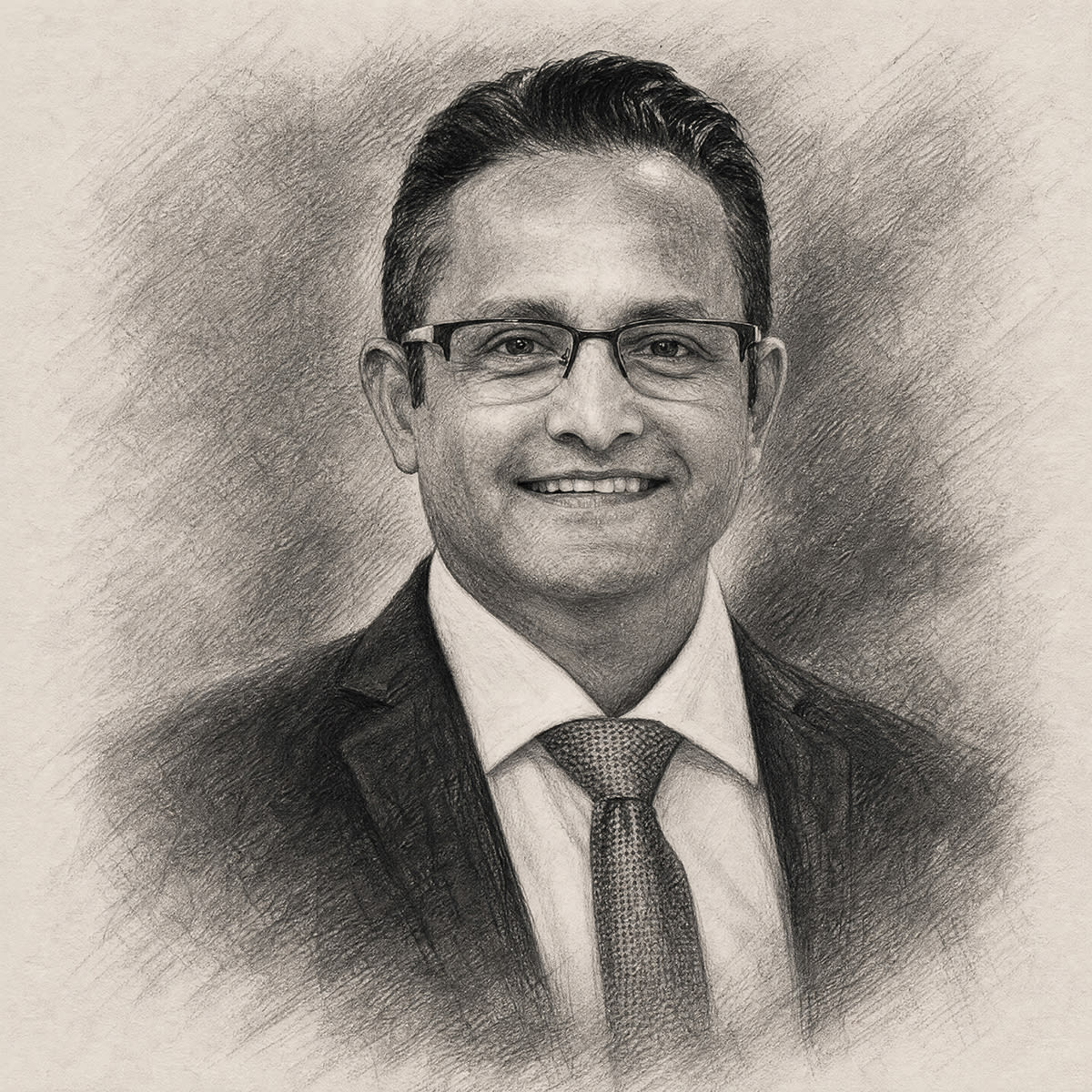
Shree Parthasarathy, Founder and Chief Revenue Officer at Metavrash, is a serial entrepreneur and leader with more than two decades of experience building and scaling cybersecurity, technology, digital transformation and risk practices across the US, India and Asia Pacific. In a conversation with Vishal S, he argues that AI should amplify human judgement, not replace it; that digital trust extends far beyond security and privacy; and that India’s bigger opportunity lies in using AI to democratise learning and skills. For MBA graduates entering an AI-abundant workplace, his advice is simple: build domain depth, think critically and start with the goal, not the tool.
Your career spans consulting, corporate leadership and now entrepreneurship. What does each vantage point let you see that the others don’t?
I see my journey through three distinct modes of operating. As a consultant, I functioned as a trusted advisor: I would enter an organisation, understand its challenges and guide it through a defined transformation programme within someone else’s structure. As I moved into leadership roles — national cyber leader, and later chief innovation officer — the mandate expanded beyond client delivery to managing practice, people and business growth. That required me to combine domain expertise with running a business, while still operating within an existing organisational structure.
Founding a company removed that structure entirely. As a founder, I found myself “multi-hatting” across finance, collections, innovation and every other function simultaneously, with no structure to lean on until the company builds one. Each stage is enriching in its own way, and leaders have to grow into each role rather than assume that the skills transfer automatically.
You’ve helped bring several cyber and technology firms into larger organisations. What should an enterprise acquire, and what should it grow on its own?
I frame the decision around a company’s core. As organisations grow, they accumulate functions — HR, procurement and more — well beyond their core business. The first step is to decide which of these can be outsourced or run more efficiently by a partner, freeing the organisation to focus on what it actually does. I helped a large telecom provider outsource everything outside its customer-facing and product functions, including IT, because those were not its core competence.
The harder question is how to keep the core itself from ageing. As companies mature, their agility and appetite for innovation tend to slow, even as the environment keeps changing. To keep that core “young”, organisations should look outward for adjacencies — agile, focused companies that complement rather than duplicate the core — and bring them in through acquisition rather than trying to build everything organically. Apple, for instance, does not innovate purely in-house; it also acquires to stay on the leading edge. The guiding principle in any acquisition has to be synergy with the core, not simply adding scale.
Digital transformation programmes are known for underdelivering on their business case. What separates the ones that work from the ones that stall?
Successful transformation, in my experience, rests on tone at the top, perseverance and a clear vision of the outcome an organisation is trying to achieve, backed by the right structure to deliver it. Where internal capability is missing, external experts can guide the programme, but organisations must simultaneously build internal expertise. Otherwise, the moment consultants leave, there is nothing to sustain the transformation.
Equally decisive is effective change and communication management. An organisation can implement a sophisticated digital system and still fail if, when the CEO asks for a report, someone quietly downloads the data into Excel instead of using the new workflow. The same discipline applies to AI: adoption is not plug-and-play. Organisations need to rethink their business processes around AI rather than bolt it on to existing ones. Transformation of this kind requires sustained leadership sponsorship over a long horizon.
You’ve rolled out global programmes across many geographies. How much local adaptation did you need before standardisation stopped working?
Large global implementations are really a combination of standardisation and localisation. The approach typically starts by selecting a representative sample of locations to build a common framework, then standardising, automating and replicating that framework across the rest of the organisation. In my experience, roughly 80 to 90 per cent of an implementation can be standardised this way.
The remainder has to adapt to local realities. A standard tax module built for a Netherlands headquarters, for instance, still needs to connect to India’s local government systems, laws and APIs when rolled out there. The combination — a standardised core for speed and long-term maintainability, paired with local customisation — lets a global system serve local business requirements as well.
The last decade built centres of excellence and global delivery hubs at scale. How much of that architecture carries into the next decade?
The underlying structure will largely persist — organisations will keep weighing cost, efficiency and capability when deciding what to centralise. But AI is set to be a major disruptor of where work actually gets done. As automation and AI mature, some work traditionally offshored to global capability centres will move back to the “mothership”, reducing dependence on offshore human capital for certain functions.
I see a parallel with manufacturing. The earlier era of globalised outsourcing is giving way to a more inward-looking, protectionist posture among countries, and technology offshoring may follow a similar arc. Organisations will need to continually reassess what stays in hubs such as India, the Philippines or Colombia and what gets brought back in-house, while balancing constraints such as power availability for AI-heavy data centres. Global capability centres aren’t going away, but what they do will keep changing.
On that note, what did you make of the US restricting a certain AI model from release?
I see this within a longer pattern of technology being kept within national borders. Encryption algorithms, for instance, were historically withheld from sanctioned countries because of the systemic risk their spread could pose. Governments restrict technologies they see as strategically important or as giving them a competitive edge, and I expect this instinct to apply irrespective of which country is doing the restricting.
I see this as part of a broader shift back towards nationalism and protectionism, with digital assets increasingly treated the way nations treat minerals or other strategic resources. “The world is still flat,” but there are still a lot of borders and boundaries, and I expect more such restrictions, not fewer, as the trend continues.
Digital transformation was largely about digitising existing processes. AI is starting to rewrite the processes themselves. Where do you see that distinction becoming real?
Organisations that did digital transformation well also rethought their underlying business processes and workflows rather than simply adapting to whatever a new product dictated. Kodak, for example, had to reimagine its entire business — from film manufacturing and photo studios to distribution — once photography went digital. Indian telecom incumbents similarly had to rethink themselves as the industry moved off landlines.
Every new technology wave gives organisations a chance to rewire their processes; what varies is how much change an organisation is willing to embrace to stay relevant. This isn’t unique to AI — the same philosophy should have applied to earlier waves of technology too, even if fewer organisations lived up to it.
How do you tell genuine capability shift apart from a change in vocabulary, when everyone now calls their work a ‘transformation programme’?
I see a herd mentality at work. Today’s universal claim of “doing AI” reminds me of the earlier era of Bring Your Own Device, when organisations that once saw employee mobile phones as a security risk eventually let them in and quietly figured out the controls. It was similar to the moment when every executive suddenly claimed to be “using mobile”.
Ask any CISO or executive today whether they’re doing AI, and nearly all will say yes — partly out of fear of being seen as laggards, whether or not the substance is really there.
I put some of the blame on consultants themselves for coining terms attractive enough that nobody wants to admit to running a basic IT implementation anymore. Everyone prefers to call it digital transformation and, increasingly, AI transformation. I expect the same pattern to repeat with quantum computing: organisations will claim to be “quantum ready” long before they actually are, largely to avoid being singled out as behind.
You’ve built businesses around digital trust. As AI systems make more consequential decisions, how does the definition of trust need to evolve?
Trust is broader than the security and privacy lens most people default to. I’ve experienced this through everyday failures: a Google Maps outage during a power blackout in South Africa that left me unable to navigate to the airport, or an Uber cancelling at the last minute before an important interview. Each incident breaks a different strand of trust — and once that happens often enough, people quietly switch providers.
There are several strands to trust. There is reliability, or delivering a promised service when it’s needed; quality, which means matching what was promised; transparency, particularly around pricing; security of the transaction itself; privacy of the information shared; and resilience, meaning the service is simply available when called on. A business with no digital footprint at all can still earn or lose a customer’s trust, even though security and privacy aren’t in play. That’s why I believe organisations need to think about trust as a much wider set of parameters than security alone.
You’ve said AI won’t replace leaders, but leaders who use AI will replace those who don’t. What does that look like in practice?
I see today’s AI tools as part of a longer lineage of writing assistance — autocorrect, spellcheck, Grammarly — that people have used for years without calling it a crisis of thinking. The distinction I draw is between outsourcing tasks and outsourcing thinking. Feeding AI a structure and iterating on its output is using it as an assistant. Asking it to write something end-to-end without supplying the context only you have — who the reader is, what they already know — is asking it to think for you, and it shows.
I compare this to solving a crossword with the help of an occasional clue versus solving it entirely unaided. Lean on the clue too often and the muscle you’re meant to be building never develops. Just as an unused organ becomes vestigial, a mind that stops thinking for itself starts to lose the vocabulary and context it needs even to prompt AI well.
Used well, AI and human judgement form what I call a “power combination”. But the thinking and the foundation of the thought still have to originate with the person. That’s why, after all, it’s called artificial intelligence and not intelligence.
What does a typical day look like for a leader using AI efficiently?
The shift is mainly about time compression. An email to a CEO that might once have taken half an hour to draft now takes minutes once the structure is set, and work that might once have taken 10 programmers six months can now be done in a fraction of that time. The effect is competitive acceleration: organisations that once needed 100 people for a function might now need 20, although every case has to be examined on its own merits rather than assumed as a blanket rule.
I see this as a continuation of earlier waves of workplace technology — from faxing scanned documents to instant digital communication — rather than something to resist. The point isn’t to romanticise older, slower ways of working, but to use each new tool to make the job easier, faster and more efficient without losing the judgment that makes the output trustworthy.
If AI is handling more of the routine work, where does the next generation build the judgement that comes from wrestling with incomplete information?
There’s an old adage: “garbage in, garbage out”. Outsourcing thinking to AI works only if the input was structured properly in the first place, and traditional safeguards shouldn’t be abandoned just because AI is involved.
Look at how audits are traditionally reviewed: information is compiled at one level, reviewed by the next, checked again by a domain expert and finally subjected to an independent quality review. AI-assisted work needs the same layered checks rather than being treated as a substitute for that review chain.
I also worry about the false confidence AI tools can induce. Prompt a chatbot and it will often affirm that you’re “thinking in the right direction”, even when the underlying reasoning has gaps. Judgement comes from being able to challenge that output the way a manager challenges a junior analyst’s balance sheet, and from connecting dots the model may have missed — knowing, for instance, that an allowance taken the prior year should have carried forward. That connective judgement is exactly what shouldn’t change, even as AI gets more capable.
Where do you see India’s most durable advantage as AI reshapes industries like cyber, fintech and healthcare?
India’s advantage is the scale and diversity of its workforce — vocational and intelligent workers alike. We have a fiduciary responsibility to upskill our population using AI itself, rather than assuming that only white-collar knowledge workers benefit.
I’m candid about the fact that many Indian educational institutions, despite their philanthropic origins, now operate as commercial enterprises. AI’s ability to bring down the cost of education is therefore one of its most important applications for the country. It gives us a way to democratise knowledge down to the most basic level, not just for those who can already afford it.
This has to be a public-private effort. Larger companies are already democratising AI learning internally, which is encouraging, but I see it as a national mission to bring foundational AI literacy to every citizen. If we achieve the human-AI combination I described earlier at population scale, a country of 1.4 billion people effectively multiplies its potential many times over.
What should an MBA student entering the workforce now deliberately build over the next five years?
I would focus on domain knowledge, knowledge of technology and AI, critical and analytical thinking, and soft or interpersonal skills.
Domain knowledge comes first because AI without context is directionless. Someone who wants to do “business analytics” has to specify and actually understand the sector — whether healthcare, manufacturing or fintech — before AI can be usefully applied to it.
The second point is about thinking beyond the tool. Imagine dropping a batch of students into a forest near Jamshedpur with no phone, no cash and only a compass, and telling them to find their way back to campus. Success depends not on any single tool but on knowing the end goal, reasoning out what’s available and figuring out how to use it. It’s the way a survivor or a surgeon selects the right instrument for the situation rather than reaching for the first one at hand.
That same solutioning mindset — starting from the goal and working out what resource or tool actually fits, inside or outside the organisation — is what I believe will differentiate MBA graduates in an AI-abundant workplace.
The thinking and the foundation of the thought still have to originate with the person
Organisations need to rethink their business processes around AI rather than bolt it on to existing ones
The guiding principle in any acquisition has to be synergy with the core, not simply adding scale
AI’s ability to bring down the cost of education is one of its most important applications for the country