


July, 2025
5 mins read
Your Future Coworkers Might Be AI Agents
 30 Jul 2025
In a conversation with Nandita Kumari, Mohammed Anzy, Managing Director at Guidewire Software, explores the seismic shifts reshaping technology and leadership. From agent-based AI to biotech breakthroughs, he shares how transhumanist trends are redefining work and innovation. Drawing on his SAP and startup experience, Anzy urges India’s next-gen entrepreneurs to harness public digital infrastructure and keep learning — to stay relevant and lead in a rapidly evolving landscape.
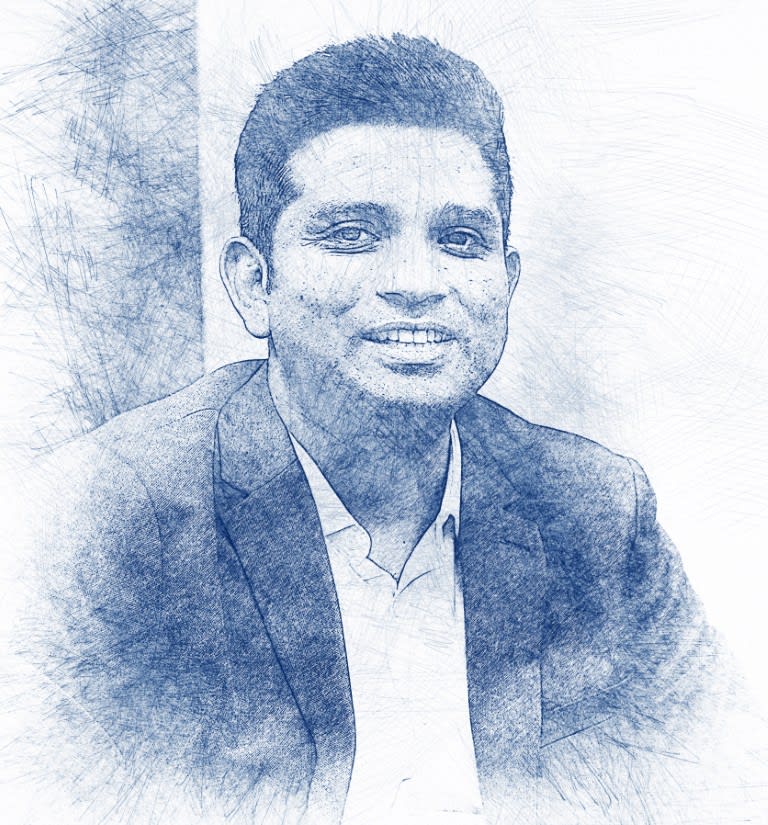
You’ve spent over two decades in the industry, witnessing rapid digital transformation and tech innovation firsthand. Which projects have excited you the most? And what key advice would you share with the next generation of leaders?
I take great pride in the work I’ve been part of. I consider myself fortunate to be working in this century — a time of tremendous change. After the Industrial Revolution, this is the most transformative era we’ve seen. Post-Covid, the surge in tech innovations, particularly transformer models and generative AI, has had a massive impact across industries.
I began my career at SAP, where I spent 18 years. The company gave me the opportunity to learn about different industries and contribute to products that made a tangible difference to customers’ day-to-day operations. It taught me how to build software at scale, especially for clients with millions of users, ensuring seamless performance without disruption.
At SAP, I also helped establish a startup programme in India — SAP Startup Studio — where I worked with multiple startups, assisting them with scaling, securing funding, building integrations, and finding product-market fit.
Another major milestone was the shift to cloud transformation — watching organisations transition from legacy systems to the cloud, enabling continuous innovation without the need for new installations. That was a significant change.
More recently, the rise of artificial intelligence, particularly generative AI, has accelerated the adoption of technology at every level. These are two of the most pivotal transformations I’ve witnessed in my career.
As a leader in tech innovation, which developments excite you the most?
Agent AI will reshape workplaces — agents, programs, and people will collaborate, pushing us to rethink traditional org structures and hierarchies
Artificial intelligence, without a doubt. People often overestimate AI’s short-term impact while underestimating its long-term potential. In the long run, AI will fundamentally change how we interact, develop, and deliver services. Entire industries will be transformed, and many organisations will face disruption.
Agent AI — where agents interact with each other to define and create software landscapes — is another thrilling development. This raises broader questions about the future structure of organisations. It won’t just be humans; there will be a mix of agents, automated programmes, and people working together. Traditional hierarchies will evolve.
We’re also seeing groundbreaking innovations in biotechnology. With tools like CRISPR, we can genetically modify DNA to enhance human potential — a major leap forward.
Brain-computer interfaces are another fascinating trend. Systems are being developed to read brain signals and interact directly with software. Apple, for instance, recently filed a patent for AirPods that capture neural activity. This could lead to far more seamless human-tech interactions.
Then there’s augmentation — wearables like smart glasses, VR headsets, and Apple watches. These can track biomarkers and provide insights into personal improvement. The possibilities are endless. The critical question is: What are we doing to stay relevant in this future?
HR and IT may merge as functions, given the blend of organic and digital elements in the workforce. Performance assessments will need to account for both augmented and non-augmented individuals.
This evolution isn’t new — some call it transhumanism, others see it as technological progress. Either way, technology is advancing at an unprecedented pace.
Drawing from your B2B startup and tech experience, what’s one key piece of advice for young entrepreneurs or MBA professionals?
India has all the ingredients — digital stack, user base, and scale — to build businesses that serve a billion people
India presents an incredible opportunity. With a population of 1.5 billion, the world’s largest biometric ID system (Aadhaar), and a robust digital stack — including UPI, ONDC (Open Network for Digital Commerce), and other public digital infrastructures — you can build entirely frictionless businesses here.
If you’re passionate about creating something, you don’t need to look beyond India. The country has the user base, mobile penetration, data access, and financial inclusion needed for scalable innovation.
You can build systems that serve a billion people. As Pramod Varma, former Chief Architect of Aadhaar, once said: Human-scale problems need human-scale solutions — and India provides the platform to develop them.
Biotechnology is another high-potential sector. It’s still relatively untapped, so entering early allows you to build intellectual property in India and scale globally.
Given these industry shifts, employees undergo many transitions. Leaders must make critical decisions while keeping teams engaged. What core values guide you in such situations?
The foremost value is fostering a culture of learning. Upskilling should be a continuous pursuit for everyone — not just CXOs. There’s no permanent competitive advantage. Every day is a test of whether you’ve improved from the day before.
Second, focus on creating delta — making a meaningful impact. Historically, we’ve been obsessed with perfection, but time-to-value matters more. Perfection should emerge as a byproduct of strong processes.
My strong recommendation is to prioritise progress —incremental development and consistent delivery. Over time, these small improvements lead to massive disruption. That mindset is crucial for any organisation.