


May, 2026
2 min Read
Bharat vs India One Market, Two Consumers?
 29 May 2026
Diverging behaviours across urban and non-urban markets are reshaping India’s consumption story — and forcing brands to rethink growth strategies
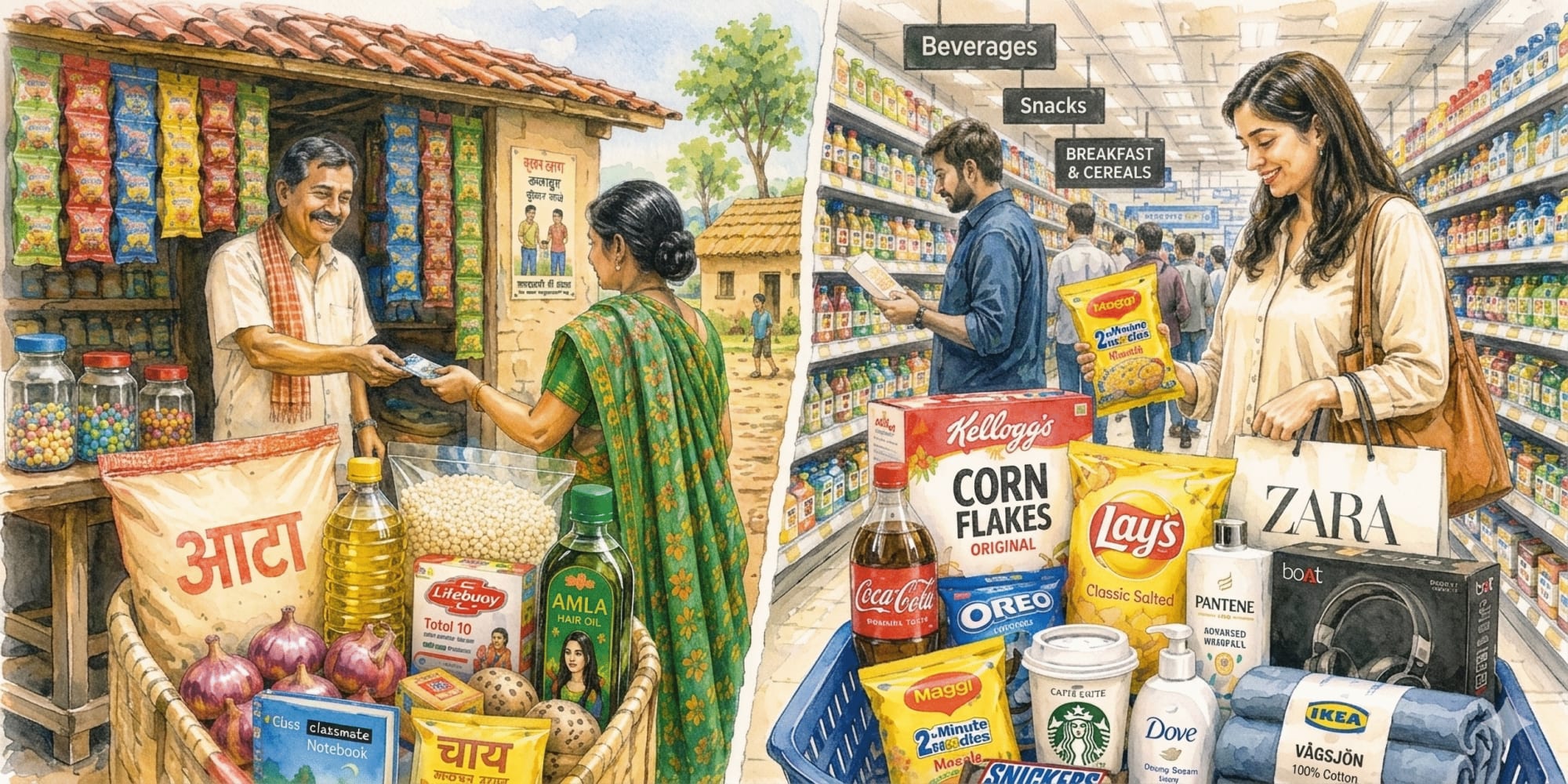
India’s economic growth story is one of a kind. It is a well-documented fact that ever since the country opened its economy to global markets in 1991, there has been staggering growth in the country, as evidenced by a year-on-year rise in gross domestic product over the subsequent decades.
This incredible growth in ‘production’ is not in isolation; a similar significant increase in ‘consumption’ has also taken place, marked by a rise in average monthly expenditure across households. Indians today produce and consume more thantheir predecessors did — a result of trade-friendly government policies, inflow of private investment, subsequent economic
reforms and increasing consumer aspirations.
One measure of this ‘consumption’ is Monthly Per Capita Consumption Expenditure (MPCE), which is tracked by the Ministry of Statistics and Programme Implementation (MoSPI) through Household Consumption Expenditure Surveys (HCES), which further categorise it across ‘urban’ and ‘rural’ households.
Increasing Divide
This highlights a growing divergence between urban and rural household spending in terms of absolute values. While the urban-rural difference as a percentage of rural MPCE has decreased over the years, the absolute difference has risen from `845 (in 1999-’00) to `1,502 (in 2022-’23). This indicates that while rural India is catching up with urban India in terms of monthly spending, an average rural Indian still spends less than a city-dweller, and the difference is increasing every year.
What drives this absolute gap? Growing income disparity? Impact of socio-economic factors? Increasing urban population? The answer to this question is multi-faceted and is a subject of comprehensive research and analysis. But one thing remains certain: the gap is increasing, and this is leading to the formation of an increasingly segmented market.
Emergence of Two Markets
Some estimates suggest that the rural population of India includes more than 937 million people, while the urban population accounts for almost 513 million people (Source: World Bank Open Data), which is almost half of the rural population. But even with almost double the number of people, rural India’s MPCE is roughly only 60 per cent of that of urban India. This shows that urban customers are driving value, while rural customers are driving volume. An urban customer has greater disposable income and is paying more for discretionary, premium or high-priced items than a rural customer, who buys standard, average-priced commodities and services.
What Does it Mean for Brands?
The emergence of two markets within the country should have an impact on brand strategies. Treating India as a single homogeneous market is no longer an option. There needs to be stricter segmentation practices, not to create inequality, but to recognise today’s reality and adapt accordingly.
Brands can make use of this two-speed economic growth to segment sharply, to pursue both value (urban) and volume (rural) simultaneously, rather than diluting strategies to cater to a single market. Stricter segmentation ensures companies allocate resources where they yield the highest returns.
Take the example of Maruti Suzuki’s dual sales channel strategy. Maruti Suzuki recognised the growing separation of rural and urban markets and created two different sales channels: NEXA (for a premium, urban positioning) and ARENA (for the mass market). There is significant difference between the strategies employed by the two channels, in terms of the SKUs/models offered, the retail experience and the perceived quality of customer service received, and this has yielded positive results.
Maruti Suzuki’s dual channel strategy has contributed to sustained growth in sales and revenue, reflected in its strong stock performance over the past five years. This shows that brands need to perform a strategic trade-off: either maximise margins in urban markets, or maximise reach in rural India, or build parallel capabilities to do both to stay competitive. Identical pricing, distribution and communication strategies will not work in an increasingly segmented market.
Parallel Paths
While a growing expenditure gap can be alarming, and efforts are being made to reduce this gap through government policies, acknowledging this growing divide is also important, and can help policy makers design differentiated schemes and policies to achieve balanced growth and to prevent rural markets from being left behind.
Stricter segmentation can help in creating tailored schemes at both commercial and societal level. This should not be taken as a division of the market or the population, but rather customised solutions catering to different requirements to ensure growth for all.
India is not one market waiting to converge; it is two markets evolving in parallel. Brands that recognise this early will not just grow with India but grow because of its differences.