


April, 2026
2 min Read
Built in VOLATILITY Winning in FLUX
 29 Apr 2026
In a world where disruption is constant, firms accustomed to uncertainty — especially from emerging markets — are outperforming, leveraging control, adaptability, and long-term thinking to navigate a fragile global system
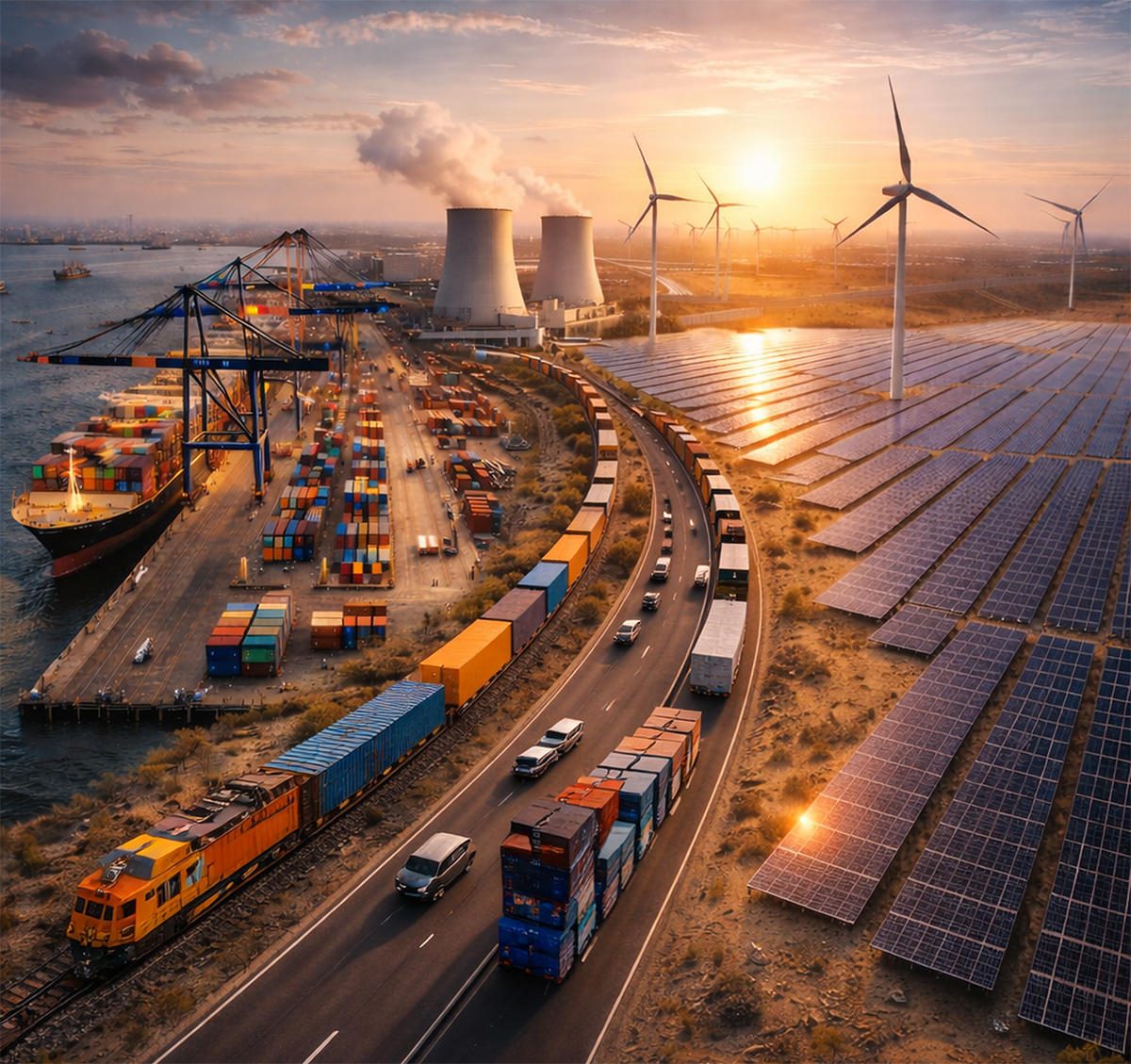
In recent months, global trade has faced repeated disruptions. Shipping routes through the Red Sea have been strained by geopolitical tensions. Supply chains are being rerouted with little notice. Energy markets are reacting sharply to conflict signals. What were once rare shocks are becoming part of normal business conditions.
For decades, globalisation was built on efficiency. Firms optimised for cost, scale, and seamless cross-border operations. The assumption was stability. That assumption is now under pressure.
A shift is underway. Firms are moving from efficiency to resilience. The focus is shifting towards control, flexibility, and the ability to operate under uncertainty. In this transition, emerging market multinationals are gaining an advantage.
From Efficiency to Control
The Adani Group offers a clear example of this shift. Its strategy is centred on building control across infrastructure, logistics, and energy. This is visible in how its businesses are structured across ports, mining, power, and transport.
Adani Ports and SEZ has built a dominant logistics position and expanded globally, including Haifa Port in Israel, along with linkages across Asia and the Middle East. This reflects a broader strategy of controlling trade gateways rather than depending on them.
This is not just expansion. It is strategic positioning. By owning ports, logistics, and energy assets, the group reduces dependence on fragmented global systems. This creates the ability to respond faster when disruptions occur.
The same logic extends to capital allocation. In FY 2024-25 alone, Adani Enterprises deployed `31,838 crore in capital expenditure towards infrastructure and next-generation businesses. This reflects a long-term commitment to building hard assets that anchor resilience.
Built for Uncertainty
Emerging market multinationals are particularly well positioned in this environment. Many have grown in conditions where uncertainty is constant. Policy shifts, infrastructure gaps, and volatile demand are part of everyday operations. As a result, resilience is built into their business models.
Their expansion strategy also differs. Instead of focusing only on stable markets, they are willing to enter Africa, the Middle East, and parts of Asia, where risks are higher but strategic opportunities are significant. These include access to resources, infrastructure demand, and long-term trade flows.
Companies like the Tata Group reflect similar approaches. Their strategies are shaped less by efficiency alone and more by continuity and control.
Balancing Energy and Transition
Sustainability adds another layer to this shift. Emerging market multinationals often operate in sectors such as energy and mining, where environmental impact is significant. This creates a structural tension. The Adani Group’s resource strategy follows a similar pattern. Investments in coal mining in Indonesia and the Carmichael project in Australia are linked to long-term supply security.
Coal mining may appear misaligned with clean energy, but it supports energy security during the transition. With renewables still intermittent, baseload power remains critical. Adani’s overseas mining ensures supply stability and reduces market risk, making it a hedge against energy uncertainty. This approach aligns with a broader shift in global energy systems. According to the International Energy Agency, global energy investment is expected to reach $3.3 trillion in 2025, with clean energy attracting $2.2 trillion — twice the level of fossil fuels.
This signals a structural shift. Capital is moving towards systems that ensure energy security, electrification, and long-term stability. The Adani group has committed $100 billion towards green transition investments over the next decade. Its renewable energy capacity has already reached 14.2 GW, with a target of 50 GW by 2030.
This dual strategy reflects a broader reality. Firms must meet current energy demand while preparing for a lower-carbon future. Resilience now includes the ability to manage both operational shocks and sustainability transitions.
Endurance Over Expansion
The next phase of globalisation will not be defined by how efficiently firms expand, but by how well they endure. Geopolitical tensions, resource competition, and climate pressures are likely to persist.
Emerging market multinationals are already operating with this mindset. Their experience in navigating complexity is becoming a strategic advantage. However, this advantage will depend on how effectively they align resilience with responsibility.
For global businesses, the implication is clear. Competing in the future will require more than optimising costs. It will demand control over critical assets, flexibility in strategy, and the ability to invest with a long-term view.
The question is no longer whether globalisation will continue, but which firms are best prepared for the version of it that is emerging.