


August, 2025
5min read
Closing the Loop: How Circular Economy is Redefining CSR
 30 Aug 2025
Circular economy principles are reshaping CSR, moving it from checkboxes to core strategy — reducing waste, enhancing value chains, and building future-ready, responsible businesses.
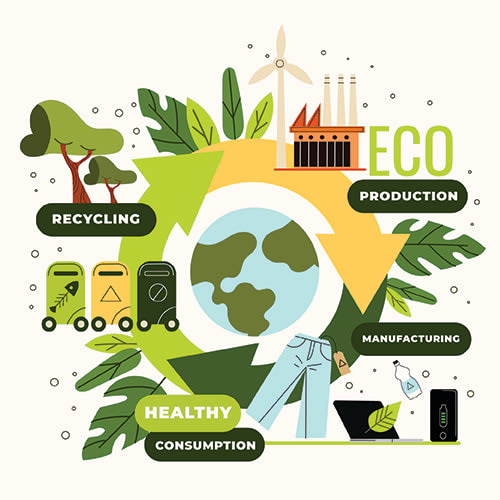
For years, corporate social responsibility (CSR) and sustainability have revolved around compliance, philanthropy, and damage control. However, as environmental and resource pressures intensify, businesses are being called to reimagine not just how they operate but also how they design their entire value chain. This is where the idea of the circular economy steps in, pushing CSR beyond charity and into the very core of corporate strategy.
At its heart, the circular economy is a systems-level approach to economic development that aims to eliminate waste and keep as many materials in use for as long as possible. It challenges the “take-make-dispose” model and advocates for a regenerative design: products and processes that reuse, repair, recycle, and repurpose rather than discard. When integrated with CSR, it becomes a robust framework for companies to deliver lasting environmental, social, and economic value.
Why Circular Economy Matters in CSR Today
Global resource extraction has more than tripled since the 70s, and only about 6-7 per cent of materials used in the economy today are recycled back for reuse. This linear model has not only strained ecosystems but also exposed businesses to risks such as volatile raw material prices, supply chain disruptions, and regulatory pressure. CSR strategies that incorporate circularity help mitigate these risks and drive innovation, resilience, and stakeholder trust.
Unlike traditional CSR programmes, which often operate at the periphery of business functions, circular practices demand integration across R&D, procurement, manufacturing, logistics, and even marketing. In short, they require companies to rethink their products from the ground up, with environmental impact, recyclability, and end-of-life use built into the initial design.
Industry Examples and Best Practices
The fashion industry, one of the largest polluters globally, is now waking up to circularity — albeit a little too late. Many brands, such as Patagonia, H&M, and Eileen Fisher, have started take-back programmes for garments, recycled fibres, and are updating designs to be more modular, extending product life. For instance, H&M’s “Garment Collecting” initiative allows customers to return old clothes in exchange for vouchers.
In electronics, companies such as Dell are designing modular phones and laptops that can be repaired easily or upgraded rather than discarded, paving the way for reducing e-waste — one of the most significant polluters on Earth. Dell’s circular design framework focuses on closed-loop plastics, where materials from old devices are recovered and reused in new products, reducing reliance on virgin materials.
Unilever has been experimenting with reusable packaging through its “Loop” initiative in partnership with TerraCycle. Consumers return durable packaging that gets cleaned and reused, breaking the single-use plastic cycle. This not only reduces waste but also strengthens consumer loyalty and brand purpose.
CSR Meets Circularity: Key Principles
- Design for longevity: Products should be durable, upgradeable, and repairable by default.
- Regenerative resources: Move from finite raw materials to renewables or sustainably sourced inputs.
- Waste as a resource: Treat all waste as a potential input for new products or industries.
- Stakeholder engagement: Engage customers, suppliers, and communities in circular behaviour, not just internal teams.
- Transparent reporting: Go beyond ESG disclosures; track actual material flows, reuse rates, and lifecycle impacts.
Recent Developments and Challenges
Several governments are starting to mandate extended producer responsibility (EPR), making companies accountable for the lifecycle of their products. The European Union’s Circular Economy Action Plan is a highly ambitious programme that sets targets for waste reduction, sustainable product design, and circular business models.
But there are hurdles. One major issue is the lack of standard metrics and clarity on what constitutes a “circular” product. Greenwashing is a growing concern, with companies exaggerating circular claims without system-level changes. Critics also point out that recycling alone cannot fix overconsumption — reduction and reuse must come first.
Still, the momentum is building. Investors are increasingly considering circularity as a marker of long-term viability. Business schools are weaving it into their curricula. Consumers, especially younger ones, are demanding more responsible brands.
Closing the Loop is the (Only) Future
The circular economy offers companies a practical roadmap to make CSR meaningful, scalable, and ready for the future. By incorporating circularity into core strategy, organisations can close the loop with respect to materials, trust, value, and responsibility. The question for companies today is no longer whether they can afford to go circular, but whether they can afford not to.
The future of CSR isn’t just about doing less harm. It’s about designing systems that do more good.