


March, 2026
2 min Read
Concrete, Capital & the India Growth Story Budget 2026 Doubles Down on Infrastructure-led Growth
 31 Mar 2026
With record capex, high-speed rail corridors and new urban hubs, Budget 2026 positions construction as the backbone of India’s long-term economic expansion
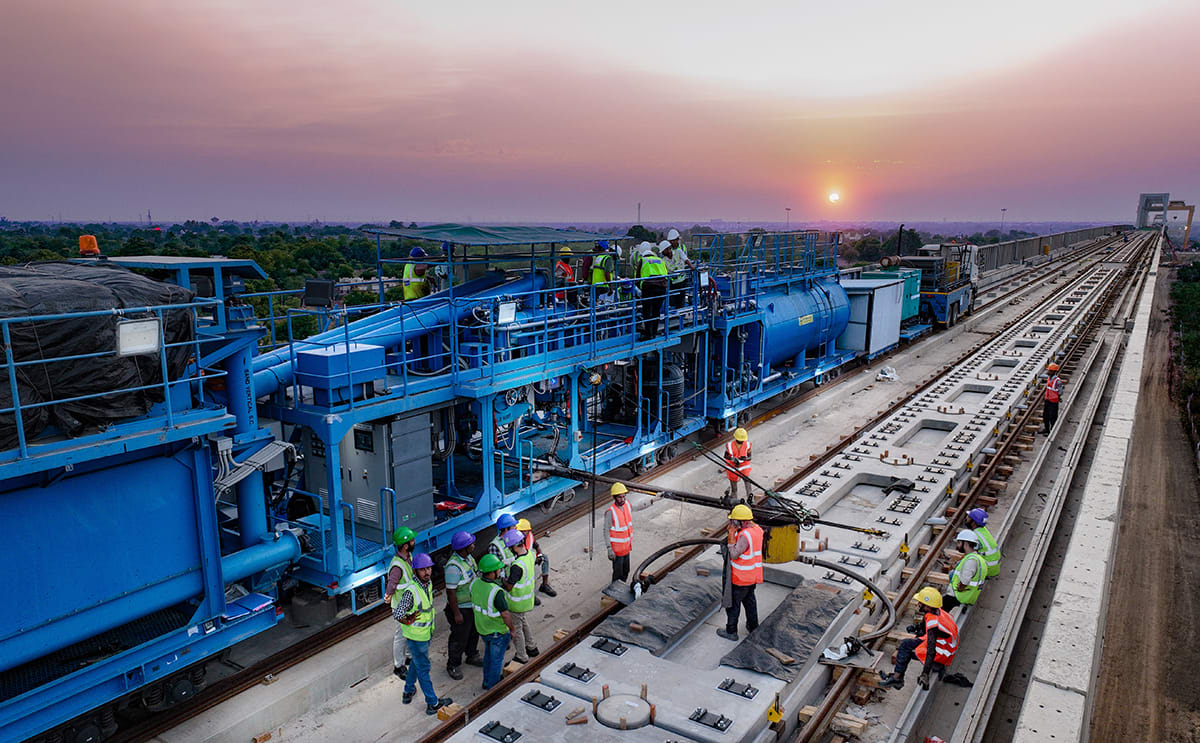
The Union Budget 2026-27 reinforces a clear message: infrastructure is no longer just a sectoral priority — it is the foundation of India’s long-term growth model. At a time when global capital is returning to hard assets and Asia is projected to account for over half of global infrastructure demand by 2040, India is positioning construction at the centre of its development strategy.
From record capital expenditure to high-speed rail corridors and urban expansion in Tier-2 and Tier-3 cities, the Budget signals structural transformation rather than short-term stimulus. The future of India’s construction industry is therefore tied not only to spending volumes but to execution capacity, financial innovation, and inclusive development.
Capex and Infrastructure-Led Growth
The budgeted capital expenditure of `12.2 lakh crore for FY 2026-27 — approximately 4.4 per cent of GDP — marks the highest-ever allocation. This reflects a decisive shift toward infrastructure-heavy budgeting post-2021.
Rising public capital expenditure serves multiple economic purposes. First, it stimulates short-term demand through construction activity, supply chain linkages, and job creation. Second, infrastructure investment carries strong multiplier effects, raising productivity over time by lowering logistics costs and improving competitiveness. Third, in an environment of relatively sluggish private investment, the state becomes the primary driver of capital formation.
Globally, such capex expansion strengthens India’s position in supply chains, especially under the “China+1” diversification strategy. Improved transport, ports, digital networks, and industrial corridors enhance India’s attractiveness as a manufacturing hub. It also enables counter-cyclical stabilisation — allowing India to sustain growth even amid global slowdowns.
However, the composition of spending warrants attention. While capital outlays have more than doubled since 2021–22, allocations to employment programmes such as MGNREGS have stabilised rather than expanded proportionately. The implicit policy assumption is that infrastructure-led growth will generate sufficient employment elasticity to compensate for slower expansion in wage-support mechanisms. The long-term success of this strategy depends on execution efficiency and inclusive job creation.
Tier-2, Tier-3 Cities and Temple Town Development
The Budget’s emphasis on strengthening infrastructure in Tier-2 and Tier-3 cities (population above 5 lakh) represents a shift toward distributed urbanisation. By recognising these cities as emerging economic hubs, the government aims to reduce pressure on mega-metros and create multiple growth poles.
The proposal to create City Economic Regions (CERs), with `5,000 crore allocated per region over five years through a reform-linked framework, seeks to upgrade mobility, utilities, and urban amenities. Investments in water, power, roads, and digital connectivity can improve quality of life while attracting businesses and real estate activity.
Additionally, the focus on temple towns and faith-based economic circuits reflects a strategic move toward tourism-led regional development. Lessons from circuits like Prayagraj-Kashi-Ayodhya suggest that religious tourism can stimulate hospitality, retail, transport, and infrastructure demand. For the construction industry, this expands opportunity beyond metros into smaller cities where infrastructure gaps remain significant.
This marks a transition from metro-centric development to a broader urban growth model — one that can deepen regional economic integration and support inclusive expansion.
Seven High-Speed Rail Corridors:
Growth Connectors
The announcement of seven high-speed rail corridors — linking Mumbai-Pune, Pune-Hyderabad, Hyderabad-Bengaluru, Hyderabad-Chennai, Chennai-Bengaluru, Delhi-Varanasi, and Varanasi-Siliguri — represents a transformative mobility strategy.
These corridors promise sharp reductions in travel time, strengthening inter-city connectivity across industrial, IT, and commercial hubs. By integrating labour markets and business ecosystems, they enhance productivity and regional economic cohesion. Faster travel enables business commuting, tourism expansion, and industrial decentralisation.
From a construction perspective, high-speed rail projects involve extensive civil works, tunnelling, elevated tracks, signalling systems, and multimodal station integration. They create long-term opportunities across engineering, materials, and project management.
However, funding remains a critical challenge. With potential investments exceeding `16 trillion over decades, financial sustainability, land acquisition efficiency, and timely execution are central risks. Past delays in large infrastructure projects highlight the need for strong governance frameworks. If implemented effectively, these corridors can support India’s ambition of becoming a developed economy by 2047.
REITs and Infrastructure Risk Guarantee Fund
The Budget also introduces structural financial reforms to support infrastructure and real estate.
The proposed Infrastructure Risk Guarantee Fund aims to de-risk lending during high-risk construction phases. By offering partial credit guarantees, it can unlock institutional capital, improve liquidity, and revive stalled projects. This is particularly beneficial for mid-sized developers struggling with financing constraints.
Similarly, the plan to channel CPSE real estate assets into REIT structures can unlock idle public land, deepen capital markets, and convert static holdings into income-generating instruments. REITs enhance transparency, broaden investor participation, and free up capital for new infrastructure investments.
However, the success of REITs depends on asset quality, occupancy levels, and market conditions. Not all government properties may immediately meet commercial viability standards, and restructuring may be required.
Execution is the Real Test
The Budget’s proposals reflect ambition and structural clarity. Record capex, regional urban development, high-speed rail expansion, and financial innovation together position construction as a core driver of India’s growth story.
Yet, allocation alone does not guarantee impact. The real test lies in execution velocity, fiscal prudence, employment generation, and regulatory coordination. Infrastructure-led growth can be transformative — but only if it translates into productivity gains, inclusive job creation, and sustainable financing.
India’s construction future looks promising. The challenge now is operationalising that promise into long-term economic resilience.