


April, 2025
5min read
E-Commerce Revolution
 27 Apr 2025
From virtual storefronts to AI-driven shopping, e-commerce has reshaped retail. Explore its journey, impact on traditional stores, and the tech shaping its future.
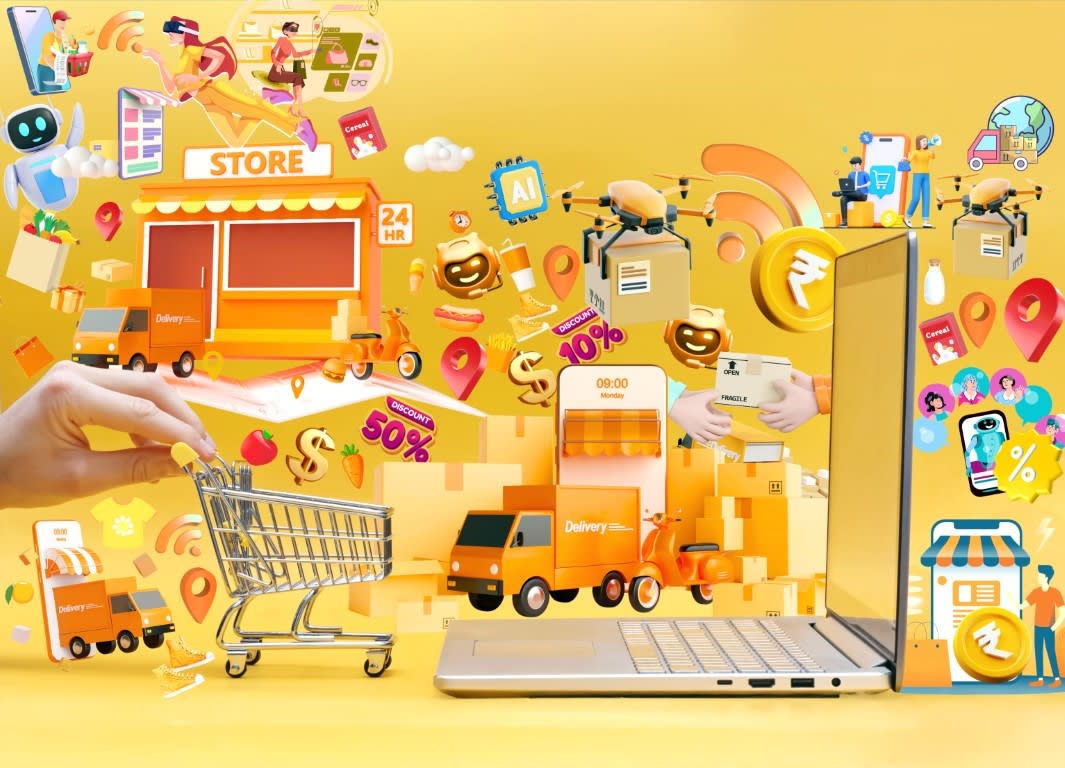
“If your business is not on the internet, then your business will be out of business.”
This profound quote by Bill Gates, the founder of Microsoft, encapsulates the seismic shift that the retail industry has undergone with the advent of e-commerce. Today, as we witness a world where digital storefronts are as ubiquitous as their physical counterparts, Gates’ words reflect a reality where the landscape of retail has been irrevocably altered by the rise of e-commerce giants. Let us therefore delve into the evolution of e-commerce, its disruptive impact on traditional retail, and glimpse the future of this ever-evolving industry.
A Historical Perspective
The history of e-commerce began in the 1960s with the introduction of Electronic Data Interchange (EDI), a system that replaced traditional mailing and faxing of documents. In 1971, the first-ever online transaction— the sale of marijuana by Stanford students — was facilitated by ARPANET, the precursor to the internet. The first significant commercial online transaction, however, occurred in 1994 with the sale of a Sting album. Michael Aldrich’s invention in the UK in 1979, using a computer and a telephone line for B2B transactions, and the 1982 launch of the Boston Computer Exchange, are often regarded as foundational events that established modern e-commerce.
The evolution of e-commerce, however, is incomplete without mentioning Amazon, founded by Jeff Bezos in 1994. Initially launched as an online bookstore, Amazon rapidly expanded its product offerings across multiple categories and has today emerged as an e-commerce behemoth, befitting its moniker “The Everything Store”, thereby symbolising the potential and scalability of e-commerce platforms. The industry further gained momentum with companies like eBay, PayPal, and Alibaba, each shaping the online retail landscape — from payment processing to online reselling and global trade. Their growth from niche online platforms to global dominators highlights the transformative power of e-commerce.
In India, post-1995, following economic liberalisation, the first B2B directory emerged, marking the beginning of the country’s e-commerce journey. The launch of IRCTC’s online ticketing system and the rise of homegrown e-commerce platforms like Flipkart and Snapdeal were important milestones that signified the expanding reach of e-commerce in India. The influx of affordable mobile data services by Jio in 2016 also catalysed a dramatic increase in India’s internet user base, propelling the e-commerce industry into a new era of exponential growth. More recently, the rise of the “buy now, pay later” option, backed by financial institutions, has further catapulted e-commerce’s exponential rise.
Disruption of Traditional Retail
The emergence of e-commerce has significantly changed consumer expectations and purchasing behaviours. Online shopping has become increasingly popular due to its unparalleled convenience. The ease with which consumers can now browse and buy anything at any time and from any location has completely transformed the way people think about shopping. Millions around the world now shop online while on the go, aided by the growing use of smartphones, which is accelerating this shift.
Personalisation has also emerged as a game-changer in e-commerce. Advanced algorithms enable online retailers to offer tailored recommendations, enhancing user experience and engagement. This trend is perhaps best illustrated by Amazon’s automated recommendations, which are based on browsing and purchase history. The 24/7 availability of e-commerce platforms marks another disruptive shift. Unlike traditional stores with fixed hours, online stores cater to customers around the clock, accommodating varied schedules and time zones. Amazon’s introduction of Amazon Go stores takes convenience to the next level by eliminating traditional checkout processes. Instead, sensors and cameras automatically track what customers take and charge their Amazon accounts accordingly. Shoppers can simply walk in, pick up the items they need, and leave without queuing or interacting with a cashier — offering a seamless and hassle-free experience.
All this has significantly disrupted traditional retail, leading to the closure of many brick-and-mortar stores. American retail giants like Sears and Toys “R” Us have filed for bankruptcy, unable to compete with e-commerce leaders such as Amazon. The trend extends beyond large chains to smaller businesses, like independent bookstores, which struggle against the convenience and variety offered online. The shift to digital shopping has also impacted retail employment, with a decline in jobs across the sector, often forcing workers to seek alternative employment or retrain for new careers.
What’s in Store for the Future?
Looking ahead, the future of e-commerce is poised for transformative changes with the integration of technologies like the metaverse and blockchain. The metaverse promises a revolutionary shopping experience, offering a 3D virtual world where digital and physical realities merge. Brands can create immersive, interactive spaces, allowing customers to engage with products in ways beyond what traditional e-commerce or even physical stores can provide.
Blockchain technology can enhance the security and efficiency of e-commerce transactions through its decentralised nature, ensuring transparent and tamper-proof records, thereby building trust and streamlining operations. It could revolutionise logistics, enabling real-time tracking and reducing shipping costs — benefiting both retailers and consumers.
In India, government initiatives like the Open Network for Digital Commerce (ONDC) could be a game-changer by moving away from platform-centric models to an open-source, interoperable framework, democratising e-commerce in the process. ONDC could level the playing field for smaller retailers, offering them the opportunity to compete with e-commerce behemoths.
The e-commerce sector is evolving rapidly due to constant innovation and technological advancements, allowing us to envision a future where e-commerce is not merely a transactional platform but a secure, inclusive, immersive, and customer-focused ecosystem. With these emerging technologies and frameworks, we are only beginning to scratch the surface of possibilities — ushering in a whole new world of e-commerce and internet-enabled business models.