


March, 2026
2 min Read
Fiscal Straitjacket Is Budget 2026 Trading Growth for Prudence?
 31 Mar 2026
As growth slows and private investment hesitates, Budget 2026-27 prioritises fiscal discipline — raising a critical question: Is caution undermining the investment needed for India’s next growth phase?
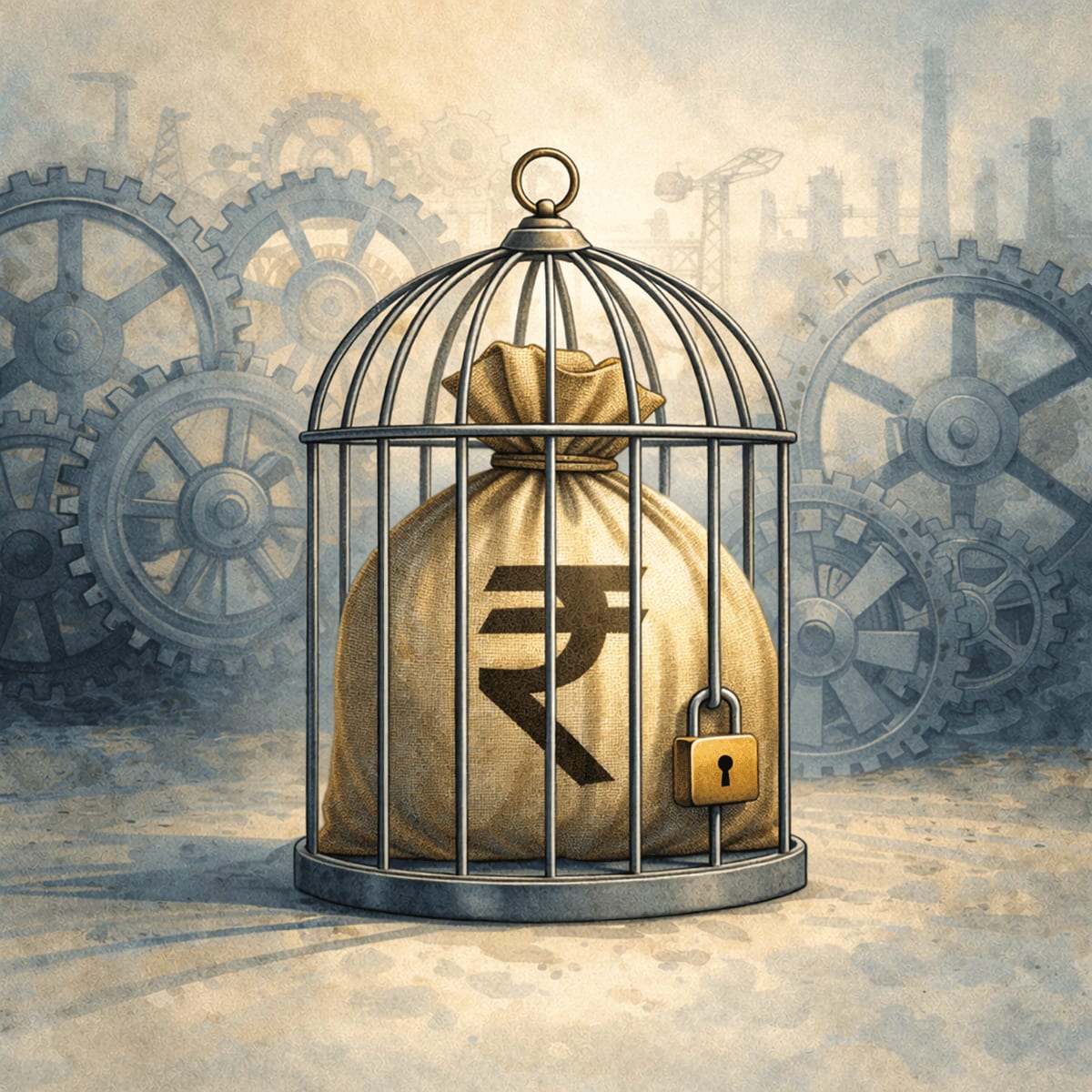
Union Budget 2026-27 presents a curious contradiction. On the surface, the finance minister projects confidence in India’s growth trajectory. Yet a closer reading of the Budget reveals a government increasingly constrained by its own fiscal conservatism. With a targeted budgetary deficit of 4.4 per cent of GDP and capital expenditure pegged at around `11.21 lakh crore, the Budget appears more focused on restraint than on the scale of investment required to sustain high growth. The central question, therefore, is whether India is trading growth for prudence. The Fiscal Consolidation Push: Necessary or Premature?
The government’s decision to reduce the fiscal deficit from 4.8 per cent to 4.4 per cent reflects a continued commitment to fiscal consolidation. Proponents argue that this signals credibility to global rating agencies and foreign investors, potentially lowering borrowing costs and attracting capital inflows. However, this argument deserves closer scrutiny. India’s growth has moderated to around 6.4 per cent, a clear deceleration from the post-pandemic rebound. Private investment remains subdued, consumer demand is weak, and global economic conditions are uncertain. In this context, an aggressive push towards fiscal tightening risks resembling austerity at precisely the moment when the economy needs counter-cyclical support.
History offers a contrasting approach. During the global financial crisis of 2008-09 and the pandemic shock of 2020-21, the government allowed deficits to expand to stabilise the economy. Today, despite the absence of a comparable crisis, amid visible growth headwinds, the emphasis has shifted to restraint. This raises a fundamental question: is fiscal consolidation a means to long-term growth, or has it become an end in itself? If growth is the objective, the current stance appears misaligned. Capital Expenditure: Ambitious in Optics, Limited in Impact While the Budget highlights capital expenditure as a growth driver, the numbers suggest otherwise. At roughly 3.1 per cent of GDP, public capex remains flat. For an economy aspiring to reach $7 trillion by 2030, this level of investment is insufficient. Infrastructure expansion, manufacturing scale-up and technological advancement require sustained and rising public investment, particularly when private sector investment is hesitant. Moreover, the composition of capital spending matters as much as its size.
Initiatives in semiconductors and biopharma are welcome, but without parallel investments in skills, research ecosystems and regulatory capacity, such announcements risk becoming expensive showcases rather than engines of structural transformation. Compounding this constraint is the rising burden of interest payments, which now account for nearly one-fifth of total government expenditure. Every rupee allocated to servicing debt is a rupee unavailable for productive investment. While fiscal responsibility cannot be ignored, the Budget prioritises creditor confidence over developmental outcomes. A Missed Counter-Cyclical Opportunity Perhaps the most striking weakness of Budget 2026-27 is its failure to act as a stabilising force during a growth slowdown. Conventional macroeconomic wisdom suggests that governments should expand spending during downturns and consolidate during periods of strong growth. This Budget does the opposite. It tightens fiscal policy as growth moderates, risking a feedback loop in which lower public spending dampens growth, necessitating further restraint.
Tax relief measures such as higher standard deductions and rationalised income tax slabs are positive but modest. Given weak wage growth and high household savings, these steps are unlikely to boost consumption significantly. The underlying approach seems to rely on trickle-down effects from fiscal discipline and investment sentiment — an assumption that recent Indian experience does not robustly support. A Question of Priorities At its core, Budget 2026-27 represents a strategic bet. The government is wagering that fiscal discipline will crowd in private investment and foreign capital, offsetting its own restraint. This is a high-risk assumption. If private investment fails to materialise at the required scale, India could find itself trapped in a low-investment, low-growth equilibrium at a critical juncture in its development journey.
The Budget is not without merit. It demonstrates fiscal discipline and sectoral prioritisation. Yet in an era marked by geopolitical uncertainty, rapid technological change and mounting climate challenges, excessive caution may pose the most significant risk. India’s demographic advantage is time-bound, and the window for transformative investment is narrowing. Budget 2026-27 ultimately leaves an uncomfortable question unanswered: In seeking to protect the present through restraint, are we compromising the future we aspire to build?