


August 2026
6 mins read
FRIENDSHORING When Efficiency Meets Geopolitics
 31 Aug 2026
Cheap manufacturing once defined globalisation. Today, resilience, geopolitics and trust are reshaping where companies build, buy and invest, as efficiency alone is no longer enough.
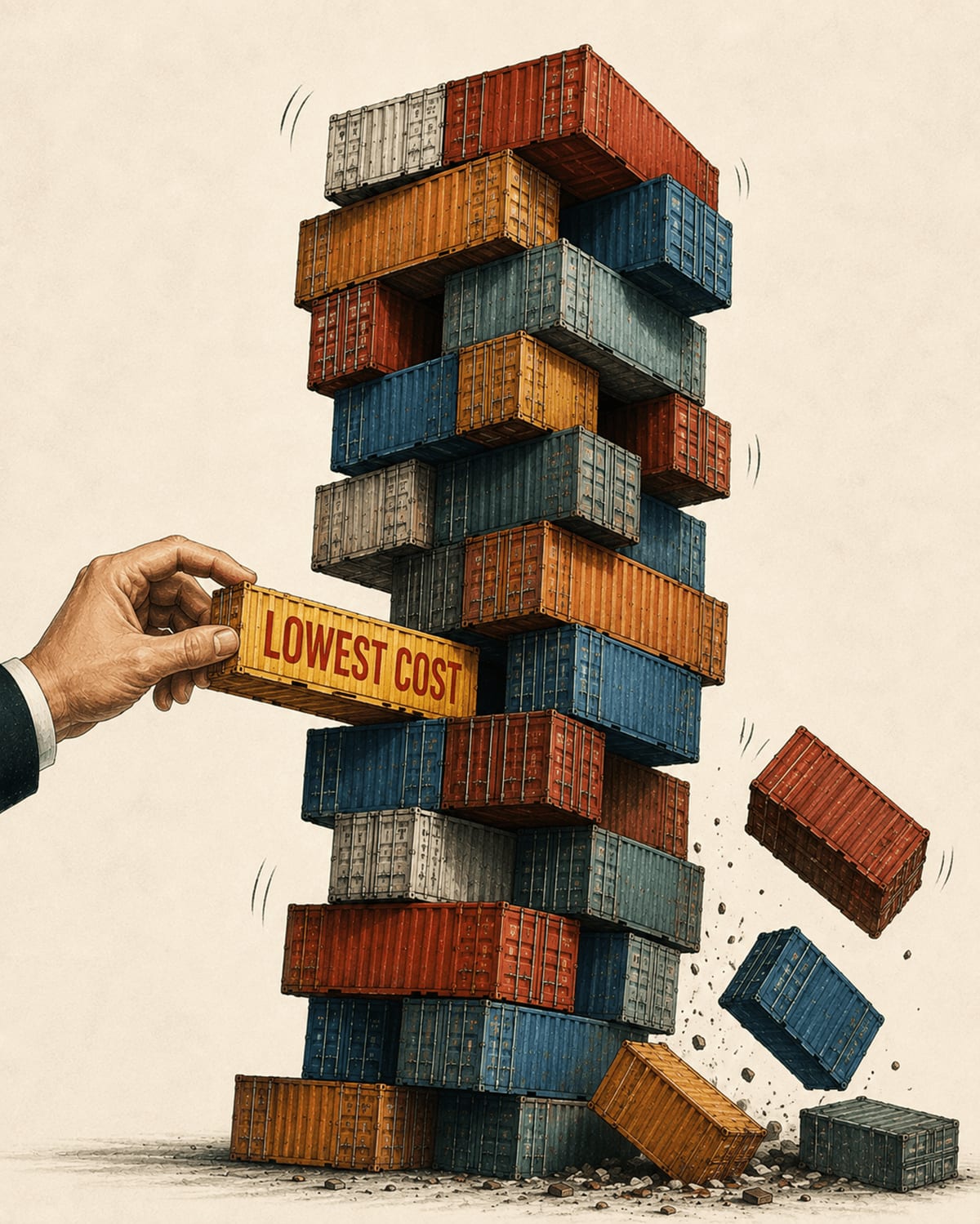
When I first came across the term friendshoring, it sounded like policy jargon trying too hard to sound strategic. But the deeper I’ve gone into it, the more I’ve come to believe that it signals something genuinely structural. This isn’t just policy jargon. It’s a reconfiguration of how global capitalism handles risk.
The Efficiency Trap
For decades, the logic of offshoring was simple: produce where costs are lowest. This efficiency-first mindset shaped global supply chains into lean, highly optimised systems, with China emerging as the “factory of the world”. The model assumed stability. The past few years, however, have been anything but stable. The US-China trade war, Covid-19 lockdowns, semiconductor shortages and Russia’s invasion of Ukraine were a collective stress test. Together, they revealed a hard truth: supply chains optimised purely for cost are most vulnerable in times of disruption.
By early 2024, 92 per cent of US manufacturing executives had considered either nearshoring or reshoring, according to Kearney’s Annual Reshoring Index. The just-in-time model was being quietly replaced by something more expensive but far more survivable: just-in-case.
Trust Over Cost
At its core, friendshoring refers to rerouting supply chains to countries perceived as politically and economically safe or low-risk, thereby prioritising reliability over pure cost efficiency. Unlike offshoring, it isn’t primarily about wage arbitrage. Instead, it centres on trust, security and a long-term shared vision, which translates into better protection of intellectual property, more predictable regulatory environments and a reduced risk of critical components suddenly becoming subject to export bans.
Former US Treasury Secretary Janet Yellen articulated Washington’s position plainly. She argued that, rather than relying heavily on countries with geopolitical tensions and unreliable supplies, the goal should be to diversify towards more dependable partners. That’s the political pitch. But the corporate logic runs parallel and independently: a supply chain partner that might face sudden tariffs, factory lockdowns or export controls is a financial liability, regardless of how cheap it is today.
The numbers reflect this shift. According to the Reshoring Initiative, US manufacturing reshoring and foreign direct investment topped 244,000 announced jobs in 2024, driven by companies seeking to shorten supply chains, reduce exposure to geopolitical risks and avoid costs associated with impending tariffs. The Reshoring Initiative’s 2023 annual report recorded 287,000 reshoring and foreign direct investment job announcements, with EV batteries, semiconductor chips and solar accounting for 39 per cent of those announcements. These are not trivial numbers. This is large-scale industrial reallocation.
Apple’s New Map
No company illustrates this shift better than Apple. Apple has accelerated its “China Plus One” strategy, expanding production in India and Vietnam. Industry estimates suggested that, by late 2024, roughly 15 per cent of iPhones were assembled in India, with production expected to rise to around 25 per cent by 2027.
By mid-2025, Apple chief executive Tim Cook confirmed during the company’s earnings call: “For June 2025, we expect the majority of iPhones sold in the US will have India as their country of origin, and Vietnam to be the country of origin for almost all iPad, Mac, Apple Watch, and AirPods.”
On the surface, this sounds like a clean break. It isn’t. The shift is more limited than it appears. While final assembly is moving to India and Vietnam, dependence on advanced semiconductor manufacturing in East Asia remains largely unchanged. This pattern extends across industries: although China’s share of US imports has declined, countries such as Vietnam and Mexico continue to rely heavily on Chinese intermediary goods.
This creates a resilience paradox: companies are visibly diversifying their supply chains while leaving many of their core dependencies intact. The label on the box says “Assembled in India”. The story inside the box is more complicated.
Governments Take the Wheel
This transformation is not purely market-driven. Government policy is actively reshaping supply chain economics.
The US passed two landmark pieces of legislation in 2022 that fundamentally altered the economics of supply chain decisions: the Inflation Reduction Act, the country’s largest-ever investment in climate and energy security, and the CHIPS and Science Act, which provides incentives for semiconductor manufacturing. Both laws embedded geopolitical alignment directly into corporate incentives, thereby driving reshoring up by 53 per cent, according to the Reshoring Initiative.
Similar patterns are emerging globally. Europe is advancing “Made in Europe” strategies, while China is pushing domestic substitution. The result is a fragmented global system in which supply chains are increasingly shaped by policy as much as by markets.
This introduces a trade-off: reduced geopolitical exposure, but at the cost of efficiency and potential subsidy-driven distortions.
Beyond the Binary
Framing this as a binary misses the point.
What’s actually happening is convergence. Corporate risk management and geopolitical priorities are aligning. Companies would have diversified their supply chains eventually, but government policy has accelerated the shift dramatically.
At the same time, there are constraints. Diversification is slow, expensive and limited by skilled labour shortages. More importantly, geopolitical alignment is inherently unstable. Today’s “friend” may not remain one tomorrow, meaning firms are not eliminating risk so much as reshaping it.
What This Means for Managers
As future managers, the lesson isn’t simply to “build more resilient supply chains.” That is now the baseline.
The deeper shift is that supply chain strategy has moved from operations to the boardroom. It now sits at the intersection of economics, geopolitics, risk management and industrial policy, and the decisions made there carry consequences that no cost model can fully capture.
The firms that succeed won’t be those chasing the lowest cost or the largest subsidy. They’ll be the ones capable of navigating uncertainty through diversification, scenario planning and a clear understanding that no supply chain is ever truly secure.
Friendshoring doesn’t eliminate risk; it repackages it. The real challenge is deciding which risks are worth keeping.
Supply chains optimised purely for cost are most vulnerable in times of disruption
Friendshoring prioritises reliability over pure cost efficiency, placing trust, security and long-term resilience at the centre of supply chain decisions