


May, 2026
2 min Read
Gen Z Doesn’t Buy Products They Buy Belief
 29 May 2026
For Gen Z, purchases are no longer driven by aspiration alone. Brands must now prove their values, ethics and authenticity before earning trust
I worked at HSBC, and one question that comes to mind is: when was the last time anyone saw any Gen Z consumers in a long queue outside a bank or an ATM? That is not because Gen Z does not need financial services, but because, for Gen Z, a branch is not where their relationship with money starts.
During my tenure at HSBC, I saw a shift in the infrastructure of banking, a shift that was not just technical but also behavioural. Younger generations are not just opening accounts to save; they are opening wallets for a sense of belonging.
Trust Beyond Transactions
If we look at the difference, we can see that Millennials grew up in a generation where brand aspiration addressed the wants and needs of individuals. Millennials make and own their purchases with the trust that brands will serve them well. But for Gen Z, the story is a little different. The generation known for having opinions on almost everything is also the most brand-aware and the one that trusts brands the least.
Gen Z checks everything about a brand first. What is the story of the brand? What does the brand stand for? Is the brand doing right by society and its shared resources? All this scepticism around brands has also made companies very conscious of how they are portrayed on public forums.
A 2022 report by McKinsey & Company, True Gen: Generation Z and its implications for companies, states that Gen Z is more likely than any previous generation to make purchase decisions based on a company’s ethical stance, whether on climate, labour or representation. They are not just consumers. They are silent auditors.
The Internet Never Forgets
A question might arise: why is there such a difference between these two generations? The answer is that Gen Z grew up with the internet as a fact-checking tool, not merely a platform for entertainment. All it takes is a Reddit thread or an Instagram story to expose a brand that talks about sustainability while shipping products in layers of plastic wrap.
A very interesting campaign that comes to mind is Patagonia’s, which once ran a full-page advertisement stating “Don’t Buy This Jacket” — very contrary to what an advertisement usually stands for — but the purpose was to appeal to customers to think and evaluate before making a decision. That was not a marketing stunt; it was conviction. And the outcome was as expected: the new generation not only noticed it, but rewarded it with loyalty and advocacy.
On the contrary, some fast-fashion labels place an “eco-collection” tag on a very small percentage of their catalogue while the majority of their product lines rely on exploitative labour or questionable practices. In today’s world, the views of netizens travel faster than a PR team can draft a response.
Ownership Is No Longer Essential
Another major shift is that the newer generation is comfortable not owning material goods and paying for services instead. One classic example is Apple Music being preferred over CD collections. Thrifted fashion over a packed wardrobe.
Deloitte’s 2023 Global Gen Z Survey found that the cost of living is their single biggest concern. But this is also a values statement. Ownership carries an environmental cost. Sharing signals consciousness. This shows that it is both a conscious and an economic response to a deeper concern.
The New Step in Marketing
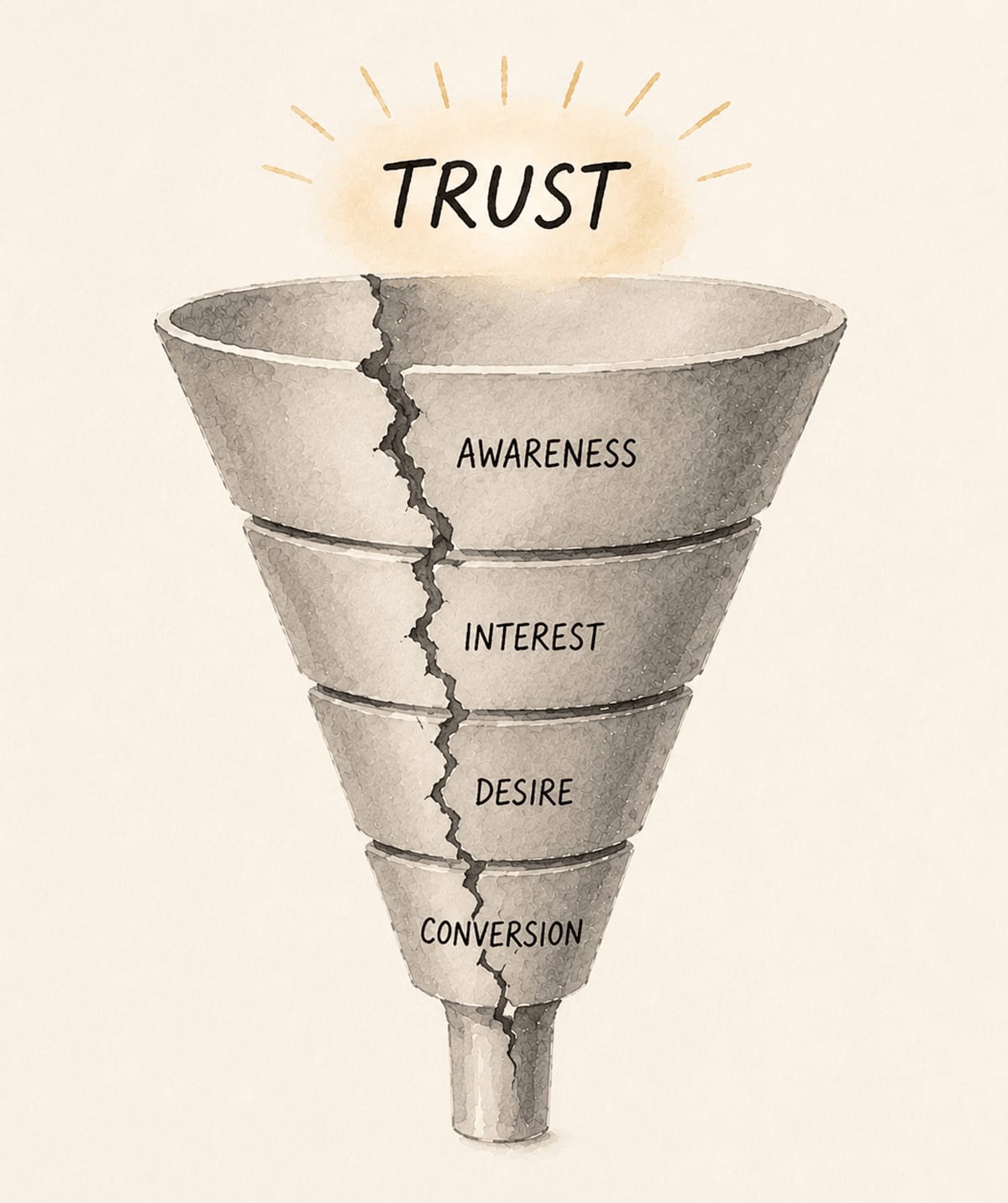
The iconic marketing funnel — build awareness, create desire and convert — is not one-size-fits-all anymore. When we look at newer generations, one more step has been added to the journey: investigation. What is the company’s story? What problem is it trying to solve? What are its values and vision? How does it treat its workers? How honest and ethical is it in its approach?
For brands, marketers and every business student thinking about consumer behaviour, the shift is not just generational. It is structural. Gen Z did not just change what they buy. They changed the entire basis on which trust is built.
And they open their wallets only when they truly feel they belong.