


December 2023
6min read
Gender Diversity and Inclusivity at the Shop Floor Level
 27 Dec 2023
In India’s dynamic manufacturing landscape, a transformative shift is underway on the shop floor, propelled by initiatives empowering women. This article explores their pivotal role in reshaping the nation’s economic fabric, emphasising their journey amid policy changes and corporate strategies.
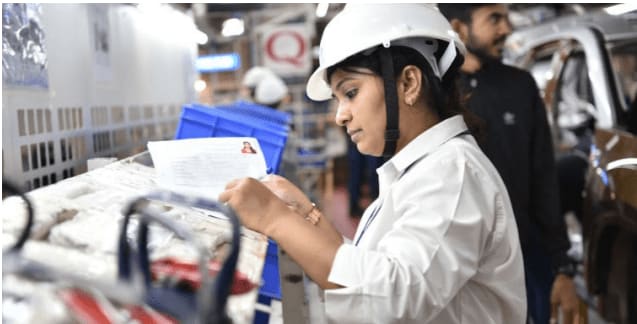
In the recent times, there have been many developments in India’s efforts to empower women. The government has implemented several policies aimed at enhancing women’s health, education, and economic opportunities. There has been a significant increase in the number of women participating in the workforce, and women have achieved stellar positions in various fields, including politics, business, and entertainment. Recently a constitutional amendment reserving one-third of the seats in Parliament, State legislatures, and the Delhi Legislative Assembly for women can be regarded as a “progressive step” towards attaining gender parity in politics.
Women empowerment in various fields cannot be complete without discounting their participation in industry. Women participation in work force has been a crucial barometer for evaluating the gender diversity in industry and is an indispensable measure of women empowerment where women contribute to productive forces of the economy.
Gender diversity and inclusion can be gauged from the female labour force participation rate which has been incremental over years. This shows the effective contribution of women as potential force for the economy. As per the latest available Annual PLFS Reports, the estimated Labour Force Participation Rate (LFPR) on usual status for women of age 15 years and above in the country was 30.0%, 32.5% and 32.8% during 2019-20, 2020-21 and 2021-22, respectively, which shows an increasing trend.
However, in recent years, women’s LFPR saw some improvement. In 2017-18, 22.9% of women aged 15-59 were part of the labour force. This improved to 23.4% in 2018-19, and saw a jump of nearly 5 percentage points in 2019-20.
Manufacturing – Need for Inclusivity and equity at Shop Floor The gender gap in manufacturing employment varies widely across states. Manipur is the only state with a gender balance among those working in its manufacturing sector. The share of women workers in the state stood at 50.8% in 2019-20. Manipur was followed by Kerala (45.5%), Karnataka (41.8%) and Tamil Nadu (40.4%).
Chhattisgarh had the most gender-skewed industrial workforce with women making up just 2.9% of those working in its manufacturing units. It was followed by Delhi with women comprising 4.7%, and Jammu and Kashmir and West Bengal where women made up just 5.5% of the total manufacturing workforce each.
Among the five most industrialised states, the picture is bit dicey with Maharashtra (12%), Uttar Pradesh (5.7%) and Gujarat (6.8%) having large gender gaps and Tamil Nadu (40.4 %) and Andhra Pradesh (30.2%) faring much better. Women’s share among industrial employees was less than 10% in 16 states and Union territories. An industry-wise analysis of female employment from ASI 2019-20 shows a skewed gender workforce across most industries, and this also suggests that women are more likely to be working in only few industries Among major industries (those that employed 50,000 or more workers), only one – ‘Wearing apparel’ – had an equal share of men and women. The tobacco industry is the only one that employs a higher share of women. In all the other major industries, men have significantly outnumbered women.
This shows that there is ardent need to bring more inclusivity and access to women especially in manufacturing industries wherein their representation in the shop floor is meagre.
New initiatives in this regard- India Inc
Corporates understanding the need to bring in more inclusivity were bringing plethora of initiatives for enhancing diversity in the shop floor. This can be attributed to the fact that lean manufacturing processes, precision technologies, new emerging trends in robotics have reduced the physical exertion which hitherto was high. Previously, manufacturing works were labelled as men predominant work as it mandated hard labour work which may not suitable to women. However as stated, with emerging technologies, manufacturing processes have evolved from complex manufacturing to lean manufacturing, thanks to Industrial Revolution 4.0.
Factory floors have traditionally required workers to operate heavy machinery, which requires physical strength. But factories are becoming more mechanized, using robots, hoists and lifts to do the heavy lifting. Shop floor workers operate these machines using joysticks, which requires precision rather than strength, allowing companies to hire a more diverse workforce.Companies are of the opinion that having more women employees improves discipline, quality and output. Diversity brings in a completely different perspective on the shop floor, which can spark creativity and innovation.
Daimler India Commercial Vehicles onboarded 46 women employees, first for its factories as part of its ‘DiveIN’ (Diversity and Inclusive) initiative. Diversified conglomerate ITC Ltd is betting big on employing women as a majority workforce across its factories enthused by their regularity, dexterity and discipline leading to better efficiency in operations.Some of ITC’s new integrated consumer goods manufacturing and logistics facilities (ICMLs), which include state-of-the-art units in Karnataka, Tamil Nadu and Telangana, employ a majority of women, ranging between 50 per cent and 75 per cent of the total workforce there.
ITC’s food processing plant at Medak in Telangana for instance, employs close to 100 per cent on-roll women workforce. One of its largest FMCG plants at Trichy in Tamil Nadu has close to 1,500 women (nearly 75 per cent of the total workforce) working in the factory, while Mysuru factory also engages around 50 per cent women workforce. Its upcoming factory at Khordha in Odisha would also endeavours to employ majority women workforce.
FMCG major Nestle India is increasing the number of its women employees as part of its gender diversity efforts. Currently, around 23 per cent of Nestle India’s workforce are women, and in fact, 42 per cent of all the recruitment comprises of women. At Nestle’s new plant in Sanand, Gujarat, which manufactures its range of popular instant noodles Maggi, 62 per cent of the employees are female.Schwing Stetter hired women for the first time on the shop floor for its new factory in Cheyyar in Tamil Nadu. Women comprise around 15% of the 120 factory employees hired and are involved in making huge machines used for construction, such as concrete mixers.
The automotive and farm equipment unit of Mahindra & Mahindra employs more than 150 women in its manufacturing facility, including as supervisors in production, plant engineering, quality control and maintenance. Motorcycle manufacturer Eicher Motors has an entire engine assembly line staffed by 140 female workers, the company reports. Tier maker Ciet and steel company Tata Steel are among other companies that have hired women in their factories and have taken steps to make the workplace more suitable for them.
Some Diversity and Inclusion Measures Undertaken by Corporates
Schwing Stetter, has arranged a hostel to accommodate women employees who are mainly new graduates in their early 20s. The company also offers an after-work training program, which in five years can lead to a bachelor’s degree in engineering.
At Daimler India, ahead of onboarding the first female employees the company built missing infrastructure, such as women’s restrooms and change rooms, and also gave gender sensitivity training to existing male staff. Women hired at the Daimler factory work in engine and transmission building, quality management and the paint shop.
ITC has been providing enabling atmosphere to encourage more women to take up blue- collar jobs. The company has identified diversity and inclusion (D&I) as a key priority area as it focuses on scaling up women participation from recruitment to leadership roles. It has instituted a host of polices, including hybrid work model, additional flexibility in work arrangements for expectant and young mothers, extended maternity and child care leave, travel support for infant and caregiver during business travel by women employees, paternity leave and extension of medical benefits for same gender partners.
Breaking the Stereo types- Need of the hour
Finding women willing to work in factories remains a challenge due to long-held societal and cultural mindsets, especially in small towns and rural India where women traditionally stay at home.There is more demand for women to work on assembly lines at electronics companies, especially those that make handsets and semi-conductors.
According to an earlier version of the Factories Act, women could be employed only between 6am and 7pm. However, in most manufacturing companies that operates even two shifts, timings could significantly differ from the allotted hours under the Act, depending on the spectrum of work done at the plants.
The situation is changing though while the government prepares to do away with this piece of outdated legislation totally. Hence, currently the companies still have to deal with this statutory provision as this limits the options for women to work beyond 7pm. Normally, the total duration of the two shifts is 17 working hours to ensure an effective eight hours of work per shift – essential for competitiveness from the shop floor.However, the government is opening up by letting the states amend their respective Factories Rules to give women an equal opportunity, by encouraging them to work in all shifts. This policy change will provide the required impetus for manufacturing, especially the auto companies to hire more women on the shop floor, thus benefitting the company as well as the women workforce in the long run.
However, to tap this opportunity we need to plan and ensure we have higher number of skilled women workforce available to be deployed for these roles. It is predominantly opined that women are considered to have superior motor skills and dexterity, and some companies want as much as 70% of their assembly line staff to be women. Once new women employees settle into their jobs and see that working and having an income can increase their status, it changes attitudes. Thus, diversity in shop floor has been changing the landscape of diversity in manufacturing industries
This has a multiplier effect wherein as more manufacturing companies have a good experience with women staff, experts say more companies will revise their hiring plans.However, it is argued that finding talent has been a challenge especially for blue- collar workers at the shop floor. A community engagement model wherein talent search can happen through road shows in hinterlands can be a good idea. The families should be ensured of their wards safety and security as it is numero-uno priority.
The importance of women-led development in India cannot be completed without highlighting contributions of women to industries.Thus, to realize the Nari Shakti in both letter and spirit, inclusion and diversity at shop floor is indispensable for building a productive, resilient and vibrant India