


December, 2025
3 mins read
Hello, World, You’re Offline
 31 Dec 2025
A global tech outage exposed a deeper truth: in a hyperconnected world, reliability is leadership work. The SRE playbook shows why resilience and continuous learning now sit at the heart of strategy
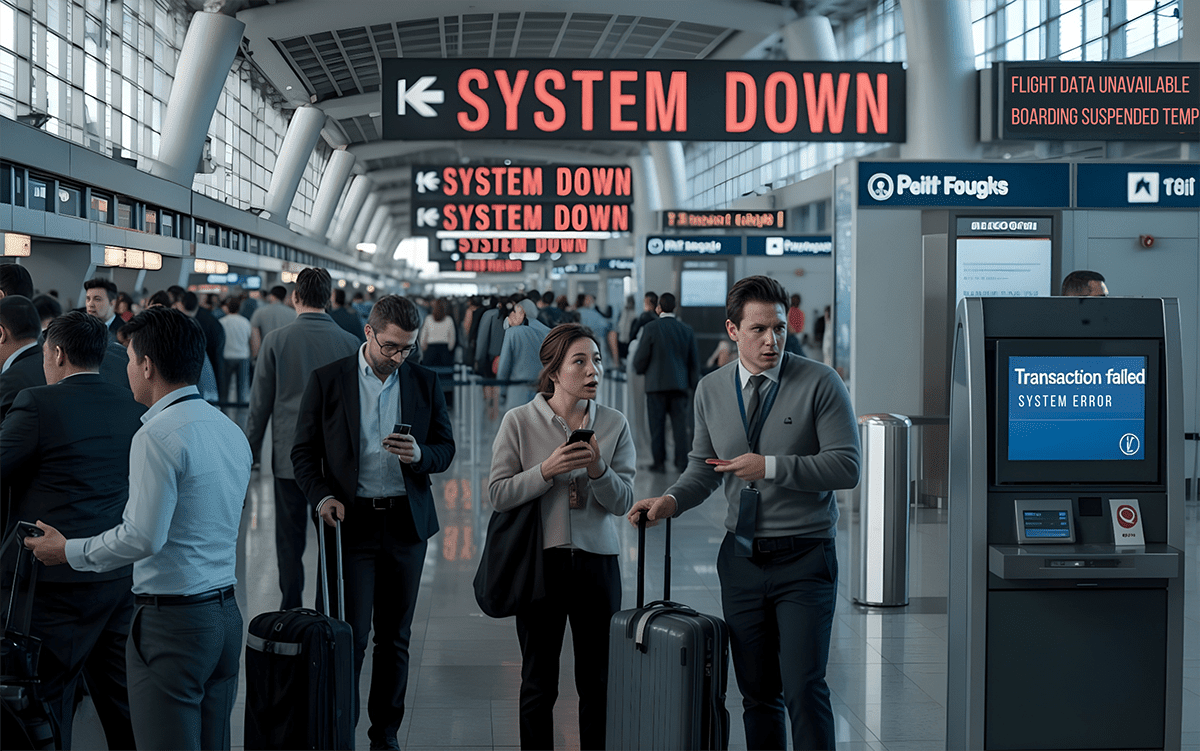
For decades, “Hello, World” has been the first line of code for any technologist, announcing that something new has come alive. It
marked the beginning of a code that would run on servers to produce useful results. But on a quiet October morning in 2025, the
world woke up to silence. The same digital chorus that once said “Hello” to humanity suddenly went offline.
The reason? A single AWS service glitch, caused by a minor DNS update that had gone wrong, rippled across continents.
Flights were grounded, payments froze, healthcare portals shut down, and even the most digital-first enterprises stood still. The
internet’s nervous system had crashed, delivering a sobering reminder: in a world built entirely on connectivity, one failure can
take everything offline — businesses, systems and even strategy itself.
What began as a technical outage evolved into a strategic cautionary tale, underscoring a truth every modern CXO must
confront: reliability is no longer merely an IT metric but a strategic necessity. This is where the idea of site reliability engineering
(SRE) comes in — built on reliability, resilience and constant improvement, it transcends technology. It offers a playbook for
leaders navigating a new reality where strategy and systems are inseparable.
1. Reliability: Strategic Uptime
In SRE, reliability is measured in “nines” of uptime — 99.9 per cent, 99.99 per cent, 99.999 per cent. In business, reliability
means consistently delivering on promises, regardless of turbulence.
CXOs can take a cue from SREs by defining clear strategic service-level objectives (SLOs): measurable goals for balancing
revenue growth, customer experience and innovation speed. When these goals are backed by real-time data dashboards and
automated monitoring, strategy stops being abstract and starts being accountable.
Reliability is not glamorous, but it builds trust. Just as users stay loyal to reliable systems, stakeholders stay loyal to reliable
leadership. Reliable strategies, like reliable systems, are built on precision and not just promises.
2. Resilience: Designing for Failure
SREs assume one thing with certainty: systems will fail. The goal is not to prevent every failure, but to recover quickly and learn
deeply.
When AWS faltered, organisations with built-in resilience — multi-cloud architectures, redundancy and solid disaster
recovery plans — bounced back faster. Their secret was not luck; it was engineering for recovery before the outage occurred.
For CXOs, resilience means stress-testing business models, diversifying dependencies and building teams that
respond, not react. It is about embedding flexibility in both operations and culture. It requires a strategic plan that
ensures systems behave gracefully and do not just crash.
3. Evolution: Continuous Learning as a Strategic Muscle
If reliability sustains and resilience protects, evolution propels. SREs thrive on continuous integration, experimentation and
incident post-mortems. Similarly, CXOs must embrace rolling strategies: living documents that adapt as markets shift and data
evolve.
The SRE concept of an “error budget” advocates for a realistic uptime target that is not 100 per cent, thereby encouraging
smart risks, tolerating short-term misses and creating space to invest in system upgrades. An evolutionary strategy is a true sign
of visionary leadership.
4. Observability: Seeing Strategy in Motion
A lesser-known SRE principle is observability — the ability to see inside complex systems and act before failures
escalate. For CXOs, observability translates into strategic visibility: building mechanisms to detect early warning signals
from customers, employees and operations.
During the AWS outage, many firms suffered twice: once from the downtime, and again from blindness — they could not
see the scope of the failure until it was too late. Strategy, like code, must be instrumented. Without visibility, leadership flies
blind.
5. The CXO as Chief Reliability Officer
In a digital-first world, the modern CXO is no longer just a strategist — they are the chief reliability officer. Their mission is to
balance innovation with stability, growth with preparedness, and vision with vigilance.
Strategic reliability is not about avoiding every disruption; it is about learning and adapting faster than others when it
happens. Like a resilient system, a resilient organisation does not collapse under stress — it self-heals.
Engineering Strategy for the Real World
The AWS outage was a headline-grabbing event, but its lesson runs deeper. It reminded leaders everywhere that fragility is
systemic — and that strategy, like software, must be engineered for uptime.
By applying SRE principles to leadership, CXOs can design strategies that are reliable in execution, resilient under pressure
and evolving with every insight.
Just as engineers keep servers online, today’s CXOs must keep strategy alive —reliable, resilient and ready for whatever comes
next.
What began as a technical outage evolved into a strategic cautionary tale — reminding leaders that in a world built on connectivity, one failure can take everything offline.
The goal is not to prevent every failure, but to recover quickly and learn deeply — engineering recovery before disruption occurs, not
scrambling after systems collapse.