


June, 2026
2 min Read
In Data We Trust Notes from the Church of Analytics
 29 Jun 2026
Corporations have never had more information — and have never been more reluctant to think. The dashboard has become the modern substitute for judgment
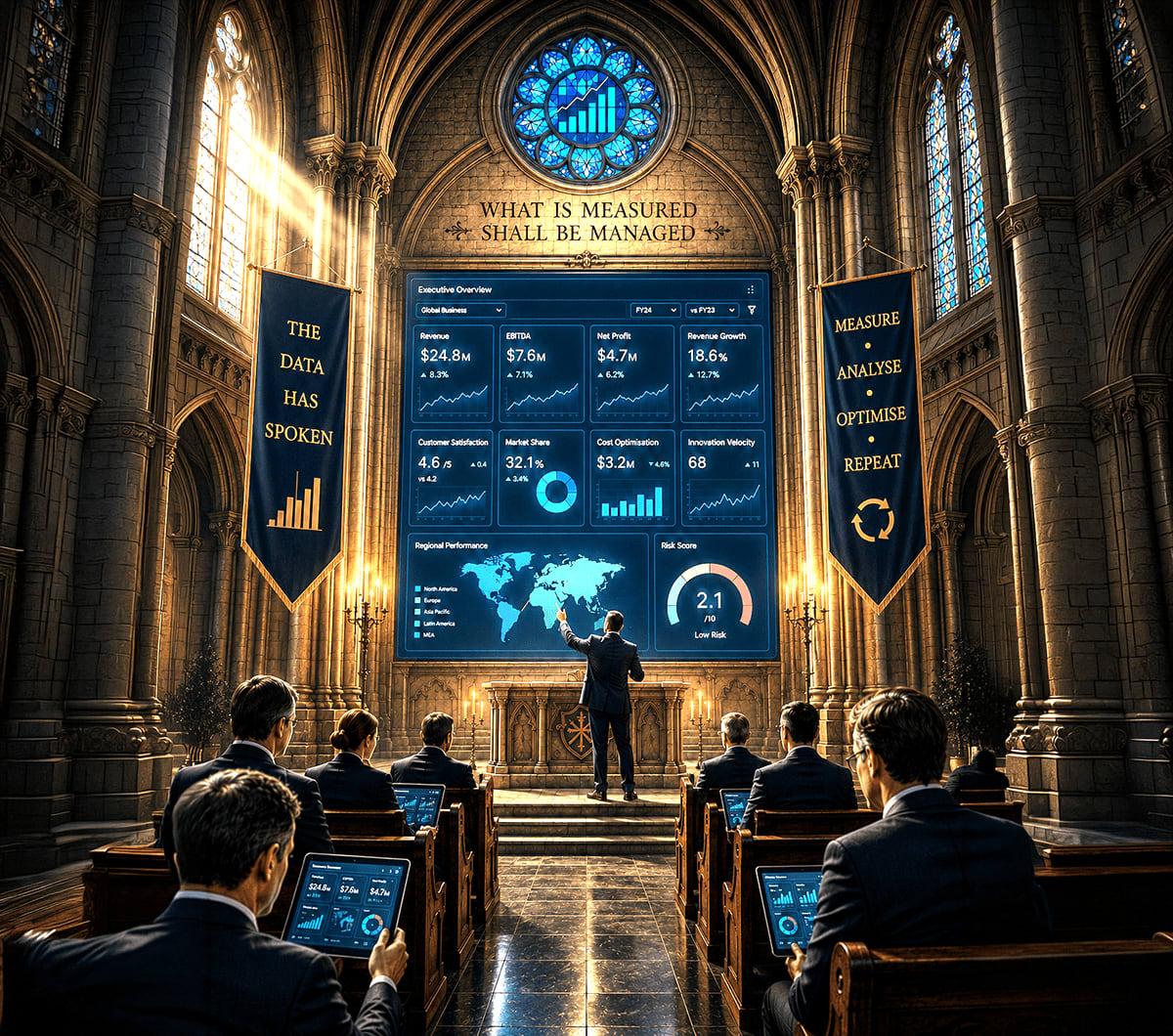
Every era has its gods. The ancients had rain gods. Medieval societies had kings who ruled by divine right. Modern corporations have dashboards.
The rituals are familiar.
On Monday mornings, executives gather around large screens displaying charts in soothing shades of blue and green. Someone points at an upward trend. Heads nod. Someone points at a downward trend. Brows furrow. An action item is created.
Nobody asks why the metric exists in the first place. That would be heresy.
The Gospel of the Dashboard
Welcome to the Church of Analytics, where all decisions are data-driven, all metrics are objective, and every organisational problem can be solved by adding one more dashboard. The faith is thriving. Its central doctrine is simple: if something can be measured, it can be managed. If it cannot be measured, it probably does not matter. And if it still matters despite being immeasurable, a consultant will soon invent a framework for it.
Need to measure happiness? Employee Engagement Index. Need to measure culture? Cultural Alignment Score. Need to measure innovation? Innovation Velocity Metric. Need to measure trust? Give us a quarter and a budget.
The modern corporation has become astonishingly skilled at converting complex human experiences into numbers and then acting surprised when the numbers fail to behave like humans.
Consider the employee engagement survey.
Once a year, organisations ask employees whether they feel valued, inspired, empowered, and aligned with the company’s vision. The results arrive in a beautifully designed report.
Engagement: 7.4. Trust in leadership: 6.8. Psychological safety: 8.1.
The numbers are discussed with great seriousness. Nobody mentions that reducing trust, anxiety, ambition, frustration, belonging, and identity into decimal points is roughly equivalent to describing a symphony as “moderately loud.” But the spreadsheet looks impressive. And spreadsheets, unlike people, do not argue.
This obsession with measurement rests on a curious assumption: that data is somehow objective. As if datasets descend from the heavens, untouched by human hands. In reality, every piece of data begins with a decision. Someone decides what to count, what to ignore, which questions to ask, and which questions would be inconvenient. Data is not discovered. It is manufactured.
A customer satisfaction score does not emerge naturally from the universe like gravity. It emerges because somebody designed a survey, selected a sample, wrote the questions, chose a scale, cleaned the responses, removed the outliers, and then declared the final number “insight.”
The process is less science than storytelling with spreadsheets. This does not mean data is useless. It means data is human. And humans are messy.
Data Is Not Discovered. It Is Made
That is what makes the contemporary worship of analytics so fascinating. At the precise moment organisations possess more information than at any point in history, they appear increasingly uncomfortable with uncertainty.
Executives no longer say, “We think.” They say, “The data suggests.”
A subtle shift.
One acknowledges judgment. The other transfers responsibility.
After all, if the decision fails, nobody made a mistake. The dashboard merely expressed its opinion. Perhaps this is why organisations keep building dashboards. Not because they provide answers. Because they provide reassurance. A dashboard is a security blanket for adults with MBAs. It creates the comforting illusion that complexity has been conquered. Yet some of the most important questions facing organisations stubbornly resist quantification.
The Questions No Algorithm Can Answer
How much trust exists within a team? How much courage exists within leadership? How much creativity is lost when employees become afraid of failure? How many brilliant ideas never emerge because the wrong metric is being optimised?
No algorithm can answer these questions with certainty. The problem is not technical. It is philosophical. The great management thinker of the future may not be the person with the most sophisticated predictive model. It may be the person willing to ask whether the model is solving the right problem at all.
This is where the mythology begins to crack.
Because the organisations that outperform are rarely those with the most data. Most large companies are already drowning in information. They have dashboards for their dashboards.
What separates exceptional organisations is something far less glamorous. They possess leaders capable of questioning assumptions. Leaders who understand that correlation is not causation. That metrics are proxies, not reality. That what matters most is often invisible. And that every dataset reflects a particular way of seeing the world.
The irony is almost poetic.
In our quest to become more data-driven, we may have accidentally become less thoughtful. We have mistaken measurement for understanding, reporting for reflection, and information for wisdom. The challenge for future managers is not learning how to collect more data. Machines are becoming quite good at that. The challenge is learning how to think when the data ends. Because eventually it always does. And when it does, there is no dashboard waiting on the other side. Only judgment.
The one thing modern organisations seem determined not to measure.