


September 2026
5 mins read
India's Manufacturing Push
 18 Oct 2026
India has a rare opportunity to capture the China Plus One shift, but unlocking manufacturing scale will require deep structural reforms, not just government subsidies.
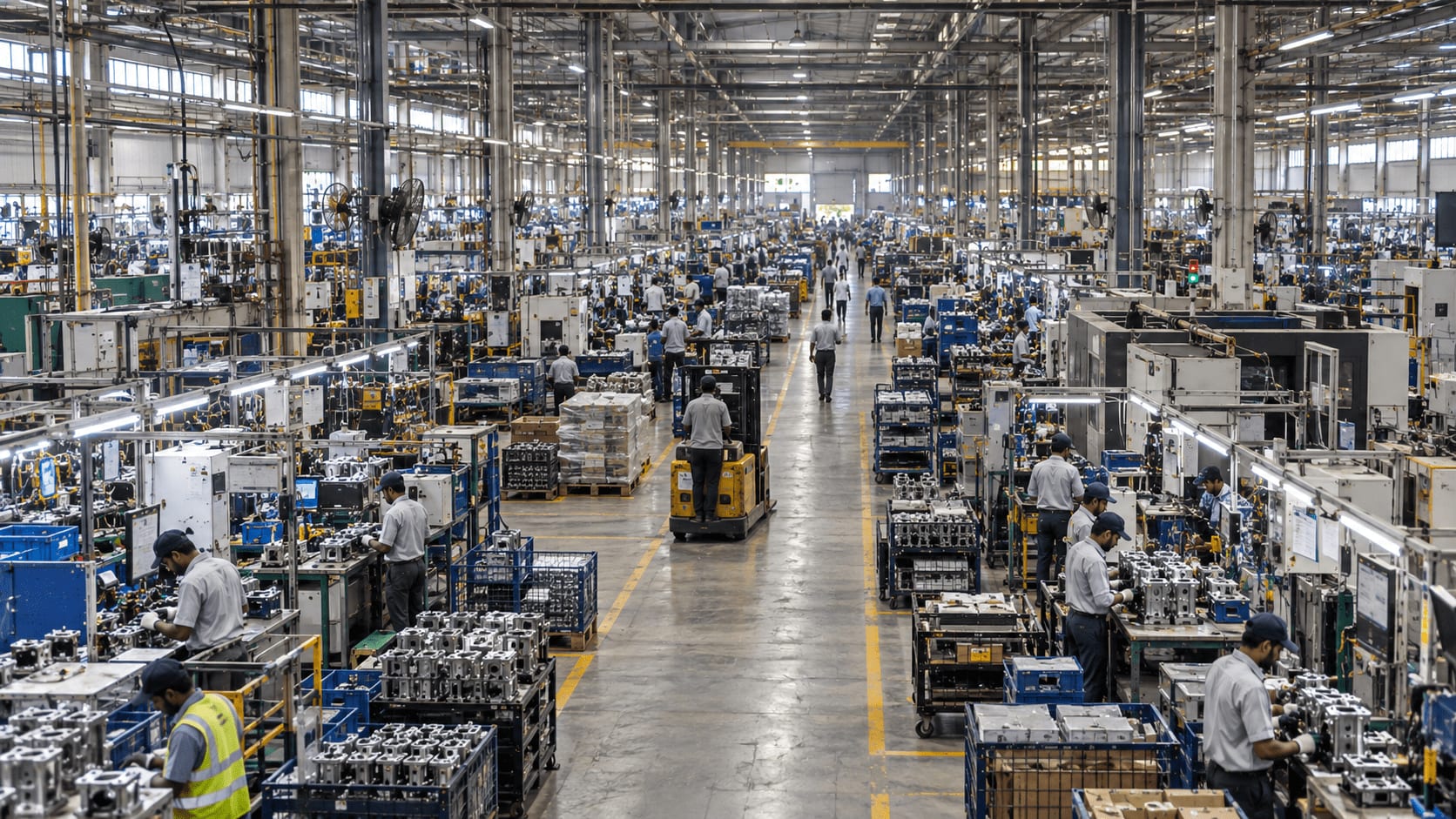
The Covid-19 pandemic and export controls have significantly shifted the focus from purely efficient supply chains towards supply chains with resilience, prompting a move towards diversifying manufacturing away from China, often referred to as “China Plus One” or friendshoring. The global imperative to diversify manufacturing bases has been met by India’s own proactive measures. The government has actively encouraged domestic production through significant financial incentives such as the $26 billion Production-Linked Incentive (PLI) schemes, electronic manufacturing clusters and a massive semiconductor push.
This strategy is clearly yielding results in some sectors. For example, Apple is rapidly scaling operations, and India now accounts for roughly a quarter of its global iPhone production (see Fig. 2). In absolute terms, Indian manufacturing generates over $400 billion in value. But a stubborn reality persists: the sector employs just 11 per cent of the workforce and, despite the influx of foreign capital and ambitious government policies, manufacturing’s share of GDP is stuck at 15 to 17 per cent (see Fig. 1), well short of the 25 per cent target envisioned under Make in India. We are inviting capital, but scale still eludes us.
We cannot afford to skip the industrial phase. While high-value services can be lucrative, they simply will not be able to absorb the 45 per cent of India’s workforce still dependent on agriculture. In fact, shifting millions of unskilled and semi-skilled workers into manufacturing jobs is essential to meeting the government’s ambitious target of doubling farmer incomes by moving excess labour out of disguised unemployment in the agricultural sector.
Beyond jobs, manufacturing also serves security and strategic autonomy purposes, such as in critical minerals and semiconductors. As External Affairs Minister S Jaishankar underscored, “Supply chains are no longer just about economic efficiency; they are national security imperatives.” We cannot be held hostage by foreign monopolies for essential goods such as APIs or semiconductors.
Opportunity vs Policy
India is uniquely positioned to execute large-scale manufacturing. Domestically, we offer a massive demographic dividend, low wages that provide a distinct labour-arbitrage advantage, and a vast internal market that allows scale. Globally, despite a volatile and often hostile geopolitical environment, the urgent need for supply-chain diversification and friendshoring has made China increasingly risky for export-oriented MNCs. This presents a critical, narrow window for an Indian labour-intensive manufacturing boom.
The policy response, however, misdiagnoses the problem. While some macroeconomists argue that we should lean into our comparative advantage in high-end services rather than make a forced attempt to achieve an industrial boom through state subsidies, NITI Aayog has positioned the PLI scheme as an important step towards boosting manufacturing in sunrise sectors.
The PLI scheme has successfully driven electronics exports, but it heavily subsidises capital-intensive, final-stage assembly. As former RBI Governor Raghuram Rajan cautions, we are “subsidising capital in a labour-abundant country”. We are not putting enough focus on labour-intensive sectors such as garments and footwear that built the East Asian economic miracles.
The Missing Ecosystem
Protectionism exacerbates this issue. As former NITI Aayog Vice-Chairman Arvind Panagariya points out, raising import tariffs on intermediate parts under the Atmanirbhar banner risks deglobalisation. We may also be ignoring a crucial geopolitical reality. Western economies will not repeat the mistake of the early globalisation era. They have no intention of allowing another single nation to achieve the monopolistic manufacturing dominance that China did.
Multinationals are actively seeking highly diversified supply chains spread across multiple friendly nations. Modern manufacturing requires frictionless, cross-border component flows to tackle this economic fragmentation. Taxing imported parts makes finished Indian goods more expensive and uncompetitive in global markets. It encourages companies to assemble products merely for the captive domestic market to harvest subsidies, rather than building genuine export engines.
Macroeconomic ambition is meaningless without proper ground-level execution. At the state level, factor markets, including land, labour and logistics, remain severe bottlenecks. Without these structural reforms, it is difficult for manufacturing to really take off. India suffers from a missing-middle problem: we lack the mid-sized, highly productive factories that drive global scale.
The Labour Constraint
Historically, stringent labour laws penalised scale, forcing entrepreneurs to deliberately stay small or operate as dwarfs to avoid the inspector raj. As economist Shruti Rajagopalan highlights, this regulatory cholesterol actively creates a system that protects smallness rather than protecting labour.
Furthermore, as former Chief Economic Advisor Arvind Subramanian has diagnosed, India suffers from a unique internal variant of the Dutch disease. Historically, rigid and artificially high public-sector salaries distorted the broader labour market. This raised economy-wide wage expectations without delivering a parallel increase in shop-floor productivity, making low-margin Indian manufacturing globally uncompetitive before it could even mature.
Making Scale Work
Add to this the skills deficit, a dismal female labour-force participation rate, and physical friction on the ground, such as bureaucratic red tape. There are other issues, including high industrial power costs due to cross-subsidisation, messy land acquisition and port delays, that hamper manufacturing scale. Subsidies cannot fix these structural frictions.
Indian manufacturing is growing in absolute terms, but the explosive growth of the services sector dwarfs the manufacturing GDP share. To increase the manufacturing GDP share, we must transition from mere low-value assembly to deep component manufacturing and indigenous value addition, and focus more on labour-intensive manufacturing.
Capturing the China Plus One shift requires more than just top-down capital subsidies. We must initiate a virtuous flywheel effect of value addition, where state-level factor reforms reduce the physical cost of doing business, which in turn attracts the scale needed to justify localised component ecosystems. Scale will only arrive when it is structurally cheaper and easier to produce in India, rather than simply when it is subsidised.
India’s manufacturing sector employs just 11 per cent of the workforce and, despite the influx of foreign capital and ambitious government policies, manufacturing’s share of GDP is stuck at 15 to 17 per cent
The PLI scheme has successfully driven electronics exports, but it heavily subsidises capital-intensive, final-stage assembly. We’re lacking focus on labour-intensive sectors