


November, 2025
3 mins read
Reclaiming the Human Mind: Thinking Freely in the Age of AI
 29 Nov 2025
We’re letting AI think, decide, and even validate for us. Each time we do, a little of our independent thought — and courage to err — fades away
“This is how it has always been done.”
We have been listening to this from elders and people in authoritative positions for ages. It speaks of a mindset constructed on familiarity, repetition, and confidence in established systems. While tradition can often provide stability, it sometimes creates barriers to innovation. Interestingly, as we step into 2025, the same saying is beginning to surround artificial intelligence. While AI is trumpeted as the engine of the future, many of us are already developing a “why change what works” dependency on it.
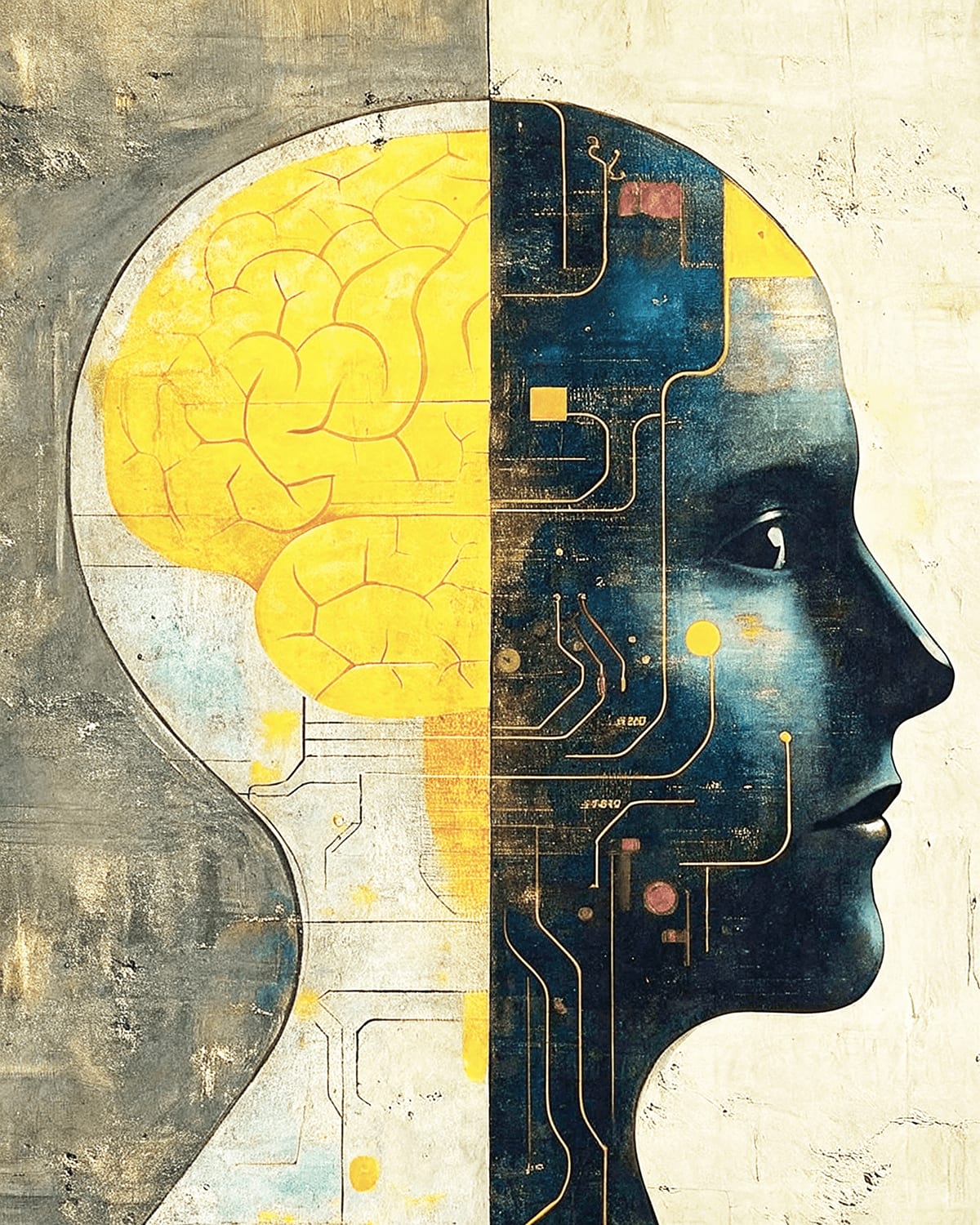
As management students, thinking strategically, challenging assumptions, and breaking new ground is something that we are consistently encouraged to do. AI literacy is undeniably essential today, not as a skill but as a survival tool in academia and industry. However, what concerns me is not the use of AI, but the subtle shift in our thinking that results from it. We are increasingly running our ideas, opinions — even creative sparks — through AI to validate if they are “correct.” What began as an assisting tool is quietly becoming the evaluator of our thought process.
The Cost of Convenience
At first, this shift can seem harmless. After all, AI provides fast, accurate, and well-structured answers. But learning — particularly in business education — has never been about arriving at a polished answer; it has always been about the chaotic, uncertain, iterative process that leads to insight. And when we outsource this journey, we risk outsourcing originality itself.
Innovation has always been linked with experimentation, and experimentation, by its very nature, involves error. Mistakes have never been incidental to progress; they’ve driven it.
Take the story of Wilson Greatbatch in 1956. Trained as an engineer, Greatbatch was building a heart rhythm recording device when he accidentally inserted the wrong resistor during the assembly process. The device, when powered, began to emit a repetitive pulse — an unusual glitch that immediately drew his attention. Rather than discarding the error and starting again, he examined it. What he found was nothing short of remarkable: the pulse produced by the “faulty” device resembled the rhythm required to regulate a human heartbeat. This accident led to the invention of the first implantable pacemaker, a device that has since saved millions of lives worldwide.
One mistake, one moment of curiosity rather than correction, and one refusal to discard the imperfect were enough to change medical science.
Today, our systems, classrooms, workplaces, and digital tools are set up to prevent mistakes. AI accelerates this further: it corrects grammar before the thought is fully formed, suggests conclusions before we grapple with complexity, and presents answers before we learn how to frame the right questions. The space for productive errors is shrinking — the kind of errors that lead to breakthrough thinking.
The result? We risk becoming efficient, informed, competent but intellectually timid.
Taking Back Control
So, what can be done?
The answer doesn’t lie in rejecting AI. It lies in reclaiming our agency in how we use it. We have to practice active experimentation, thereby playing with ideas without instantly testing them against the “ideal” AI standard. Brainstorming sessions need to be AI-free areas at the very outset. First, let the messiness of human reasoning rise to the surface before structured refinement is applied. Professors and student groups can encourage reflective assignments, idea journals, prototype thinking, and discussions where partial thoughts are welcomed, not judged.
Equally important is giving our minds real, uninterrupted cognitive time. Creativity does not bloom in acceleration; it grows in pause, reflection, and mental wandering. Whether through solo reading, unstructured discussions, or simply sitting with a problem before rushing to type it into a search bar, we must learn to tolerate uncertainty again.
AI works on the past, learning from patterns, repetitions, and established knowledge. The world we prepare for, though, is one full of problems to which answers do not exist yet. If we only learn to reproduce what already exists, we run the risk of building a future suspiciously like yesterday.
The challenge facing our generation is not to adapt to AI but to ensure that we are not limited by it. The future will not belong to those who use AI the fastest but to those who can think beyond what AI already knows.
What began as an assisting tool is quietly becoming the evaluator of our thought process — we’re outsourcing originality in the pursuit of validation
The future will belong not to those who use AI the fastest, but to those who can think beyond what AI already knows