


April, 2026
2 min Read
Rewriting Globalisation’s New Playbook
 29 Apr 2026
As geopolitics redraws trade routes, Indian firms are moving from cost players to strategic architects in a fragmented yet fiercely interconnected global economy
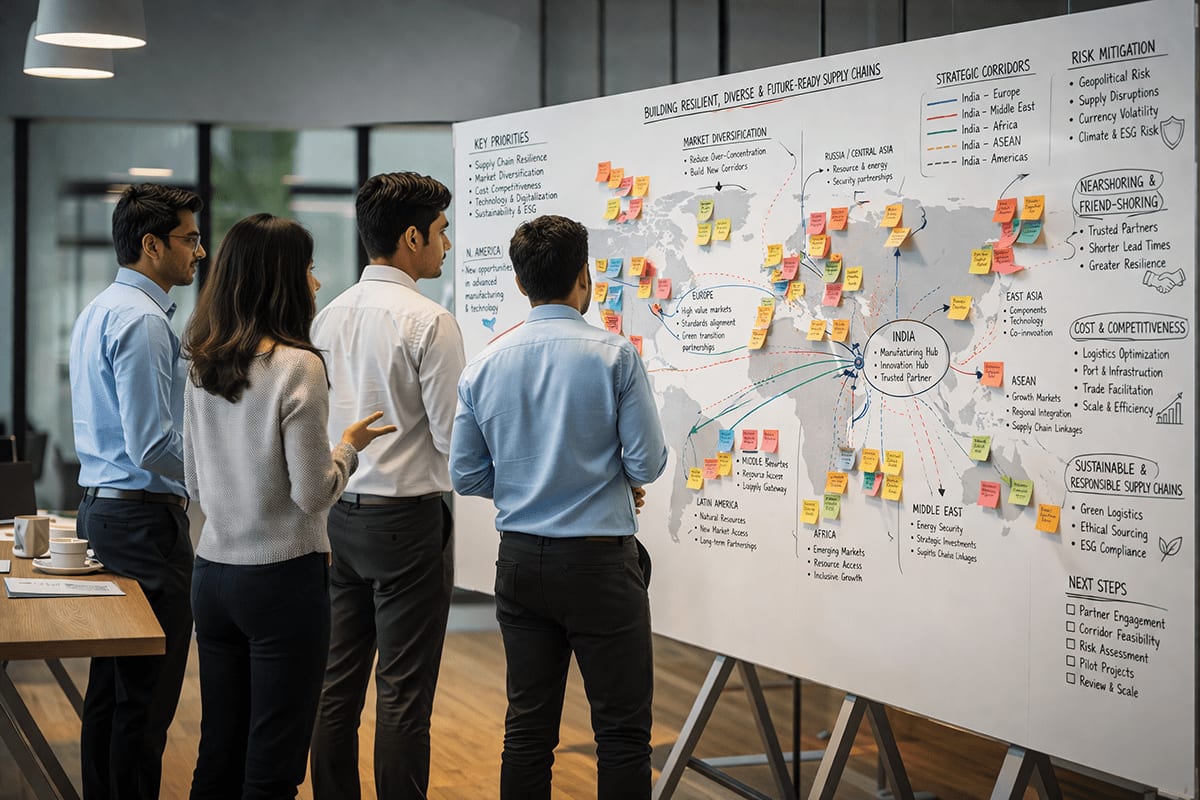
“The era of hyper-globalisation is over; what follows is a contest to reshape it.”
For decades, globalisation promised a world of frictionless trade, optimised supply chains, and borderless capital flows. Today, that promise stands redefined. The global economy is no longer organised purely around efficiency, but around resilience, political alignment, and strategic autonomy. As geopolitical tensions intensify and supply chains fragment, businesses are being forced to rethink not just where they operate, but how they compete. In this transition, Indian firms are emerging not as passive participants but as active architects of a new globalisation: one that is selective, strategic, and deeply shaped by geopolitics.
From Cost Arbitrage to
Strategic Alignment
The earlier logic of globalisation was straightforward: produce where costs are lowest and scale across borders. However, disruptions such as the Covid-19 pandemic exposed the fragility of hyper-optimised supply chains. Firms that once prioritised efficiency found themselves vulnerable to sudden shocks, prompting a fundamental shift in strategy. Concepts such as friend-shoring and near-shoring now dominate boardroom discussions, signalling a move toward politically aligned and geographically proximate production networks.
This change has created new strategic opportunities for Indian companies. India has become well known in industries like pharmaceuticals, electronics, and digital services because it is seen as a reasonably stable and reliable partner. The new geography of trade places a higher priority on dependability, regulatory compatibility, and geopolitical alignment than previous offshoring waves, where location choices were determined by cost effectiveness. By expanding their domestic capabilities, diversifying their supply chains, and integrating themselves into new trade corridors, Indian businesses are taking advantage of this shift. In doing so, they are contributing to the definition of the world’s boundaries rather than just adjusting to it.
Geopolitics at the Strategy Table
Geopolitics, once a distant concern for most corporations, has become a central determinant of business strategy. Events such as the Russia-Ukraine conflict have underscored how quickly political developments can disrupt markets, trigger sanctions, and reshape global flows of capital and goods. As a result, leading firms are increasingly integrating geopolitical intelligence into decision-making, treating it not as an external variable but as a core strategic input.
In this context, Indian businesses and other multinationals from emerging markets have proven especially adaptable. They bring a degree of flexibility that is becoming more and more important in a fragmented world because they are used to working in an environment of institutional uncertainty. Their tactics, which include diversifying markets, creating robust supply chains, and conforming to regulatory frameworks, demonstrate a balance between global ambition and local sensitivity. Significantly, their ascent calls into question the long-standing hegemony of Western multinational corporations, indicating a change in the global business environment.
This change also underscores a broader lesson: today’s competitive advantage lies not only in scale or cost but also in the ability to foresee and manage geopolitical complexity. Businesses that identified these changes early on, such as by investing in strategic alliances or lowering reliance on particular markets, have shown greater resilience. In a setting that is becoming more unpredictable, those who did not are now trying to catch up.
Globalisation Isn’t Retreating —
It’s Reconfiguring
A fundamental change from an efficiency-driven paradigm to one shaped by resilience, alignment, and strategic foresight is highlighted by the ongoing reconfiguration of globalisation. In this new order, geopolitics is an endogenous factor that is incorporated into business decision-making rather than an exogenous constraint. This shift offers Indian businesses a unique turning point: because of their capacity to manage institutional complexity, diversify risk, and adapt to changing trade architectures, they are becoming important participants in the next stage of global economic integration.
More broadly, the rise of friend-shoring, the centrality of geopolitical risk, and the growing prominence of emerging market multinationals collectively signal that globalisation is not retreating but transforming. The future will be defined not by the breadth of global presence but by the depth of strategic positioning within a fragmented yet interconnected system. In this context, firms that successfully integrate geopolitical intelligence with economic strategy will not only withstand uncertainty but actively shape the contours of the new global order.