


August 2026
5 mins read
Silence, Costed
 31 Aug 2026
In a world where geopolitics increasingly reaches the balance sheet, corporate neutrality is no longer silence. It is strategy — and it comes at a price.
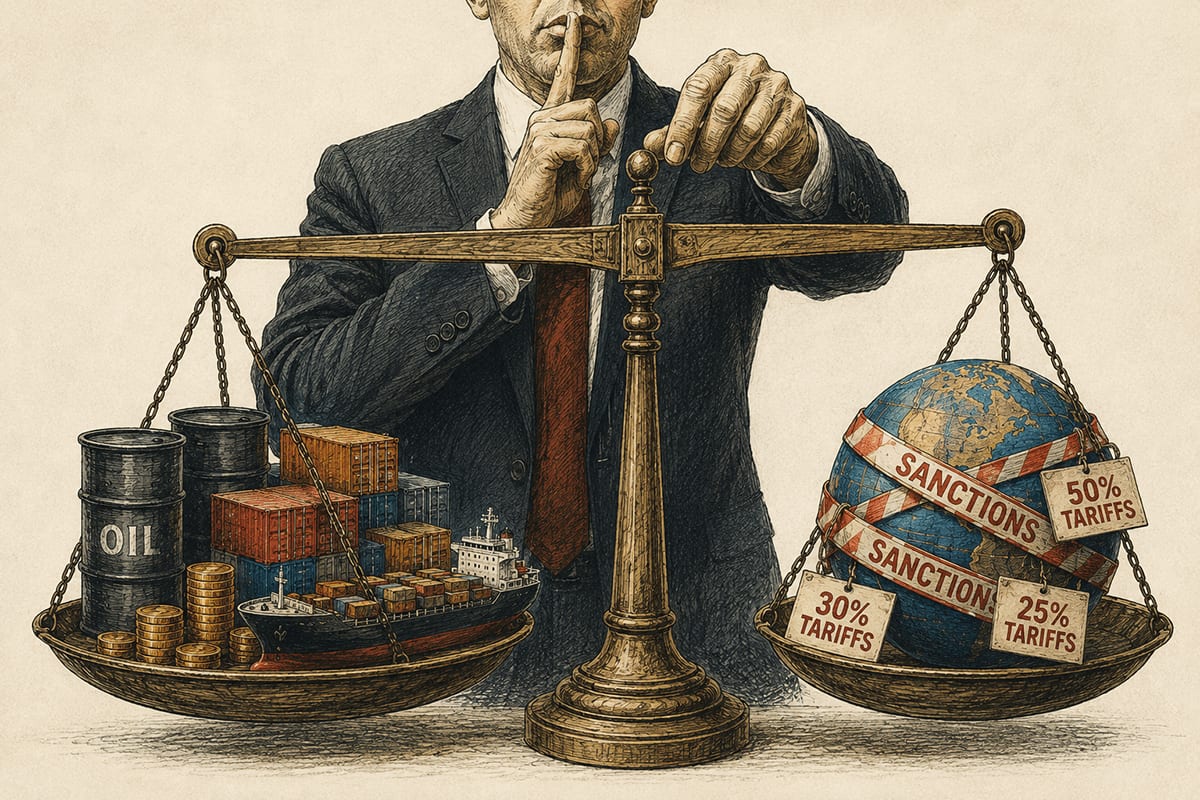
On November 20, 2025, Reliance Industries stopped feeding Russian crude into one half of its Jamnagar complex. Only one half. The export refinery in the SEZ went clean so its diesel could keep landing in Europe once the EU’s ban on fuels made from Russian oil kicked in on January 21, 2026. The older domestic unit next door carried on processing whatever showed up.
Same company. Same coastline. Two positions on the same war, separated by a fence.
That is what corporate neutrality actually looks like now. Not a shrug. Plumbing.
Neutrality by Design
We tend to read neutrality as an absence: the firm that didn’t post, didn’t sign the open letter. Sit inside the room where it gets decided and it looks like the opposite. Neutrality is one of the more expensive things a company manufactures. It has a design brief, a budget line and a team.
Nvidia has an invoice for it. To win export licences for its H20 chips in China, Nvidia and AMD agreed to hand the US government 15 per cent of the revenue from those sales. Trump announced it from a podium, including the detail that he had opened at 20 per cent and Jensen Huang talked him down. By December 2025, the model had been extended: 25 per cent on the more advanced H200s. Nvidia’s line throughout: it follows the rules Washington sets. That is the sound of a company paying, in basis points, for the right to stay useful to two governments that cannot stand each other.
The Cost of Saying Less
Sometimes the price isn’t cash. Sometimes it’s vocabulary. Put two years of American filings side by side and something odd falls out. The Conference Board found the acronym “DEI” appeared 68 per cent less often in S&P 500 filings in 2025 than in 2024; a separate count had usage at 34 per cent of the index, down from roughly 90 per cent. Easy to file that under retreat.
Except 78 per cent of those same companies still carried at least one diversity-related disclosure, and the share reporting board-level oversight of it went up, from 72 per cent to 79 per cent. The programmes didn’t leave. The sentences did.
Behavioural economics has a name for the machinery underneath, and it isn’t a kind one. In a 2007 paper in Economic Theory, Jason Dana, Roberto Weber and Jason Kuang ran dictator games in which players could find out, at no cost whatsoever, whether their choice was hurting the other person. A large share chose not to look. Given a free exit from knowing, generosity collapsed. Their reading was that people aren’t especially fair; they dislike appearing unfair, to others and to themselves. Take away the audience and the preference evaporates.
Companies run the industrial-scale version. The ambiguity is not a by-product of indecision. It is an asset. If nobody can prove which side you’re on, nobody can organise a boycott around it, and both capitals keep returning your calls.
The professionals have stopped pretending otherwise. USC Annenberg’s 2026 Global Communication Report found 41 per cent of PR professionals saying silence can sometimes be the most effective strategy; among in-house teams, 52 per cent. Support for companies speaking on issues unrelated to their business has fallen 38 per cent since the killing of George Floyd. The budget lines expected to grow over the next five years are government relations and crisis communication. Purpose, sustainability and inclusion spending is expected to shrink. Departments built to say things are being rebuilt to manage the consequences of having said things.
Silence Within
Two things are worth sitting with, given most of us are about to go and do this for a living.
First, neutrality is a luxury good. Reliance Industries could split its position because it owns two refineries. Nvidia could pay the toll because the margin swallows it. A mid-sized supplier gets the sanctions letter with none of the optionality. The appearance of not choosing scales with the balance sheet, which makes it a form of market power rather than a form of modesty.
Second, silence compounds inward. A company that stops saying what it stands for in public will, a few cycles later, struggle to say it to a room of new hires. HR inherits the hardest version of that problem: recruit on values you are no longer permitted to print, retain people who read the scrubbed filing and drew their own conclusions.
None of this is hypocrisy, exactly. A refinery is not a foreign ministry, and Reliance Industries was never elected to have a Ukraine policy. But somewhere between “we don’t comment on politics” and re-plumbing a refinery so the politics can’t reach you, a decision got made that will never have to be defended in public.
That’s the whole trick. The most consequential position most firms take this decade is one they will never announce.
Neutrality is one of the more expensive things a company manufactures. It has a design brief, a budget line and a team
The appearance of not choosing scales with the balance sheet, makes it a form of market power rather than a form of modesty
That is the sound of a company paying, in basis points, for the right to stay useful to two governments that cannot stand each other