


September 2026
5 mins read
The Country Nobody Wants to Buy
 18 Oct 2026
The world has stopped buying economies. India is the clearest case, and it is measuring the wrong thing.
Late in July, a written reply in the Rajya Sabha contained two numbers that seemed to belong to different countries.
Last year India received $95 billion in foreign direct investment, the most in its history. After foreign investors pulled money out and Indian firms invested abroad, $7 billion of it stayed. Three years ago, on a smaller haul, $28 billion stayed.
India is attracting more foreign capital than it ever has, and keeping less of it than at any point in a decade. That gap is not a contradiction. It is a price.
And it is not only India’s price. Warsaw, Monterrey, Hanoi, Johor: every economy courting capital fleeing China has noticed the same thing. The factories are real, the jobs are real, and none of it feels settled. Capital has stopped moving in. It visits, at scale, with its bags by the door.
The Comfortable Explanation
The official response is that this is what success looks like, and the argument is decent.
The Reserve Bank calls easy exit the mark of a mature market. Money that cannot leave is money that never arrives. And look at how it actually left. Hyundai raised billions listing its Indian arm, a company cashing in on a market finally deep enough to let it. Ford’s exit, meanwhile, had almost nothing to do with India; the same restructuring closed plants in Brazil.
Harvest and indifference, then. Not flight. Fair enough.
But the reassurance conceals something. A market that capital can leave easily and a market that capital only half-enters produce identical inflow figures. Both look like triumphs while the money is arriving. They separate later, on one variable: what it costs to go.
That is what commitment actually means. Not intent, not memoranda, not investment summits. Cost. A firm is committed to a country when leaving destroys something it cannot rebuild elsewhere: a supplier two hours away who has learned its tolerances, engineers who have solved this factory’s specific problems, a component base assembled over a decade.
The One Place We Can Measure It
There is exactly one place in India where this is visible, and it happens to be the country’s proudest industry.
India is now the world’s second-largest maker of phones. Watch one being finished here and you will see something impressive and slightly hollow: screens, batteries, chips and camera modules arriving in containers, and Indian hands putting them together. Of every 100 rupees of that phone’s value, somewhere between 18 and 20 is created in India. The rest was created before the box landed.
Final assembly is the most portable stage of any supply chain. That is its purpose. Assembly lines are built to move; component ecosystems are not.
Policymakers know this exactly. The next phase of India’s electronics scheme is expected to demand far higher local value, more than half, against an earlier ambition of a third. Read as industrial policy, that is a production target. Read honestly, it is an attempt to make leaving expensive.
Who Pays for the Right to Leave
Here is the part that should unsettle us.
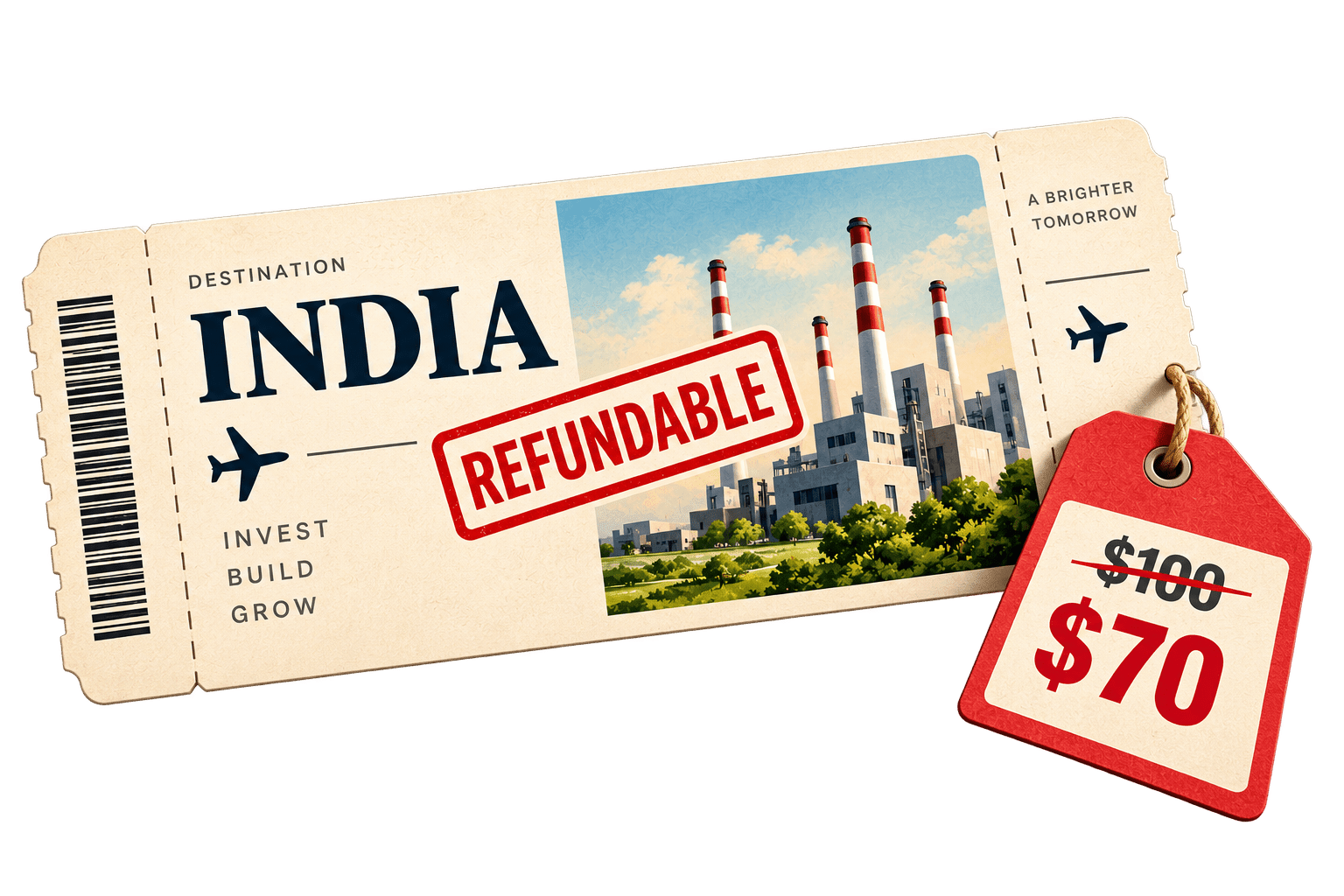
Anyone who has booked a flight knows that a refundable ticket costs more. The right to change your mind is a product, and the person who wants it pays extra to the person who gives it up. That is the oldest rule in finance and the most intuitive one.
Now look at what India is doing. It offers land, power, tax holidays and production subsidies to firms that retain the right to walk away in 18 months. India is selling the refundable ticket and discounting it. We are paying a premium for the privilege of being optional and reporting the arrivals as victory.
The symmetry is unkind. In the same period, Indian companies spent record sums buying businesses abroad, a third more than the year before. Indian capital is signing decade-long commitments in other countries while foreign capital keeps its Indian commitments short. Somebody in this arrangement is thinking in decades. It is not the visitors.
When the Option Expires
Every option has an expiry. This one is straightforward: the world came here because China became expensive and risky at the same moment. When that gap narrows, or when a cheaper, calmer alternative appears, the reason expires, and provisional presence resolves into a decision.
India is not failing. Record inflows are a genuine achievement, and they have given us a stronger negotiating position than we have held in years. But the scoreboard is wrong. We count capital attracted. The number that matters is how much of it has grown roots: components rather than assembly, research rather than back office, products designed here rather than merely packed here.
The question is not how much of the world showed up.
It is how much of it would find it painful to leave.
A market that capital can leave easily and a market that capital only half-enters produce identical inflow figures. Both look like triumphs while the money is arriving
India is selling the refundable ticket and discounting it