


December, 2025
3 mins read
The Green Prisoner’s Dilemma Why Boards Still Hold Back
 31 Dec 2025
The Green Prisoner’s Dilemma Why Boards Still Hold Back
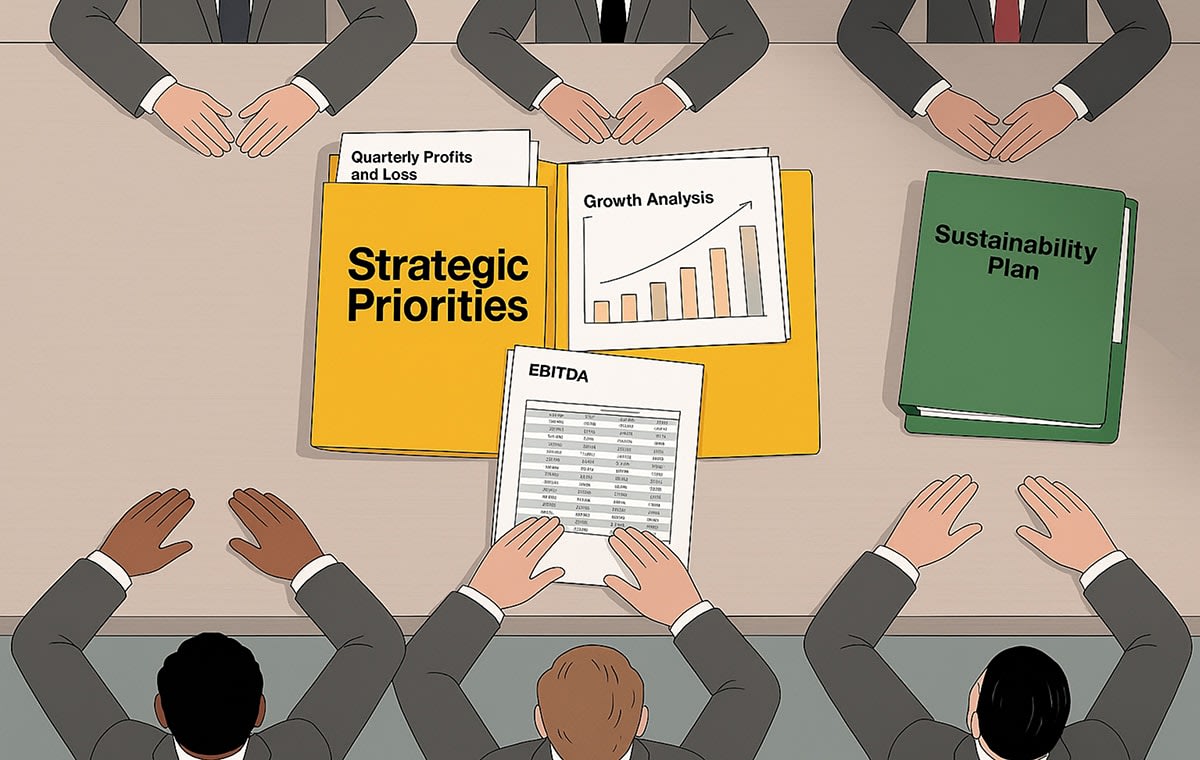
Sustainability is often seen as a moral requirement for companies, with the risks of climate change cited as the primary reason to act. Companies consistently announce ESG reports, make net-zero pledges, and cultivate a positive image through sustainable activities. Yet the reality behind these public commitments is slow and contradictory: the majority of corporate boards remain unwilling to invest substantially and for the long term in sustainability.
The reason is not corporate ignorance or indifference. It is a structural, strategic trap. Boards are under constant pressure from competition, short-term financial demands, shareholder expectations and quarterly evaluations. This creates a ‘green prisoner’s dilemma,’ in which sustainability is seen as a high-risk move for an individual company but a collective benefit for all. Put bluntly: if no one else acts, each company’s short-term optimal decision is to stand still — even though, ultimately, all will lose.
Short-Term Gain vs Long-Term Benefit
Today, corporate boards face a classic prisoner’s dilemma:
Cooperate: Commit to sustainability and decarbonisation.
Defect: Postpone investments and concentrate on immediate profits.
This predicament can be represented in a simple payoff matrix:
| Competitor does not invest | Competitor invests | |
| Board does not invest | Short-term gain, status quo | Short-term loss, competitor advantage |
| Board invests | Long-term loss, alone in cost | Win–Win: Long-term gain, shared progress |
If neither company invests, both enjoy short-term profits but delay the shift to sustainable models. If only one invests, it faces higher costs with no competitive advantage. Only when all companies invest together can the industry gain long-term resilience, regulatory readiness and shared sustainable growth.
Why Moral Appeals Fail in Governance
Boards are not indifferent to climate change. The core issue is that governance frameworks and financial rewards are oriented towards short-term achievements, thereby neglecting the planet’s long-term health.
Three factors trap boards in this predicament:
Quarterly capital markets: Shareholders reward companies that maximise short-term profits and often penalise those that incur sustainability costs whose benefits will emerge years later.
Executive incentives are misaligned: Sustainability-linked metrics are seldom included in bonus calculations, KPIs or compensation structures. A CEO who cuts sustainability spending often appears operationally more efficient than one who invests in it.
Free-rider advantage: A company that delays action avoids early costs while benefiting from progress made by others. The system indirectly rewards inactivity.
A Governance Shift to Sustainability
The way out of the green prisoner’s dilemma is not moral appeal, but changing incentives so that sustainability becomes the rational strategy for every board — regardless of what rivals do.
Industry-wide carbon credit disclosure: Mandatory common carbon reporting makes it impossible to conceal emissions, rendering the full carbon cost visible. The competitive advantage of non-investment shrinks or disappears.
Monitoring of each other by competitors: Sectors such as apparel, chemicals and automotive are increasingly forming inter-firm sustainability alliances. These alliances:
Reduce uncertainty
Ensure shared accountability
Incrementally share best practices among members
This “coopetition” model guides the whole industry toward coordinated action.
Regulatory self-monitoring: Trade groups can require sustainability practices that exceed legal minimums, with regulators enforcing them evenly. Common rules remove the fear of unilateral disadvantage.
Shared investment and risk pools: Joint sustainability funds or shared R&D pools lower costs for each firm and accelerate innovation.
Net Zero and the Urgency for Change
Net Zero is a challenge that requires concerted action — something current governance structures obstruct. By realigning rewards and penalties, boards can come to see sustainability as a matter of corporate survival, not just philanthropy.
Sustainability is not simply a question of morality but a strategic blockage embedded in governance. Once this is recognised, and boards’ incentives are redesigned so that sustainable decisions become the only rational and unavoidable choice, we can unlock the long-term benefits essential for both corporate success and the planet’s health.