


August 2026
5 mins read
THE INDIA OPPORTUNITY No One Knows How to Price
 31 Aug 2026
India offers extraordinary scale, but no single consumer, price point or market. Its complexity is not a barrier to growth; it is the opportunity itself.
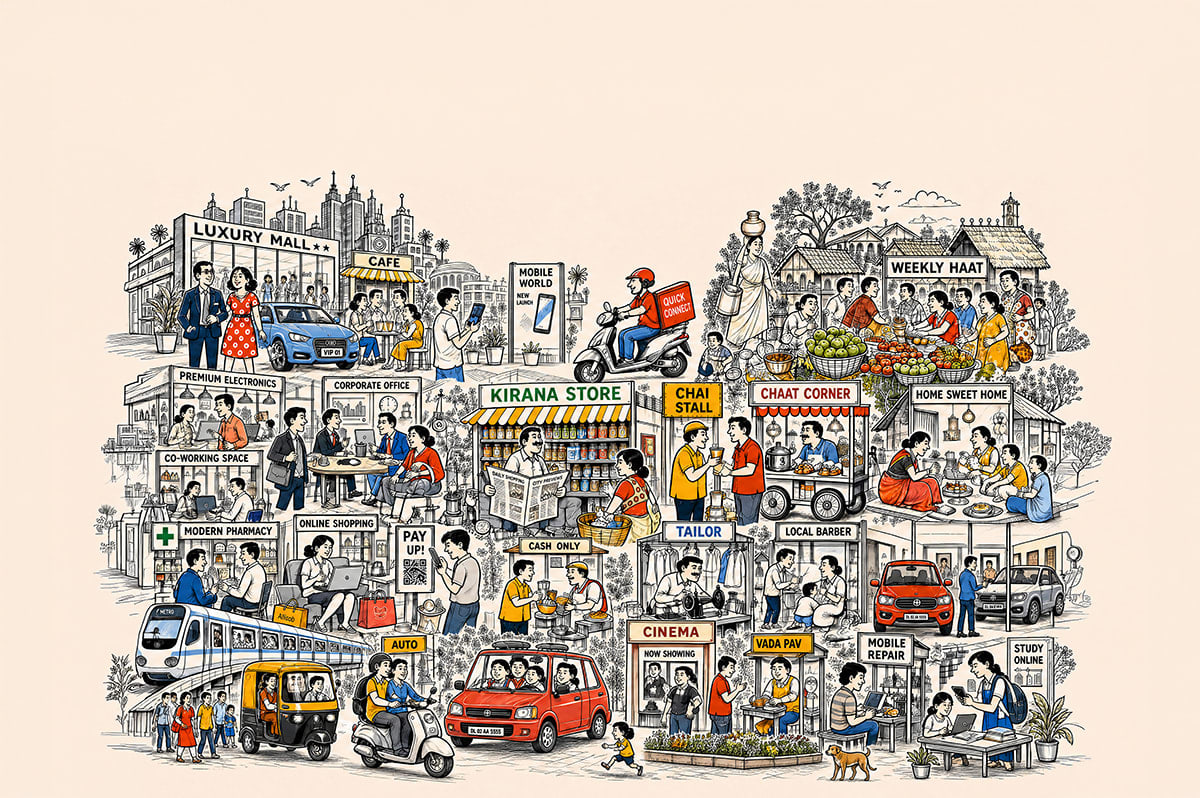
Ford spent two decades in India and topped out at under 100,000 units a year — a month’s work for a local rival. Tesla arrived 15 years later and made a version of the same mistake, pricing the Model Y as if India were just another export market instead of a place with its own logic. Roughly 600 orders came in against a 2,500-unit quota. The lesson repeats because it’s easy to underestimate: India isn’t one market with one price point. It’s dozens of markets layered under a single flag, and the number that describes all of them at once doesn’t exist.
The macro story makes that easy to forget. A $4.15 trillion economy heading towards $7.3 trillion by 2030, a consumer economy nearing $1.9 trillion, a middle class set to reach 715 million people — the kind of figures used to justify entry. But they describe scale, not shape. Per-capita output in Sikkim runs more than 10 times Bihar’s. McDonald’s sells no beef or pork anywhere in the country and still runs a different menu in the north than the south, because “burger” isn’t a fixed idea here — it’s a regional one.
Convenience Changes the Price Equation
What’s changing now, though, is a layer the old playbook didn’t have to account for: convenience itself has become something people will pay up for. India built its consumer habits on caution — save first, spend what’s left. That instinct hasn’t disappeared, but it’s no longer the whole story. Quick commerce is scaling from roughly $5 billion to $35-40 billion, not because groceries got more essential, but because a growing number of people have decided their time is worth the delivery fee.
Premium electronics tell the same story from a different angle — flagship phones selling out at launch pricing that would have seemed absurd to the same household a decade ago. This isn’t a market becoming uniformly richer; the appetite for ease and status is growing faster than the ability to pay for it is spreading evenly, stacking on top of the fragmentation already there instead of smoothing it out. The value-conscious buyer and the convenience-premium buyer aren’t different generations replacing each other — they’re often the same household, switching modes by category.
Premiumisation Has a Reverse Gear
The car market shows how fast that split can flip on itself. For years, entry-level hatchbacks lost ground to the SUV-and-premium wave described above — the Alto and S-Presso shedding share as buyers stretched for compact SUVs, in what the industry treated as a permanent shift. Then a late-2025 cut to India’s goods and services tax (GST) dropped prices on those small cars by roughly a quarter, and the segment reversed: Maruti’s mini-car dispatches jumped close to 92 per cent in a single month, and Alto sales were still surging months later. Structural premiumisation turned out to be a price-sensitivity story with a policy lever attached — proof that convenience spending isn’t replacing the value-conscious buyer so much as running alongside them, and that the line between the two can move overnight.
None of that settles into one stable figure: a rupee down roughly a quarter against the dollar since 2021, a data law carrying nine-figure penalties per violation, an informal economy estimated anywhere from a fifth to 45 per cent of GDP — none of it pauses for the market sprinting ahead of it. States compete for the same opportunity from the other direction: Gujarat’s semiconductor subsidies, Tamil Nadu and Uttar Pradesh layering their own incentives on top of Delhi’s. Building in India means pricing a dozen competing sub-jurisdictions before pricing the product.
Adaptation Beats Standardisation
The companies that work here don’t resolve that complexity — they build for it. Hindustan Unilever runs premium and value strategies simultaneously rather than picking one, and holds a top-two position in nine of twelve categories as a result. Unicharm sold diapers one at a time because that’s how Indian households actually manage cash, not because it was the efficient global format. Bain’s LEAP framework — lead in one category, expand deliberately, adapt regionally, perform through local infrastructure — is just a formal name for the same instinct: stop looking for the number that holds still, and start building the muscle to keep revising it.
The most recent data captures that tension. Foreign direct investment (FDI) into India rose 23 per cent year-on-year at the same time urban consumer confidence hit a multi-year low, and quick commerce and premium electronics kept selling out regardless. Investors, cautious shoppers and convenience-chasing shoppers are describing the same economy from different rooms — and India isn’t waiting for them to agree. The gap between them isn’t a problem to close. It’s where the growth is actually coming from, and the opportunity belongs to whoever stays willing to keep re-measuring it rather than pricing it once and walking away.
India isn’t one market with one price point. It’s dozens of markets layered under a single flag
The value-conscious buyer and the convenience-premium buyer aren’t different generations replacing each other — they’re often the same household