


June 2026
2 min
The Organisation Nobody Draws
 27 Jun 2026
Every organisation runs two systems: the one leaders design, and the one employees actually live in. Only one of them tells the truth.
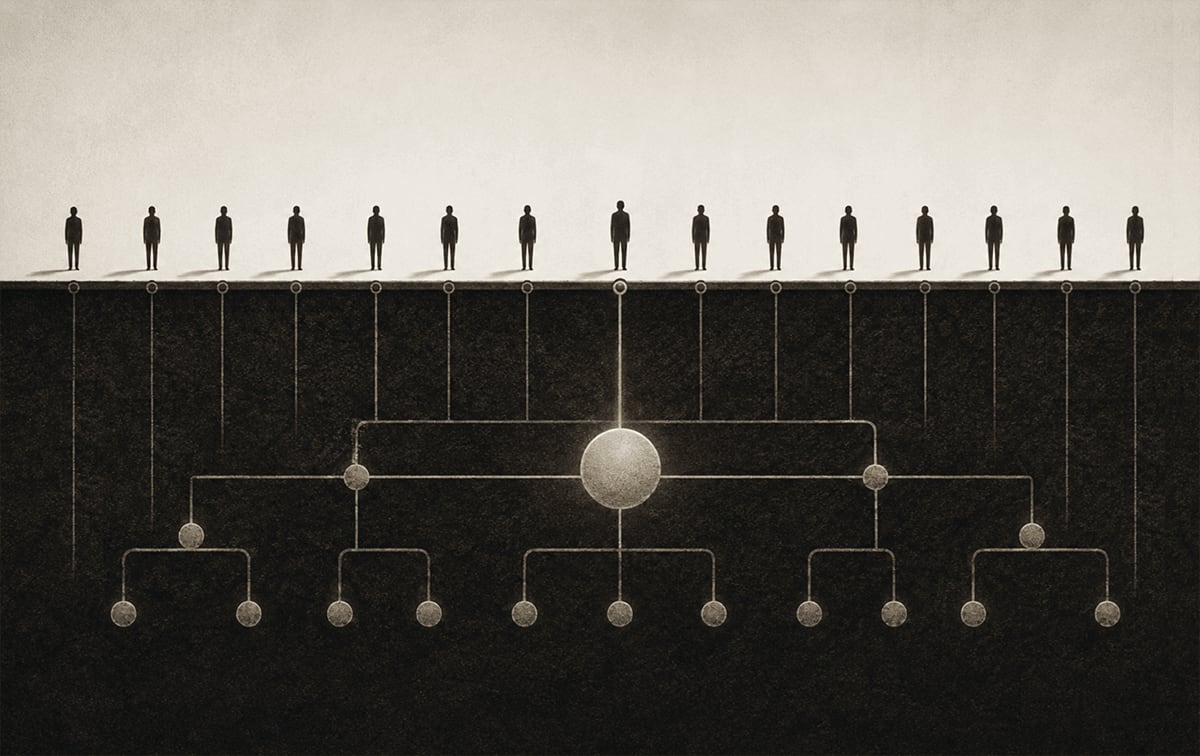
The quarter had closed well. Targets exceeded. Recognition emails sent. From every formal vantage point, this was a high-performing team doing exactly what organisations hope for. But when you walked up to their desks, something was off. Conversations were clipped. A few people switched tabs as someone approached. Work was done, but no one seemed to care. Two people were already quietly interviewing elsewhere.
The results were strong. The system was not.
Most leaders believe the organisation they manage is the one visible on the org chart: reporting lines, decision rights, policies, processes. If the design is right, the thinking goes, execution follows. But that model describes the organisation as it was intended, not as it is lived. There is always a second organisation running in parallel. It has no diagram. It does not appear in board decks. But it is where most of the real work, and most of the real friction, actually happens.
The Invisible Hierarchy
Consider the flat organisation, one of the more durable myths of modern management. The premise is genuine: fewer layers, more openness, faster decisions. In practice, power does not disappear when hierarchy is removed. It goes underground. Influence tends to flow to those with seniority, confidence, or physical proximity to leadership. Decisions still get made by a small number of voices, without the formal accountability that hierarchy, for all its faults, provides.
In a formal structure, you know where decisions sit. In an informal one, you are expected to speak freely, but you learn quickly which opinions actually move things. That gap between invitation and reality is where psychological safety quietly dies.
The more corrosive dynamic is how organisations teach people to behave without ever saying it out loud. It happens through accumulated small signals: the suggestion that gets politely ignored, the concern that generates visible friction, the moment where speaking up costs more than staying quiet. None of these is a policy. None are intentional. But they are instructions, and people are very good at reading them. Over time, the organisation no longer needs to enforce its unwritten rules. Its employees internalise and enforce them on its behalf.
Managers sit at the centre of this distortion. Organisations tend to assume that information flows cleanly between levels; it does not. Managers do not simply relay messages up and down the hierarchy. They interpret, edit, soften, and sometimes suppress. They protect their teams, protect themselves, or do both at once. The result is that leadership and employees are often operating on genuinely different versions of the same reality. Leadership believes things are functioning. Employees believe leadership is indifferent. Both are working with incomplete information, and neither knows it.
Performance measurement accelerates the problem. When organisations cannot measure outcomes with confidence, they fall back on measuring activity: time logged, tasks completed, and desk presence. When activity becomes the metric, people optimise for activity. Work that requires thinking, reflection, or careful judgment becomes difficult to justify because it produces nothing immediately visible. Efficiency gets penalised with more tasks. Long hours get celebrated as commitment, regardless of what those hours actually produce.
The most capable people figure this out fastest and draw the most rational conclusion: deliver what is required and invest nothing more.
What Gets Measured, What Gets Lost
High performance and low trust can coexist, but not indefinitely. For a while, results hold. Targets are met. The dashboards look fine. But beneath the surface, something essential is eroding. The people who built those results stop offering ideas. They stop challenging assumptions. They stop caring whether the organisation succeeds beyond the narrow scope of their own deliverables. And then, when a better opportunity arrives, they leave. Not with anger. Often without even articulating why.
The challenge for leaders is not structural. Better processes and cleaner org charts do not fix this. The harder task is developing the diagnostic instinct to notice what the formal system cannot show: the meetings where no one disagrees, the feedback surveys that are consistently positive yet somehow unconvincing, the high performer who has quietly stopped contributing beyond the minimum. These are not edge cases. They are signals from the second organisation — the one that never appears on paper but determines, more than any strategy or initiative, whether a company sustains its performance or merely appears to.
Most leaders are skilled at reading the organisation they designed. The rarer skill is learning to read the one that actually exists.