


March, 2025
10min read
Two Roads to Innovation Toyota’s Precision vs Netflix’s Disruption
 06 Mar 2025
Innovation takes many forms — Netflix thrives on bold disruption, while Toyota masters precision through steady improvements. Explore how their distinct strategies drive long-term success Innovation takes many forms — Netflix thrives on bold disruption, while Toyota masters precision through steady improvements. Explore how their distinct strategies drive long-term success
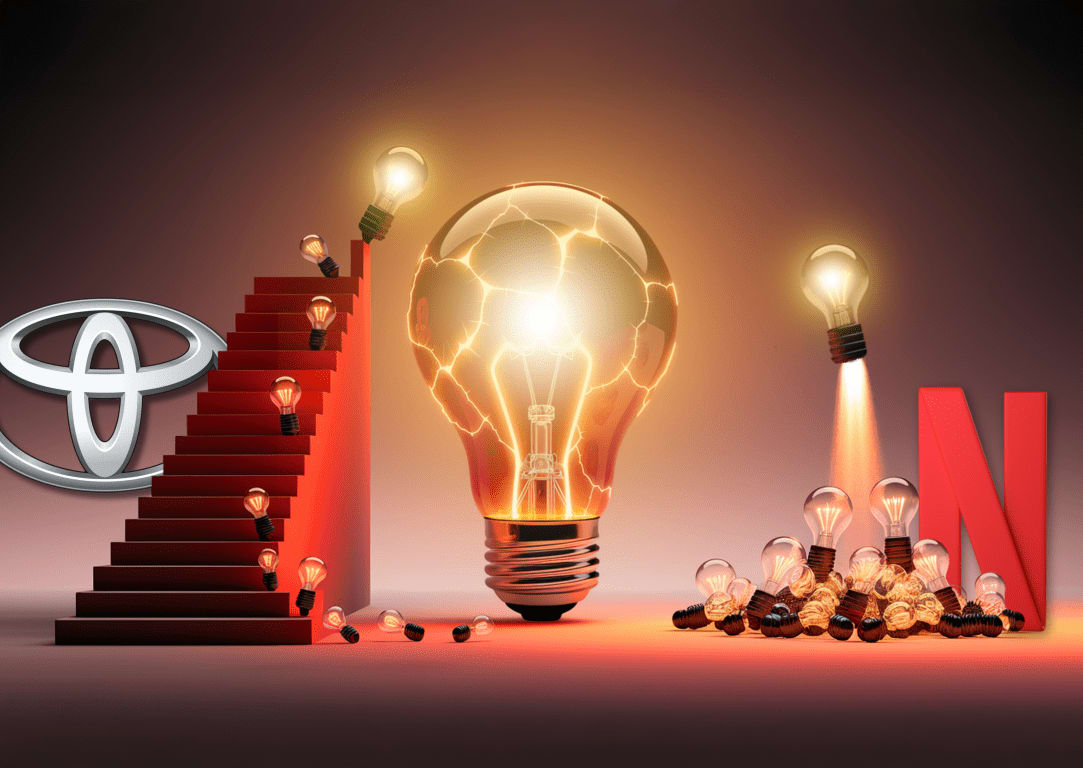
In an era of increasing competition and rapidly developing technologies, innovation remains the key to organisational longevity and survival. The challenge lies in creating an organisational culture that pushes employees towards innovation. There is no one-size-fits-all approach; it varies significantly according to industry requirements. The strategies adopted by Netflix and Toyota to drive innovation have been analysed. Both companies are renowned for their groundbreaking approaches, yet their strategies differ significantly. Netflix, a leader in entertainment and technology, thrives on disruptive creativity, while Toyota, the automotive manufacturing titan, excels through meticulous incremental improvements. This contrast reflects their industries, core philosophies, and organisational DNA. By examining their values, behaviours, and outcomes, we uncover how these companies master innovation in entirely different ways.
Core Values: Foundations of Innovation
At the core of every company’s mission is a unique set of core values. Netflix’s culture is built on judgment, curiosity, courage, and innovation, promoting an environment where employees are challenged to defy conventions and experiment. Passions and selflessness highlight its emphasis on collective success rather than individual praise. By comparison, Toyota’s philosophy is built around respect for people, continuous improvement (Kaizen), and Genchi Genbutsu (going to the source to address problems). Its focus on teamwork and stability demonstrates a commitment to precision and long-term development.
These values are key to the survival of both companies. Netflix competes in the tech and entertainment industry, which is highly volatile and demands agility in a world of rapidly shifting consumer preferences. On the other hand, Toyota navigates the high-stakes manufacturing world, where a single defect can compromise safety and reputation.
Overlapping Values, Different Expressions
Despite their differences, Netflix and Toyota share common ground in three areas:
Teamwork vs Selflessness: Both prioritise collective achievement. At Netflix, selflessness means employees share ideas freely, even if it means another team gets the credit. Toyota’s teamwork is more structured — for example, assembly line workers collaboratively pull the Andon cord (a pull cord or button that signals a quality or process problem in manufacturing) to halt production if a defect is spotted. While Netflix relies on autonomy, Toyota depends on coordinated action.
Curiosity vs Kaizen: Netflix’s curiosity drives bold experiments, like its pivot from DVDs to streaming. Toyota’s Kaizen encourages small, incremental changes — such as a worker tweaking a tool’s placement to save seconds per task. Both value improvement, but Netflix seeks leaps, while Toyota focuses on steps.
Impact vs Genchi Genbutsu: Netflix measures success by viewer engagement and market disruption. Toyota’s Genchi Genbutsu ensures problems are solved through hands-on observation — engineers visit factories to diagnose issues firsthand. Both value results, but Toyota’s approach is rooted in physical processes, while Netflix’s is digital and creative.
Divergent Paths: Freedom vs Process
The starkest contrasts emerge in how each company balances innovation with control:
Freedom vs Standardisation
Netflix’s “Freedom and Responsibility” model grants employees autonomy to make decisions without layers of approval. This fosters quick pivots, such as investing $100 million in House of Cards without pilot testing. Toyota, however, relies on rigid protocols like the Toyota Production System (TPS), which standardises workflows to minimise errors. Flexibility here is methodical, not radical.
Performance vs Longevity
Netflix famously cuts underperformers to maintain a “high-performance culture.” Toyota, valuing loyalty, invests in lifelong employee development. This reflects their industries: tech’s rapid turnover versus manufacturing’s need for seasoned expertise.
Disruption vs Incrementalism
Netflix’s innovation is revolutionary — it killed its profitable DVD business to bet on streaming. Toyota’s innovations are evolutionary, such as refining hybrid technology over decades to perfect the Prius.
Why These Differences Matter
The divergence stems from three factors:
Industry demands: Tech and entertainment reward speed and novelty; manufacturing prioritises safety and reliability. Netflix’s algorithms must adapt weekly, while Toyota’s factories cannot afford unvetted changes.
Cultural philosophies: Netflix’s mantra, “Don’t seek to please your boss,” empowers individuals. Toyota’s respect for hierarchy ensures decisions align with decades of institutional wisdom.
Risk tolerance: Netflix embraces “failing fast” (for instance, cancelling shows quickly). Toyota mitigates risk through testing — a new car part may undergo 1,000 iterations before approval.
Different Paths, Shared Success
Netflix and Toyota demonstrate how innovation can flourish in opposite environments. Netflix leads by open systems (disruptive innovation) and human relations (freedom), while Toyota excels in internal processes (standardisation) and rational goals (efficiency). Both, however, show that there is no one way to achieve success. Startups can mimic the nimbleness of Netflix, while established companies can adopt the rigour of Toyota. Ultimately, their stories serve as reminders that innovation is not about the method but the convergence of values, culture, and context. In a world where everything is changing constantly, adaptability, whether by revolution or evolution, is the real hallmark of endurance.
Netflix’s culture is built on judgment, curiosity, courage, and innovation — an environment where employees are challenged to defy conventions and experiment
Toyota’s philosophy is built around respect for people, continuous improvement (Kaizen), and Genchi Genbutsu (going to the source to address problems)