


April, 2025
3min read
Versatility vs Specialisation: A Millenial’s Dilemma
 27 Apr 2025
As automation reshapes industries, millennials face a crucial career choice — embrace versatility for adaptability or specialise for expertise. Which path ensures long-term success?.
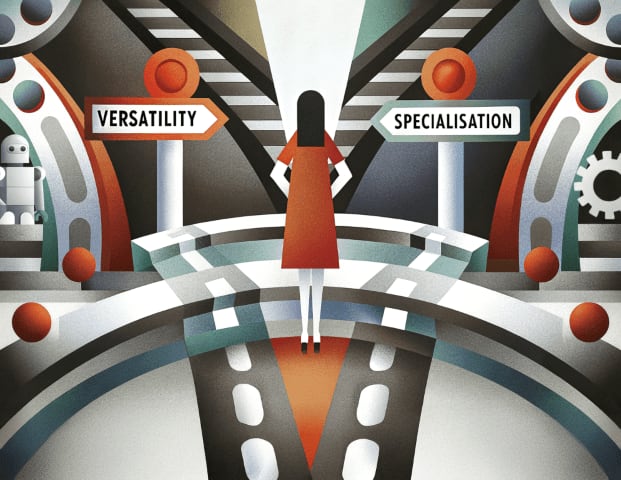
The rapid evolution of automation technologies has become one of the most transformative forces shaping modern workforces. As organisations increasingly integrate automation, artificial intelligence, robotics, and machine learning into their business arenas, workers face a significant question: whether to focus on professional flexibility or to specialise and sharpen skills in a narrow field.
Automation is not new, but recent advancements have significantly broadened its reach. From industrial control systems to the recent AI-driven self-check-in kiosks and data analysis, automation has continued to reshape rapidly how tasks are performed across industries. A 2020 study by the McKinsey Global Institute estimated that by 2030, about 14 per cent of the global workforce may need to change occupational categories due to automation.
Additionally, McKinsey, in its article Skill Shift: Automation and the Future of the Workforce, mentions that “a well-trained workforce equipped with the skills required to adopt automation and AI technologies will ensure that our economies enjoy strengthened productivity growth and that the talents of all workers are harnessed. Failure to address the demands of shifting skills could exacerbate social tensions and lead to rising skill-and-wage bifurcation.”
This change poses a crucial question for both employers and employees: in a world where machines can complete numerous jobs more quickly, affordably, and accurately, which skills will be of greater relevance?
The Power of Versatility
Adaptability and resilience: One of the most convincing arguments for versatility is that it equips workers to adapt to changing job requirements. As automation evolves, job roles are continuously shifting. A versatile employee, capable of learning new skills and adapting to different job roles, can navigate these changes with relative ease, making them more resilient to technological disruption.
While there are sufficient arguments to portray the negative impact of ever-evolving technology and automation on workforce skills, the World Economic Forum offers a contrasting observation. In its essay “Here’s How Automation and Job Creation Can Go Hand in Hand,” published on September 26, 2022, it discusses findings consistent with other studies conducted by prominent international universities:
“A study by MIT and Boston University found that the negative impact of automation on the job market can be offset by new tasks as ‘all technologies create productivity effects that contribute to labour demand.’ This is corroborated by a World Economic Forum study that predicts by 2025, digital technologies will create at least 12 million more jobs than they eliminate, as people with the right skills will be needed to programme, maintain and repair them.”
Future-proofing careers: Versatility also future-proofs careers to some extent. The ability to pivot and take on dissimilar roles as industries change can be crucial in an increasingly uncertain job market. For instance, when the Covid-19 pandemic struck, many people had to switch roles or industries, and those with a diverse skill set found it easier to make that transition.
The Value of Specialisation
Deep expertise and mastery: Specialisation, on the other hand, offers the advantage of deep expertise. In fields where precision, accuracy, and advanced knowledge are essential, specialists can provide significant value. In industries such as medicine, engineering, or law, where complex problems demand highly technical solutions, specialists will remain indispensable even in an automated world.
Higher demand for specialised skills: As automation takes over routine tasks, there is a growing demand for workers with skills that have low analysability — meaning a high degree of objective, computational procedure is needed to solve a problem, or in other words, skills that cannot be easily replicated. For example, while AI can infer data quickly, it cannot replace the time-bound process of R&D in complex and specific research scenarios. In such cases, specialists are not just valuable; they are irreplaceable. This commands higher economic benefits for employees, as specialisation offers a competitive edge, resulting in employers often being willing to pay a premium for such workers.
Finding the Balance
The reality is that the debate between versatility and specialisation is not a black-and-white choice. Instead, the most successful modern workers often have specific core specialisations alongside the flexibility and adaptability to take on various roles or learn new skills.
This hybrid approach combines the depth of specialisation with the breadth of versatility, allowing workers to navigate automation’s impact more effectively.
Organisations have a crucial role in shaping how their workforce adapts to automation. Workers and companies alike must acknowledge that, as technology advances, the future of work will require embracing both specialism and adaptability rather than choosing one over the other.
Organisations can invest in training programmes that allow employees to develop additional skills or gain exposure to various jobs. This will not only enhance the employee’s versatility but also enable the company to respond more effectively to changing market demands. Moreover, fostering a culture that values cross-functional collaboration can ensure better growth by leveraging the strengths of all functions to achieve a common goal.