


May, 2025
3min read
The Unchecked Rise of Online Misinformation
 27 May 2025
As social media becomes the world’s go-to news/information source, the unchecked spread of misinformation threatens to reshape opinions, politics, and society at large.
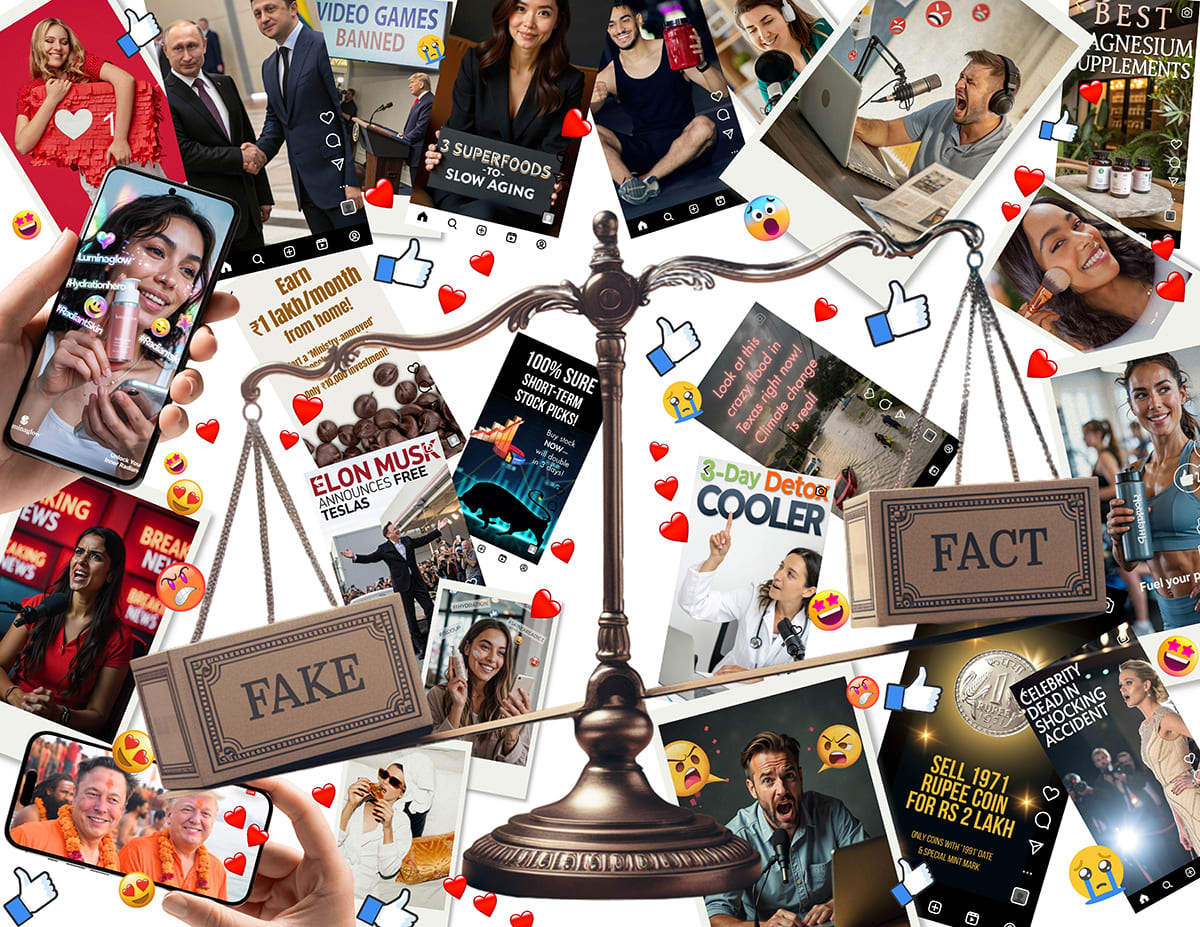
A recent Statista report on the growth of social media users worldwide places the current number at 5.17 billion and estimates that 6 billion people will be using social networks by 2028. To put that in perspective, a staggering 65 per cent of the global population currently uses social networking sites, and that’s expected to jump to 72 per cent by 2028.
Essentially, more people use — and will continue to use —social media than not. More people consume content on these platforms than not. And more people rely on social media as a source of information than not.
The accompanying graph confirms that there has been a sharp increase in the number of people who rely on digital sources as their primary source of news. The following graph shows just how far behind traditional news sources have fallen in the wake of this shift.
My point is this: it is clear that there is no escape from online news. So why are we not more concerned about its lack of veracity?
When Everyone’s a Broadcaster
Increasing digital literacy has dramatically lowered the barrier to entry for becoming a ‘content creator’ on social media. Whether it’s an influencer trying to convince you that hydration is easier than ever with their new hydro flask from brand XYZ, a digital artist desperately waving their work at the enigmatic, all-powerful algorithm in hopes it will catch an irresistible whiff, or a limitlessly bankrolled, mic-wielding street interviewer asking people whether they’d rather take the money or double it and give it to the next person.
Or — more relevant to this discussion — the news people. Ex-journalists who have broken away from mainstream media, non-journalists passionate about sharing underreported information, and relatives forwarding long, unverified messages in large WhatsApp groups. It’s now shockingly easy to say something on social networks and have it taken as irrefutable fact.
Fakes, Facts, and Everything in Between
The pandemic has forever changed how the world consumes information. Online sources reign supreme, and the number of platforms facilitating connections, networks, and information dissemination keeps increasing. With this rise in digital spaces allowing the rampant spread of news, there has been a corresponding plateau in fact-checking.
According to a 2023 study by Duke Reporters’ Lab, the previously sustained growth in reliable fact-checkers has slowed globally over the past three years (as shown in the graph on the left). This is especially concerning given the largely unregulated way in which news is both shared and consumed.
AI, the New Spin Doctor
It would be remiss not to mention the impact of generative AI on the digital information landscape. The technology remains nascent — and will likely stay that way for some time —in terms of both utilisation and regulation. As debates over the ethics of generative AI grow louder, so too does its use and abuse across industries.
In global politics, with more than 60 countries holding elections in 2024, generative AI has found an enthusiastic — and gravely misunderstood — home. The miraculous ease of generating videos from a single prompt has led to deepfakes of candidates being widely shared during election campaigns in Slovakia, the US, Bangladesh, and India. A new concern is candidates dismissing real videos as deepfakes, creating a convenient lack of accountability.
Fundamental worldviews and opinions are being shaped among young people coming of age in this era of (mis)information. Younger generations are exposed to an overwhelming volume of unverified news and content. UNESCO’s 2023 report, Growing Up in the Age of Fake News, calls for urgent development of critical thinking skills in young people to help them navigate the deluge of information they encounter online.
At its core, the issue of misinformation on digital platforms is one of trust. The trade-off between reliability and convenience in accessing and sharing information is becoming increasingly unbalanced. It’s crucial to approach news critically — both online and offline — to ensure our opinions, decisions, and social behaviours are rooted in well-sourced, factual knowledge.