


Jamshedpur CHAPTER
Are B-Schools Still Relevant? Exploring the Relevance of Management Education in Bridging Theory with Practice
 XLRI Jamshedpur
  November 29, 2024
The XLRI student-led roundtable discussion brought forward an engaging exploration of B-school relevance in modern times. From committee dynamics to curriculum challenges, the session uncovered the unique aspects of management education and how it prepares students for real-world challenges.
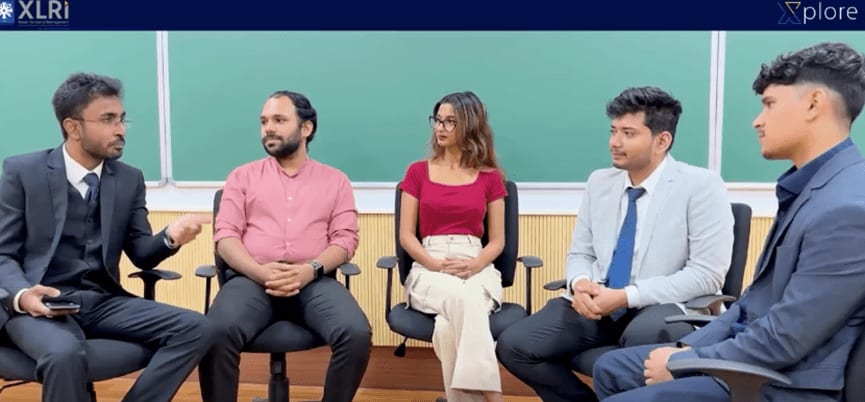
B-school committees are not just extracurricular activities; they emulate corporate teams, fostering leadership and collaboration. “Committees reflect the realities of organizations—some thrive on high performance, while others struggle with initiative. Leadership isn’t just about results; it’s about empowering your team to grow,” shared Saurabh Shukla, Secretary of FLIX.
The panel compared legacy committees, which focus on preserving culture and reputation, with newly formed committees that function like startups—risk-tolerant and innovative.
The Role of Leadership in Committees
Leadership within committees mirrors corporate responsibility, providing students with hands-on experience in decision-making and accountability.
“We rotate leadership roles within the team, allowing every member to take ownership and develop accountability,” said Nitish Chand, Secretary of E-Cell.
Panelists emphasized that leadership is best assumed organically rather than being imposed, ensuring harmony and motivation within teams.
Bridging Curriculum with Real-World Skills
The panelists emphasized the importance of aligning the curriculum with the dynamic demands of the corporate world, focusing on practical application and modern relevance.
“Our curriculum is a strong foundation, but it truly comes alive when integrated with real-world scenarios like the recent challenges faced by the Indian startup ecosystem,” noted Shantanu Dash, Secretary of PEACE.
The discussion brought forward the significance of multidisciplinary learning, combining HR and business management perspectives to equip students with a holistic approach to solving complex challenges, ensuring they are industry-ready.
Fostering Innovation and Risk-Taking
Committees serve as testing grounds for innovative ideas and risk-taking.
“During my Flipkart internship, I experienced a fail-fast culture. Committees need to adopt this mindset—take risks, learn, and iterate,” shared Saurabh Shukla.
Panelists also discussed how legacy committees often resist change, mirroring established corporates hesitant to embrace flat hierarchies or innovative approaches.
Culture: The Underrated Glue
Culture emerged as a critical yet underrated factor in both committees and organizations.
“Culture is the dark matter of organizations—it holds everything together, even if it’s invisible,” explained the moderator, Kaushik Ghosh, Secretary of Xplore.
The panelists shared how fostering a collaborative culture within committees strengthens team bonds, creating an environment of trust and innovation.
Customization in Education
The lack of customization in B-school curricula was another pain point discussed.
“Someone passionate about sustainability should have the flexibility to integrate HR or operations courses into their focus areas,” emphasized Nitish Chand.
The group proposed competency mapping and iterative feedback systems to help students align their learning paths with career aspirations.
UG vs B-School Committees
The dynamics between undergraduate and BSchool committees were explored, highlighting key differences.
“In UG, you work with younger peers, but here in Bschool, you collaborate with people who might even be older than you. This changes the way you lead and communicate,” said Haimi Praraj, Secretary of Ex-Link.
The panel noted that PG committees operate within tighter schedules, fostering a results-driven culture akin to corporate environments.
The Case for Experiential Learning
The panelists called for more experiential learning opportunities, such as plant visits and field projects.
“Real-world scenarios demand integration across disciplines. Hands-on projects can teach students to embrace uncertainty and think critically,” suggested Shantanu Dash.
They also advocated for open-ended cases without predefined solutions to promote creative problem-solving.
Is a B-School Worth It?
In their closing reflections, the panelists agreed that the value of a B-school education depends on individual engagement.
“B-school isn’t just about lectures. It’s a journey of personal growth, leadership, and experimentation,” concluded Saurabh Shukla.
The discussion highlighted that while B-schools have their flaws, they remain irreplaceable platforms for those ready to embrace challenges and transform themselves.
Attendees
Kaushik Ghosh, Secretary, Xplore
Haimi Praharaj, Secretary, ExLink
Saurabh Shukla, Secretary, FLIX
Nitish Chand, Secretary, E-Cell
Shantanu Dash, Secretary, PEACE