


June, 2026
2 min Read
Friendshoring vs Offshoring: Strategy or Political Pressure?
 25 Jun 2026
XLRI Jamshedpur student Rhythm Shah dismantles the classic corporate playbook of pure economic offshoring, explaining how rising geopolitical frictions have turned supply chain architecture into a high-stakes balancing act. As the dominant "China-centric" manufacturing model fractures under massive tariff wars, over 70% of global multinationals are adopting "China+1" diversification strategies. However, Shah notes that this shift toward "friendshoring" isn't entirely voluntary; massive state interventions, such as the U.S. CHIPS Act, effectively use aggressive subsidies and export controls to narrow corporate choices. In a fractured landscape where Asia drives over half of global growth but faces deep ideological divides, long-term business survival belongs not to the cheapest or most efficient companies, but to those that can dynamically hedge across competing political blocs.
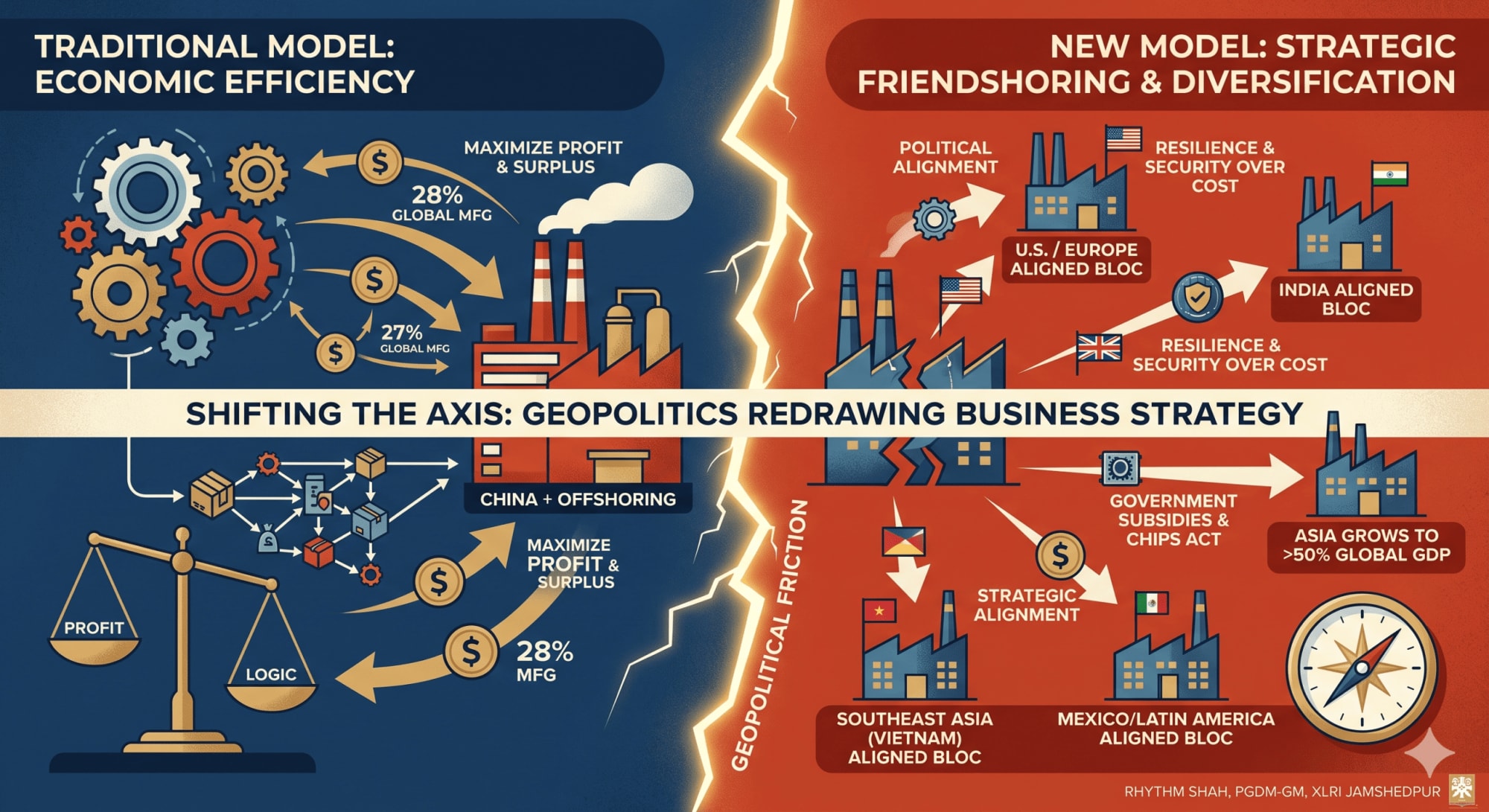
How geopolitics, government policies, and global tensions are reshaping business decisions beyond pure profit logic
Geopolitics as a Core Business Driver
In the current global landscape, businesses cannot operate in a politically neutral environment. Geopolitics has become one of the key aspects for determining strategy, forcing companies to reconsider Traditional models of relocation of business processes in developing countries to maximize profits. Increasingly, companies are shifting towards government-driven relocation of supply chains to politically aligned countries. The key question, however, remains: is this shift driven by calculated business strategy, or by pressure from governments?
From Economic Efficiency to Strategic Alignment
Historically, global business decisions were largely guided by Economic surplus and less policial aspects, maximizing market access, and leveraging comparative advantages. After World War II, the United States emerged as a dominant economic and military force, and later, the rise of Silicon Valley established it as the hub for innovation. This led to a world where aligning with the U.S was often strategically beneficial. At the same time, countries like China, India, and Russia began strengthening regional alliances, recognizing the long term importance of Asia as a high growth consumption market.
For long period, offshoring, especially to China, was the dominant model. China offered a combination of low cost labor, strong infrastructure, abundant raw materials, and a massive domestic market. By the late 2010s, China accounted for nearly 28% of global manufacturing output, making it the Dominant force of the world. However, recent geopolitical tensions have disrupted this model. The US-China trade war led to tariffs on over $360 billion worth of Chinese goods, significantly increasing costs for companies dependent on Chinese supply chains.
The Rise and Disruption of Offshoring
The shift is already underway. Businesses especially the big multinationals have been quietly moving pieces of their supply chains out of single-country dependency for a while now. The rough consensus in the industry is that around 70% of major multinationals are actively spreading their operations across multiple geographies, with Vietnam, India, and Mexico picking up a lot of that overflow.
Apple is probably the clearest example. A chunk of iPhone manufacturing has moved to India, and by 2025 India is expected to be making close to a quarter of all iPhones globally. That’s not a small bet. Most large firms are running some version of what’s been called a “China+1” approach keeping China in the mix but making sure it’s not the only option if things go sideways.
However, this shift is not purely strategic, based on maximizing profits. Governments are playing an active role in shaping Business decisions. Policies such as subsidies, tariffs, and export controls are effectively narrowing the decision making space for businesses. For example, the United States’ CHIPS and Science Act allocates over $52 billion in subsidies to encourage semiconductor manufacturing within the country. At the same time, export restrictions on advanced chips to China have forced companies to rethink their global operations.
The Shift Toward Diversification and Friendshoring
The pressure comes from all direction at once. Spreading operations across countries does make supply chains more strong that part is real. But there’s another force at play, governments have become much better at making non keeping expensive. Incentives, tax breaks, market access these things come with strings attached. So when firms talk about friendshoring, it’s not always a strategic choice they’re excited about. Sometimes it’s just the path of least resistance.
The geopolitical map is changing itself around this too. NATO holds the West together on security. But on the economic side, blocs like BRICS are carving out a different kind of gravity and Asia is where the growth actually is. The numbers around suggest Asia could drive more than half of global GDP growth by 2030.
Which puts companies in an awkward spot. You can’t fully commit to one bloc without creating friction with another. So most are threading a needle present everywhere, fully committed nowhere and hoping the geopolitical temperature doesn’t force a harder choice.
Conclusion: Strategy Within Constraints
Friendshoring isn’t really a free choice anymore — it’s as much about surviving the political environment as it is about building better supply chains. Governments have inserted themselves into decisions that used to be purely commercial, and that’s not changing anytime soon.
The companies that come out ahead won’t necessarily be the most efficient or the cheapest. They’ll be the ones that got comfortable reading a room — knowing when to align, when to hedge, and how to stay nimble while doing both. That’s a different upskill set than what business strategy required a decade ago. But right now, it might be the most important one.
Rhythm Shah is a PGDM-GM student at XLRI Jamshedpur