


July, 2026
2 min Read
From Pilot to Profit: Why Most AI Projects Stall
 08 Jul 2026
AI pilots are everywhere. Profitable AI at scale is not. Many organizations have demonstrated what AI can do. Far fewer have translated promising pilots into measurable business outcomes. The gap isn’t just about technology. It’s about execution. From fragmented data and legacy infrastructure to rising compute costs, shifting budgets, and workforce adoption, scaling AI demands far more than a successful proof of concept. The real challenge begins after the pilot ends. As businesses move from experimentation to enterprise-wide deployment, leaders face a fundamental question: Are they investing in AI that looks impressive, or AI that creates lasting value? In this latest article, Arun Saravanan V explores why so many AI initiatives stall before reaching production and what distinguishes organizations that successfully bridge the gap from pilot to profit.

The global industrial landscape is now witnessing a massive “Pilot Paradox.” According to a 2025 MIT Sloan Management Review, while 90% of large enterprises have launched Generative AI pilots, fewer than 12% have achieved “at scale” production that meaningfully impacts the bottom line. The journey from a successful lab experiment to a positive EBIT impact is where the “messy execution” begins.
- The Manufacturing Bottleneck: The OT/IT Chasm
In manufacturing environments—such as glass production or automotive assembly—the primary reason for failure is the gap between Information Technology (IT) and Operational Technology (OT).
A pilot might successfully use computer vision to detect defects in a controlled environment. However, when scaled to a heat and vibration-prone shop floor, the project often stalls. This occurs because the AI requires high-frequency data from legacy PLCs (Programmable Logic Controllers) that were never designed for cloud connectivity. Research from McKinsey (2025) indicates that 70% of industrial AI projects fail due to “Data Fragmentation”—where data exists in silos across different production lines, making a plant-wide rollout technically impossible without a massive infrastructure overhaul.
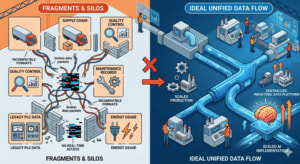
(image generated by Gemini about data fragmentation and unified data flow)
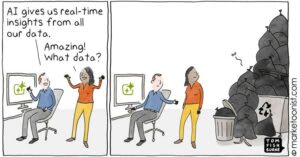
(cartoon from makecartoonist.com)
- The ROI Tracking Gap and Budget Shock
Most AI pilots are funded via “innovation budgets,” which are relatively insulated from strict ROI requirements. However, moving to production requires shifting to “operational budgets.”
The cost of scaling AI is non-linear. While a pilot might cost Rs. 50,000, running the same model across 10 global plants results in exponential increases in token costs, GPU compute, and specialised maintenance, leading to costs in the many crores. Gartner’s 2026 AI Roadmap highlights that “Compute Inflation” is now a top-three reason for project cancellation. Without a clear “Value Realisation Framework”—one that maps AI outputs directly to specific EBIT levers like reduced energy consumption or decreased scrap rates—CFOs are increasingly pulling the plug mid-transition.
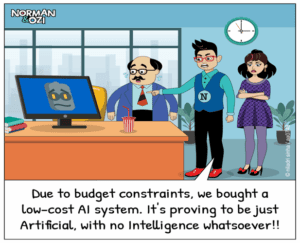
(cartoon from Norman & Ozi)
- Geopolitical and Macroeconomic Taxes
The transition to profit in 2026 is further complicated by the volatile geopolitical situation involving the USA, Iran, and Israel. This conflict has created two specific “stalling factors”:
- Energy Volatility: For energy-intensive industries (such as glass or steel), the spike in global oil and gas prices driven by Middle Eastern tensions has forced companies to reprioritise capital. AI projects that don’t offer an immediate, massive reduction in energy costs are being sidelined to protect core margins.
- Semiconductor Sovereignty: Disruptions in shipping through the Strait of Hormuz have delayed the delivery of high-end NVIDIA H200 or Blackwell chips. Projects that require massive on-premise compute power are stalling simply because the hardware cannot be delivered.
- The Human Factor: Change Management
Finally, projects stall because of a lack of ownership. In many Indian industries, AI is often seen as a threat by the workforce or a distraction by plant managers focused on daily production targets.
A successful pilot in a corporate office doesn’t account for the cultural shift required on the factory floor. Whereas in the implementation phase if the shop floor operators don’t trust the AI’s ‘Predictive Maintenance’ alerts because they don’t understand the model’s logic, they will ignore the system. This leads to what is known as Silent Failure, where the software is technically ‘live’ but produces zero business value because it isn’t integrated into the daily human workflo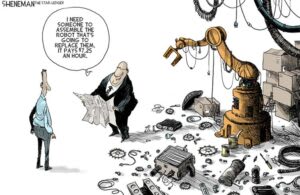
(cartoon from Drew Sheneman)
The Path Forward: Vertical AI
The organisations that successfully bridge this gap do not build general-purpose AI. They build Vertical AI.
- Example: In a glass manufacturing industry, instead of a general chatbot, they build a “Glass Furnace Optimization Agent” that is trained specifically on ten years of thermal data and sensor logs.
- Data Insight: NASSCOM’s 2026 Digital Maturity Report shows that Indian firms focusing on specialised, domain-specific models achieve a 3.5x higher success rate in moving from PoC to profit than those using generic, horizontal solutions.
Conclusion
Moving from pilot to profit requires a shift in mindset from Experimentation to Engineering. It requires solving the ‘unsexy’ problems: data cleaning, sensor integration, worker retraining, and navigating a volatile global supply chain. For leaders entering the boardroom in 2026, the goal is no longer to prove that AI works—the goal is to prove that AI pays.
(Arun Saravanan V is a PGDM(GM) student at XLRI Jamshedpur)