


June, 2026
2 min Read
Listening as Strategy : Leaders who outperform by listening deeply
 03 Jul 2026
XLRI Jamshedpur student Abhishek Agnihotri explores the failure of modern leadership to differentiate between passive hearing and strategic, deep listening. In an era dominated by metrics and dashboards, leaders frequently reduce workplace complexities to numbers, resulting in purely reactive management that fixes symptoms rather than the root blocks. Drawing parallels from historic consensus-building and psychological frameworks like Self-Determination Theory, Agnihotri emphasizes that corporate infrastructure—like skip-levels and town halls—stalls into meaningless box-ticking unless leaders actively close the loop with visible structural action. True operational performance, particularly when engaging value-driven Gen Z talent, requires converting passive observation into active, strategic interrogation.
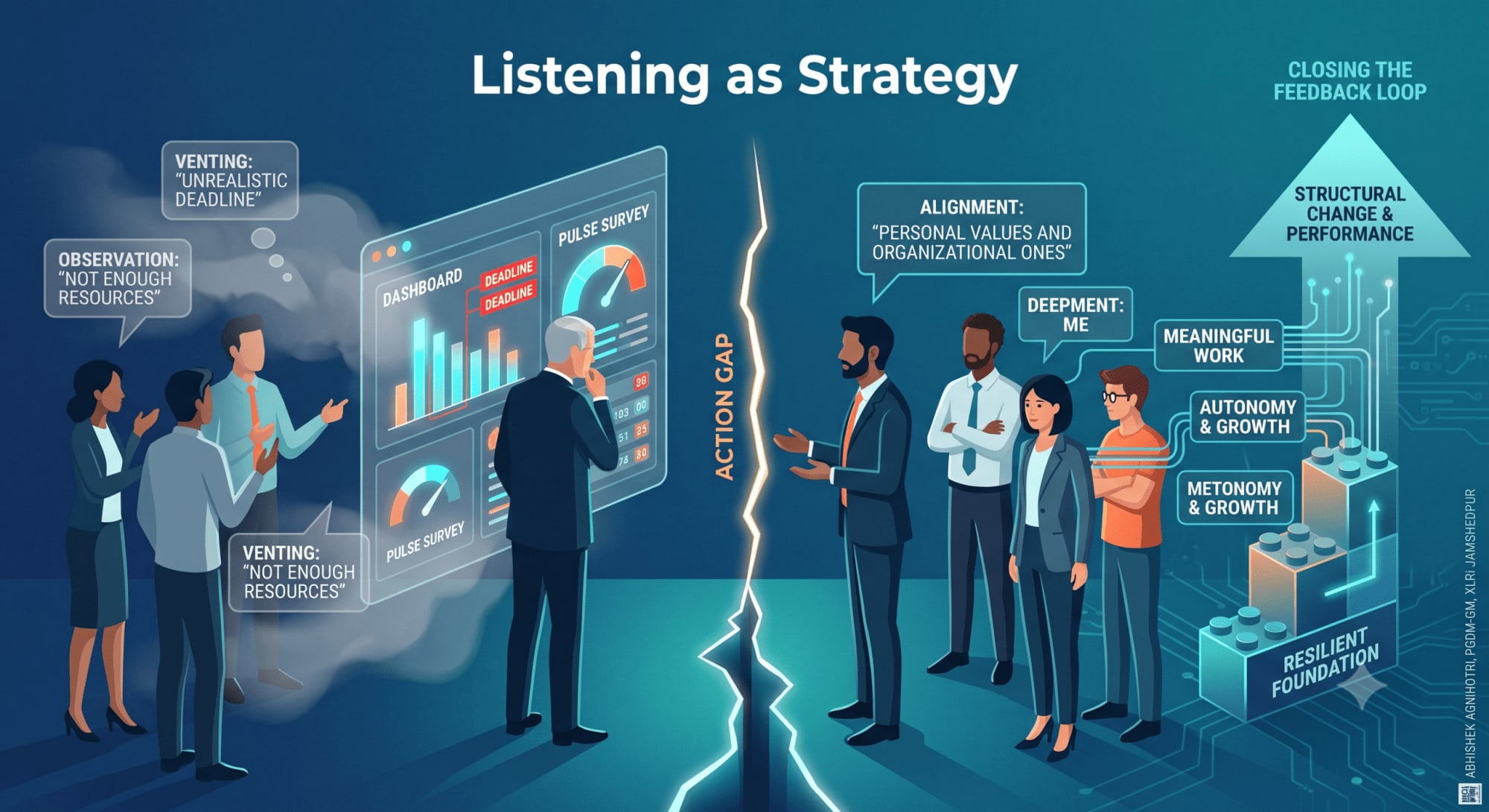
The best read on a situation comes from what someone tells you when they feel like you’re actually paying attention, the real constraint they didn’t put in the email. That only comes out when someone’s actually listening, not just waiting for enough information to act.
When one is managing multiple teams, the tendency to simplify is strong. Dashboards, Deadlines, and metrics are used because they offer certainty and control. But reduction from complexity to numbers makes leadership shallower. The difference between a good leader and a reactive one is whether they only hear what’s being said or understand what’s actually being meant. Good leaders understand whether to solve a problem using emotional intelligence with their teams or by analyzing numbers on a spreadsheet.
Managing one team is hard enough. Managing many, with competing voices and no clean majority, is a different problem entirely. Consensus sounds like the answer, but it’s usually just the path of least resistance — real alignment takes more friction than that.
Two moments from India’s pre-independence era illustrate this well. Gandhi, when he joined the Congress in 1915, didn’t try to consolidate what elitist group already existed. He went outward — villages, local grievances, people the movement hadn’t bothered to reach. That’s what turned the INC from an elite club into something that actually moved people. Later, during the Constitution drafting, Patel faced Sikh representatives stalling over minority representation. He didn’t push it to a vote. He adjourned. Gave the room time to breathe. The issue eventually got resolved. Different contexts, same instinct — that the fastest way through disagreement is usually to slow down first.
While the stakes differ, the principle remains quite similar in modern organizations. As listening is an acquired trait, it has to be deliberately assimilated. Pulse surveys, skip-level meetings, open forums, anonymous feedback channels, townhalls, these aren’t done just for box-ticking; they’re infrastructure. But infrastructure alone isn’t enough. People will only share honestly if they believe that what they say will bring a change. If an employee flags unrealistic deadlines and nothing shifts, the feedback channel becomes a venting exercise. Leaders have to close the loop. That’s what makes listening real.
Once organizations actually imbibe listening into how they operate, the next question gets more personal — what does it change for the individual? Quite a lot, it turns out. When a manager genuinely engages with what someone cares about, career development stops feeling like a fixed ladder with predetermined rungs. Expectancy Theory captures part of why: people put in real effort when they believe it leads somewhere that matters to them. That belief doesn’t come from a policy document. It comes from clear goals, honest feedback, and rewards that don’t feel arbitrary. Listening is what tells you whether any of that is actually in place.
But in reducing motivation to transactions, something is missed. Self-Determination Theory pushes listening further, people do their best work when they have real autonomy, feel genuinely competent, and aren’t isolated from the people around them. Listening quietly feeds all three. People cultivate ownership, relevant growth, and build the kind of trust that’s hard to teach any other way.
The conclusion is fairly simple: when someone feels like they’re actually being heard, they start caring about the organization’s direction — not just their own.
Gen Z professionals today are frequently described as impatient. This assessment is usually some variation of ‘they just don’t commit’. But what’s actually driving them a lot is their search for alignment between personal values and organizational ones. Between what someone is asked to do and what they find meaningful. That fit produces both performance and loyalty. Listening is where that alignment starts, because you can’t offer someone what they need if you haven’t taken the time to understand what that is.
For leaders, none of this has to be abstract. It can be translated into concrete habits. Cultivating a culture of asking questions that go beyond the obvious, an employee who missed a deadline may not necessarily need a push; they may need clarity on what actually matters right now, or access to something they’ve been hesitant to ask for. Making sure you’re listening to more than just the loudest voices in the room, the people who stay quiet in meetings often have the most important things to say. And when you hear something, do something with it. Insights without action are just observations. Action is the only thing that proves to people that sharing was worth the risk.