


July, 2026
2 min Read
The Great Formalisation: Who Wins, Who Loses? GST, digital payments, and small business transitions.
 20 Jul 2026
India’s Formalisation Journey: Progress at What Cost? Formalisation has transformed the way businesses operate in India. But has the transition created value equally for everyone? Policies such as GST and the rapid adoption of digital payments have reshaped compliance, taxation, and financial transparency, redefining the relationship between businesses, workers, and the state. While these reforms have accelerated economic formalisation, they have also raised important questions about who has been best positioned to benefit from this shift. For business leaders, the conversation extends beyond policy. It is about understanding how implementation, institutional readiness, and the ability to adapt can influence competitive advantage across firms of different sizes. In this latest article, S Vishal examines India’s formalisation journey, exploring the opportunities it has created, the challenges it has exposed, and why the pace of change matters as much as the reforms themselves.
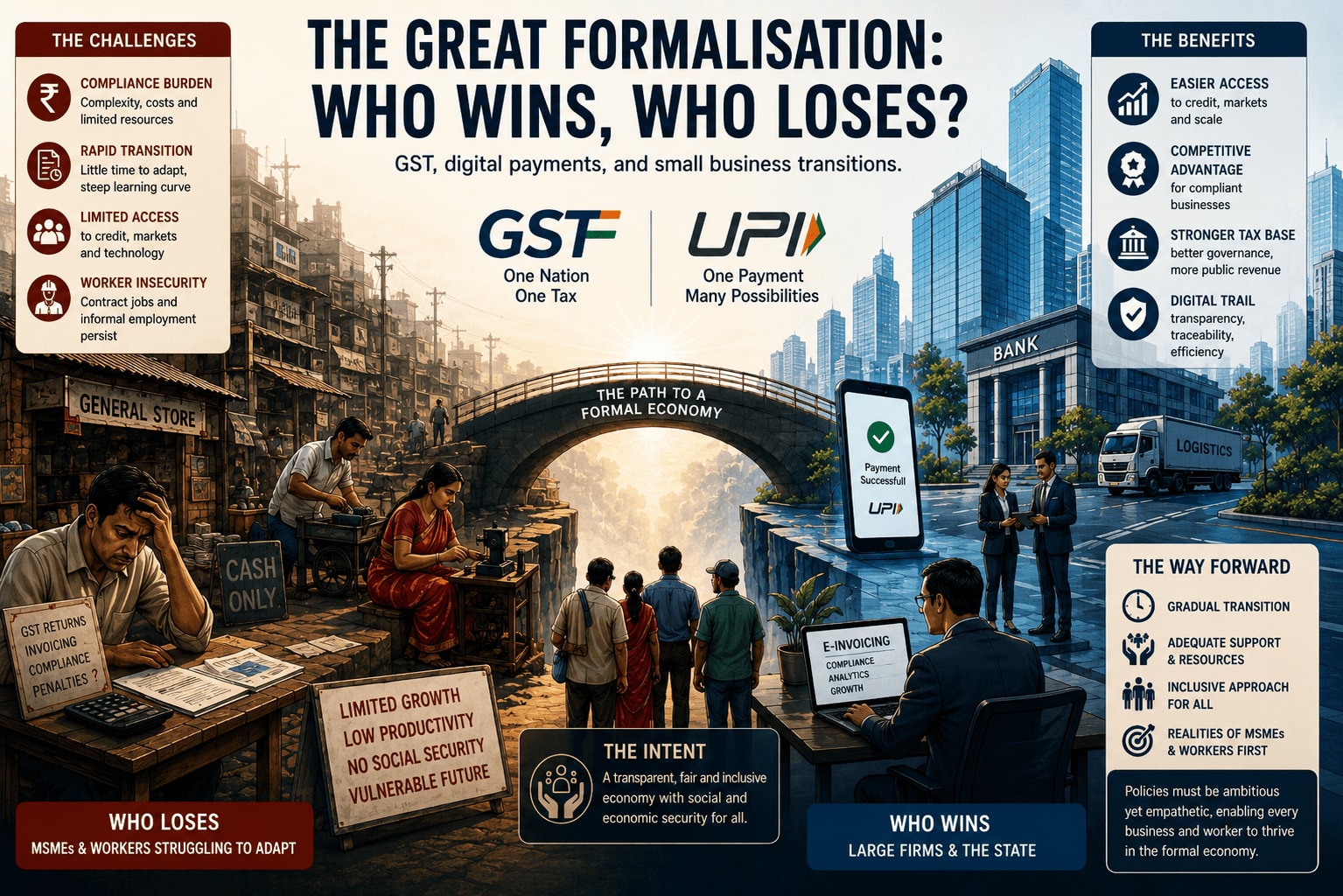
The “Great Formalisation” of the Indian economy over the last decade can be attributed to a series of policy reforms, most notably Goods and Service Tax (GST) and digital payments under Digital India initiative. These reforms were brought forward with the aim of formalising the economy and enabling a more transparent financial and economic system, broadening tax base, enabling access to more credit and also providing social and economic security to workers.
GST lies at the core of this movement; it proposed a unified tax structure by replacing the earlier system of indirect taxes. It also pushed businesses into a common compliance framework, this was aimed to encourage firms to become part of formal economy, especially small and previously unregistered entities which earlier did not have a formal taxable structure by providing a simplified taxing strategy. Alongside this, the rise of digital payment interface like Unified Payment Interface (UPI) and other fintech services and platforms have made transaction a lot more convenient while making the entire history traceable. This development strengthened the state’s ability to monitor monetary flows and to collect taxes effectively. By bringing firms and workers into the formal system, the Government hoped to improve the workers situation by providing stable wages and security benefits such as provident funds and other protections.
The movement started with a noble and forward-looking vision of creating a just and fair formal economy. However, the outcomes have not been entirely positive. Large tax compliant firms have emerged as the biggest beneficiaries as they have been better equipped to comply with the standards and adapt to the rapidly changing economic ecosystem. It provided them with an access to easier credit, greater market reach and a competitive advantage.
In contrast, many micro, small and medium enterprises (MSME’s) faced a significant challenge in adapting to these changes with their limited resources. For most it was not a smooth transition, many were forced into a precarious operation models and lost their competitive advantage. In case of workers security and benefits, even the formalised firms continued to rely on contract-based employment which offered them limited benefits. This along with informal employment which has been a norm across much of the Indian labour market, makes a majority of our workforce to be on the outside of the formal economy.
Another significant point of concern is the pace in which these polices were implemented. The state was quick to formalise the economy but never gave businesses and workers time to adapt to these rapid changes. This caused many workers and MSME’s to be in a vulnerable situation, with limited access to the protection promised by the government under this policy shift.
In this context, the “Great Formalisation” started with a genuinely noble aspiration of bringing meaningful and lasting changes to our economy. However, its outcome was not what they envisioned and advocated for. The policy was structured in a way that rewarded people who were already equipped to undertake the compliant requirement and adapt to the rapidly evolving environment, but failed to protect and support those with limited resources. The winners in this run of formalisation are large firms and the state, while the ones who lost were MSME’s and workers who were unable to adapt to these changes.
The aspiration behind this policy change is undeniably worthwhile and has a long-term impact on our economy. The fundamental issue, however was with its implementation. They should have taken a more gradual, structural and a sensitive approach, while providing adequate support, resources and transitional time to all concerned parties, while taking into account the realities of entities at the lower- and middle-income bracket of our economy.
S Vishal
PGDM GM Student at
XLRI Jamshedpur